

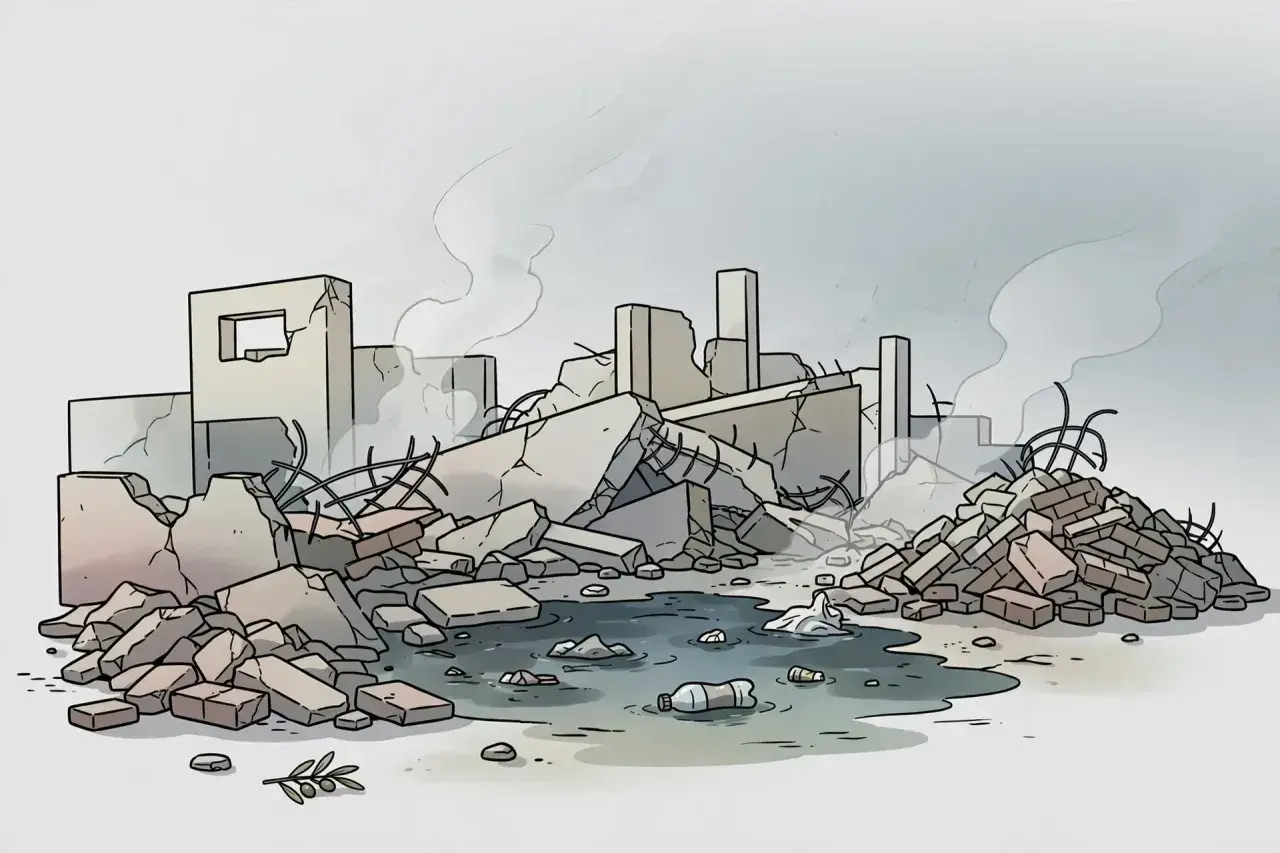
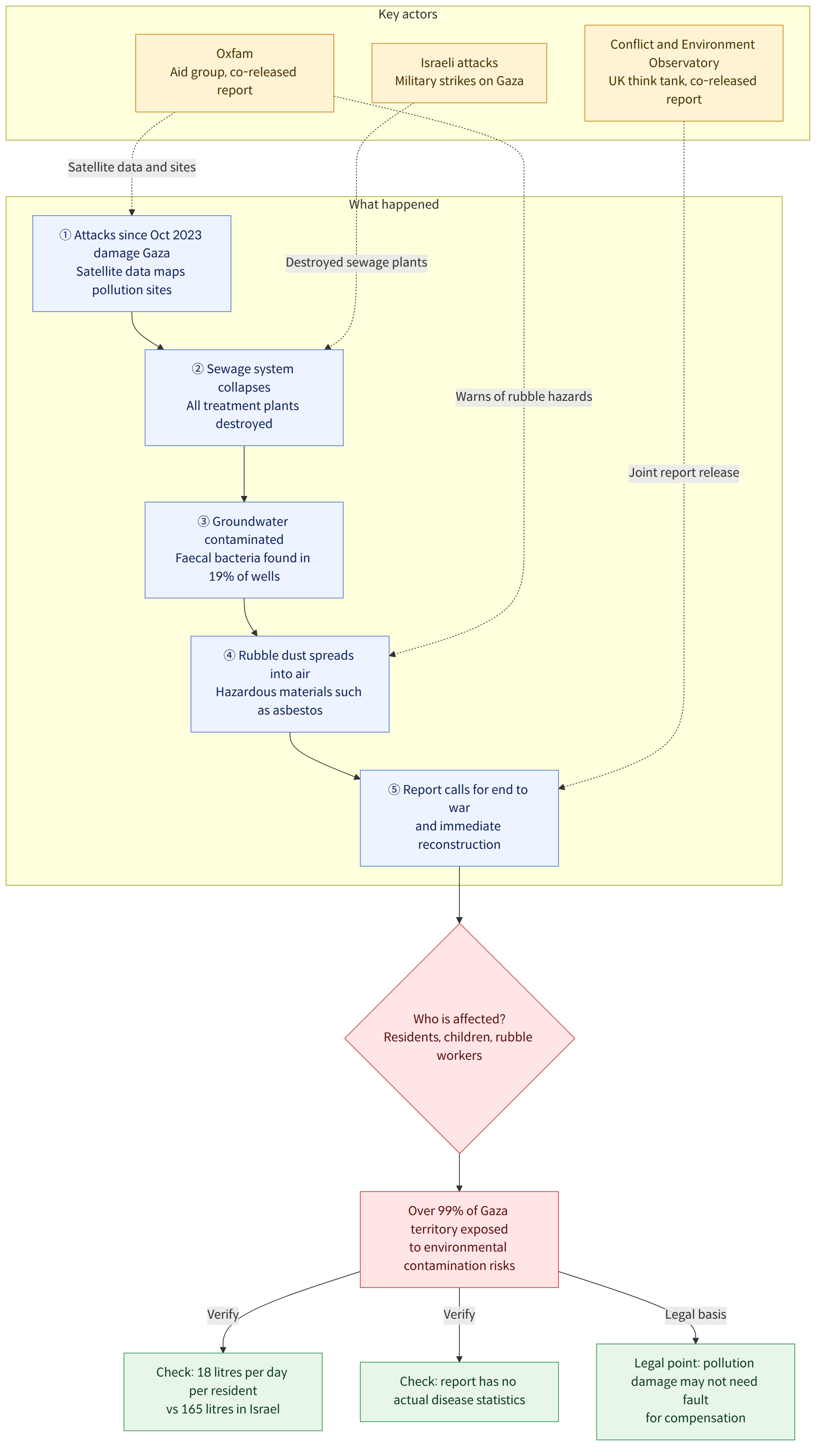
According to a report jointly released by Oxfam and the UK think tank Conflict and Environment Observatory, Israeli attacks on the Gaza Strip over the past three years have left more than 99% of its territory exposed to environmental contamination risks. The report describes Gaza as a 'toxic wasteland' where pollutants from the rubble endanger residents' lives, and it calls for an end to the war and immediate reconstruction.
Background and Context
Based on satellite imagery and other data, the report tracked sites where military attacks since the war began in October 2023 may have caused environmental pollution. It found that contamination levels are severe in densely populated cities and areas such as Gaza City, Khan Younis and Jabalia, as well as along Salah al-Din Road, the region's main arterial road.
By type of pollution, water contamination caused by the collapse of the sewage system is the most widespread. According to the report, attacks have destroyed all sewage treatment plants in Gaza, and only 19% of pumping stations and 30% of sewage networks remain operational. It is reported that 40,000 cubic metres of untreated sewage flow into the Mediterranean each day, and 15,000 cubic metres from sewage collection basins are discharged into nearby rivers and groundwater.
The condition of groundwater has also worsened. As of July 2026, faecal coliform bacteria were detected in 19% of the 79 groundwater wells in Gaza, a sharp increase compared with 2% in 2021, before the war. Also, 85% of reservoirs and water supply facilities have been damaged. As of April 2026, the amount of water available per resident was 39% of the pre-war level.
At this month's storage capacity, residents can receive only 18 litres of water per day on average. This is roughly one-tenth of the 165 litres of daily water consumption per person in Israel. The Israeli figure cites statistics from Israel's Ministry of Environmental Protection for 2024.
What This News Means
The key point of this report is that contamination does not end with a single event but can persist across the entire foundation of daily life. When water is scarce, residents have no choice but to rely on water sources that may be contaminated, which can be directly linked to health risks such as diarrhoeal diseases. However, the report should be read with the understanding that it does not present actual disease statistics or cases of health harm.
Air pollution also deserves attention. The report pointed out that dust and combustion materials generated by building collapses and fires are spread back into the air through wind, vehicle movement and the process of clearing rubble. Oxfam said this dust can irritate the respiratory system, worsen asthma and cause lung damage, and that concern is particularly high for children.
For example, workers engaged in rubble clearance face a high risk of exposure to hazardous substances such as asbestos and crystalline silica. Oxfam warned that such exposure can lead to occupational diseases that appear after a long period of time. The problem of roughly 61 million tonnes of rubble identified in the report is significant because it may remain a challenge requiring continued management during reconstruction even after the war ends.
Related Systems and Support Information
Understanding the legal standards for handling environmental pollution damage can help in grasping issues like this. According to materials from the Korea Legal Aid Corporation (법률구조공단), the existence of pollution or noise alone does not establish liability for compensation. Judgments are made by considering the extent of the damage, the causal relationship with its source, and other factors together.
- Even if a facility is operated lawfully, illegality may be recognised if hazardous substances cause harm that exceeds the ordinary limits of tolerance.
- If environmental pollution causes damage, the party responsible may be liable for compensation even without fault, although the scope of application differs case by case.
- In pollution lawsuits, the burden of proof may be eased in consideration of the difficulty victims face in scientifically proving every causal link.
- For diseases with complex causes, such as asthma, a causal relationship may not be recognised based solely on pollution exposure and the onset of illness. The timing and degree of exposure and the victim's health condition are important.
This material is general guidance based on domestic law and does not apply directly to the situation in Gaza. However, it serves as a starting point for judging what kinds of evidence would be needed to prove pollution damage.
Differences in How the News Was Reported
The original article is a single report, and no differences that can be compared with other reports were confirmed.
Confirmed Facts and Unknowns
Confirmed facts
- The report assessed that more than 99% of the Gaza Strip's territory is exposed to at least one environmental contamination risk.
- All sewage treatment plants have been destroyed, and only 19% of pumping stations and 30% of sewage networks are operational.
- As of July 2026, faecal coliform bacteria were detected in 19% of the 79 groundwater wells.
- Residents are estimated to receive only 18 litres of water per person per day on average.
- It was pointed out that the estimated 61 million tonnes of rubble contains hazardous substances such as asbestos, creating a high risk of spread.
What remains unknown
- The official position of the Israeli government does not appear in the original article.
- The specific methods and limitations of the satellite image analysis are not explained in the original article.
- No cases or disease statistics showing the actual impact of contamination on residents' health are presented.
What Readers Should Check
- Reviewing the original report and its assessment methods makes it possible to distinguish estimates based on satellite data from facts confirmed on the ground.
- For claims of environmental damage abroad, the key issue is how the causal link between the damage and its source is proven. General principles from domestic pollution lawsuit standards can help in considering the scope of evidence to collect.
- For information on health risks, it is safest to check the latest situation in official materials published by international organisations or health authorities.