


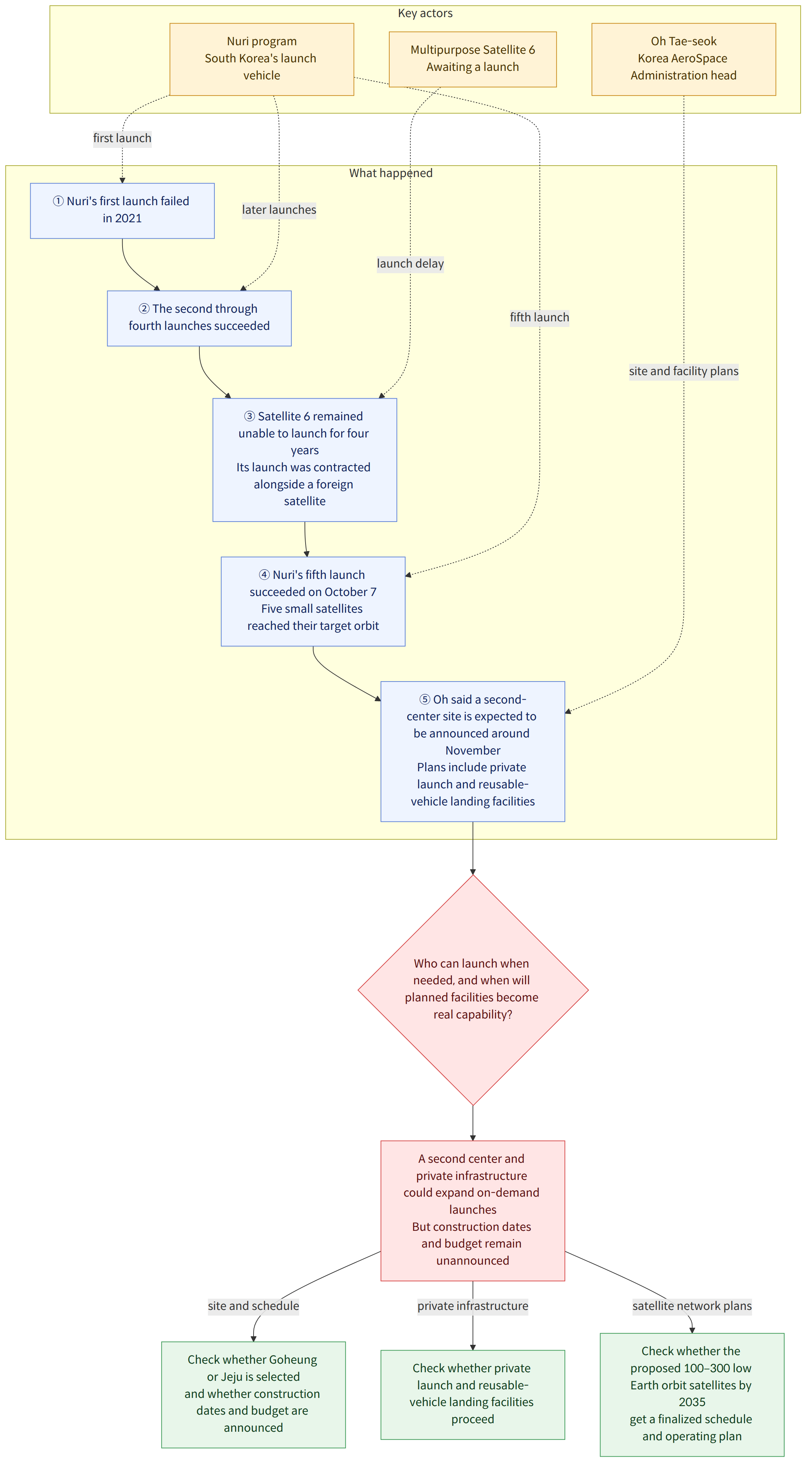
South Korea’s Nuri launch vehicle (누리호) succeeded in its fifth launch on October 7 from the Naro Space Center (나로우주센터) in Goheung, South Jeolla Province, placing five small cluster satellites into their target orbit (the designated path on which a satellite is intended to operate). After the first launch failed in 2021, the next four launches—from the second through the fifth—have all succeeded. The next challenge goes beyond the launch vehicle’s performance: building the facilities and technology needed to launch satellites when they need to be sent into space.
Background and context
Oh Tae-seok, head of the Korea AeroSpace Administration (우주항공청), said the agency plans to announce around November which of Goheung and Jeju, the candidate sites for the second space center, has been selected. The second space center project will not stop at building a launch pad. Oh said private companies’ launch facilities and landing facilities for reusable launch vehicles (rockets designed to be used again after launch) will also be needed.
The case of the Multipurpose Practical Satellite 6 (다목적 실용 위성 6호) illustrates why an independent launch infrastructure is needed. According to Oh, the satellite has been unable to launch for four years because of a contract to launch it alongside a satellite from another country. When a launch is tied to the other party’s schedule, South Korea may find it difficult to choose the launch date freely, even if it has the satellite ready. Launching alongside another country’s satellite can reduce costs, but it is a separate issue from having the ability to launch when needed.
Launch facilities are also closely linked to the industrial base. Oh projected that the global space and aerospace industry will grow to about $2 trillion by 2035. South Korea currently has about 0.7% of the market, and the government’s goal is to raise that share to more than 3% by 2035. Under the government’s 2027 budget proposal, the space and aerospace budget is approximately 1.6491 trillion won. Along with increased funding, the question remains whether domestic companies can expand their role in the space market in practice.
What this news means
The second space center could provide more options for the country to launch satellites when needed. The plan to consider not only a launch pad but also private facilities and landing facilities for reusable launch vehicles can be seen as an effort to strengthen the launch capabilities of both the government and businesses. However, even if a site is selected, the construction start and completion dates and the budget have not been announced, so it is still difficult to judge when the center will translate into actual launch capability.
Space technology is also connected to how it is used after launch. The government is considering deploying between 100 and around 300 low Earth orbit satellites (satellites that orbit close to Earth) by 2035. This satellite network could be used for communications, with potential implications not only for industry but also for security and communications self-reliance. However, this is a proposal under consideration; it does not mean that a specific deployment schedule or operating plan has been finalized.
Testing semiconductors and equipment intended to operate in space is also important. The South Korean small satellite K-RadCube, which took part in the U.S. Artemis project (아르테미스 프로젝트), carried commercial semiconductors from Samsung Electronics and SK Hynix. However, normal communications were not established, and the team could not obtain enough of the data it wanted. It is therefore difficult to conclude from this case alone whether commercial semiconductors can withstand the space environment. The case can be understood as showing that communications and data collection are crucial to the success of technology testing.
For example, even if a South Korean company develops equipment to be carried on a satellite, it may be difficult to plan testing and business schedules if the launch date depends on another country’s satellite or on the readiness of a contractual partner. This is a hypothetical example, but it illustrates how building launch infrastructure could affect not only rocket launches themselves, but also opportunities to test domestic technology and participate in the industry.
Human spaceflight programs are another part of the long-term plan. Since astronaut Yi So-yeon visited the International Space Station in 2008, South Korea has effectively had no independent human spaceflight program. Oh said the next Space Development Basic Plan (우주개발 기본계획), which is now being drawn up, should set out a roadmap for a human spaceflight program. Because sending people into space requires consideration not only of launch vehicles but also of their time in space and research and industrial activities there, the plan’s level of detail will be important.
What is confirmed and what remains unknown
Confirmed facts
- Nuri succeeded in its fifth launch on October 7, placing five small cluster satellites into their target orbit.
- The candidate sites for the second space center are Goheung and Jeju. Oh Tae-seok, head of the Korea AeroSpace Administration, said the agency plans to announce the selection result around November.
- Oh said the second space center would need private launch facilities and landing facilities for reusable launch vehicles, in addition to a launch pad.
- Oh explained that the Multipurpose Practical Satellite 6 has been unable to launch for four years because of a contract to launch it alongside a satellite from another country.
- The government is considering deploying between 100 and around 300 low Earth orbit satellites by 2035 and is drawing up the next Space Development Basic Plan.
What remains unknown
- What criteria will be used to select the second space center site, and which of Goheung and Jeju will be the final choice?
- How will the center’s construction start and completion dates and project budget be determined?
- What approach and schedule will be set for the human spaceflight program in the next basic plan?
- When and under what operating plan will the low Earth orbit satellite deployment proposal be made more specific?
What readers should watch
- When the second space center site is announced, it will be important to look not only at the site but also at the scope and schedule of the launch pad, private facilities and landing facilities.
- Tracking how the launch schedule and contract arrangements for the Multipurpose Practical Satellite 6 change can help show whether independent launch capability actually reduces launch delays.
- It is worth watching whether the roadmap for a human spaceflight program and the low Earth orbit satellite deployment proposal are made more specific in the next Space Development Basic Plan.