

U.S. stocks plunged on November 20, 2026, amid a sell-off in technology shares, including those tied to artificial intelligence (AI). The Dow Jones Industrial Average closed down 949.73 points (1.93%) at 48,147.33, while the S&P 500 closed down 265.41 points (3.70%) at 6,910.42. The tech-heavy Nasdaq Composite ended the session down 1,261.47 points (5.28%) at 22,617.73, and its year-to-date return turned negative.
Background and context
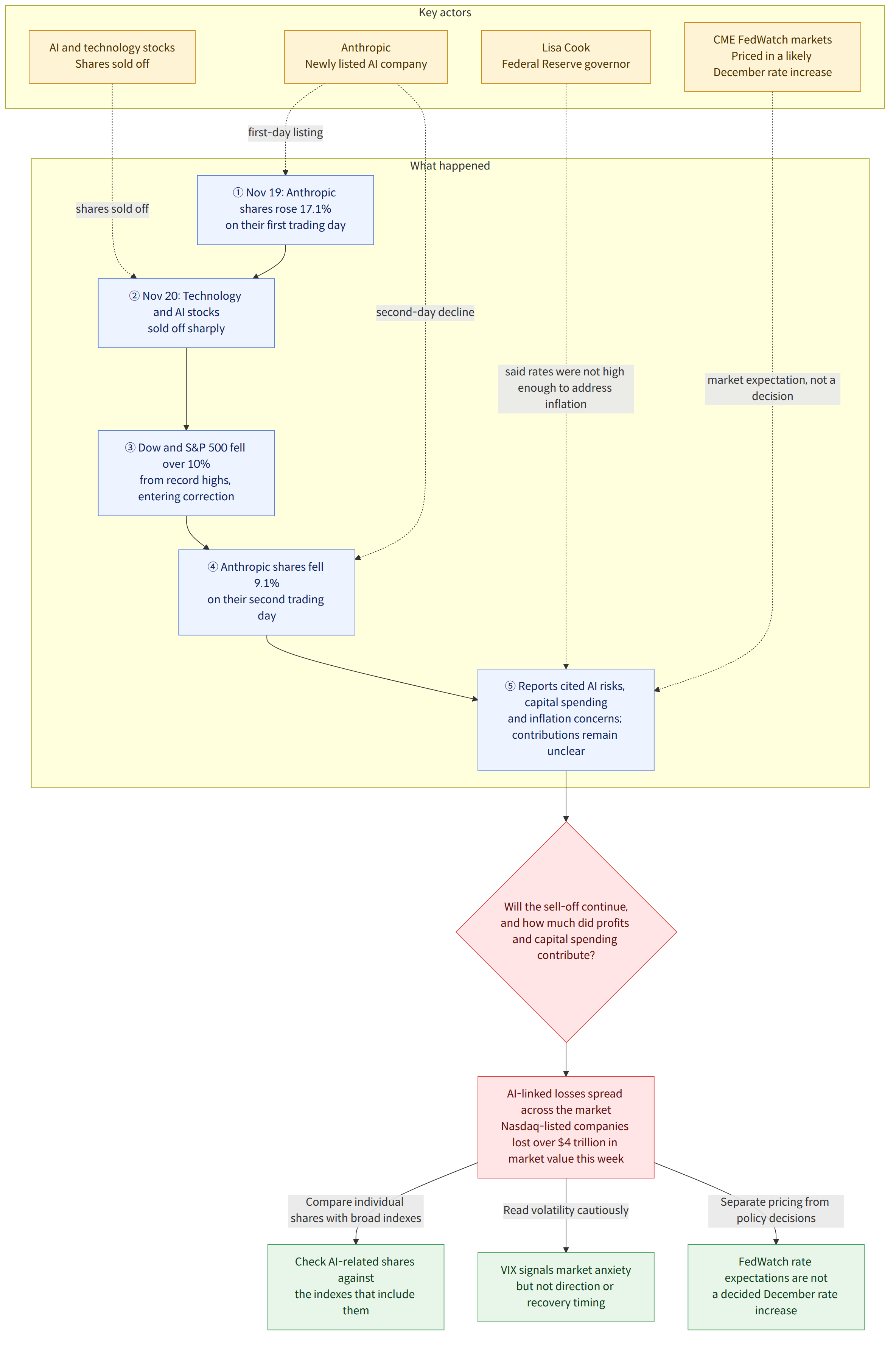
The Dow and S&P 500 had each fallen more than 10% from their respective record highs, entering correction territory. A correction generally refers to a decline of at least 10% from a market index’s peak. The S&P 500 fell for seven consecutive trading sessions, its longest such streak since February 2020.
The declines were particularly pronounced among semiconductor and AI-related stocks within the technology sector. The Philadelphia Semiconductor Index (SOX; 필라델피아 반도체지수) fell 10.73% in a single day, reducing its year-to-date gain to 18.7%. This week, the market capitalization of Nasdaq-listed companies fell by more than $4 trillion. The CBOE Volatility Index (VIX; CBOE 변동성지수), which measures the level of market anxiety, closed at 35.89, up 26.20%, its highest level since April 7, 2025.
Individual stocks also posted steep declines. Nvidia fell 13.8%, leaving it about 48% below its all-time high on October 6. Amazon dropped 3.9%, and Meta fell 5.9%. AI cloud companies CoreWeave and Nebius fell 12.1% and 16.1%, respectively.
Anthropic’s listing failed to revive investor sentiment toward AI stocks. On its first day of trading, November 19, the stock closed 17.1% above its $83 offering price. The following day, it fell 9.1% to close at $88.91. The original report says concerns about the risks associated with AI technology and the large capital expenditures required for early-stage technologies weighed on investor sentiment. However, it is not clear how much actual earnings and capital spending each contributed to the share-price declines.
Concerns about interest rates and inflation were also cited. Federal Reserve Governor Lisa Cook said the current policy rate was not high enough to address inflation. According to CME Group’s FedWatch Tool (CME그룹 페드워치), markets had priced in a 0.25-percentage-point increase in the federal funds rate at the December FOMC meeting as all but certain. This reflects market expectations; it does not mean a rate hike has been decided at the meeting.
What this news means
The move into correction territory is notable because it means major indexes as a whole have fallen substantially from their peaks, rather than the declines being limited to a handful of technology stocks. In particular, the loss in market capitalization among Nasdaq-listed companies and the sharp drop in the semiconductor index show that stocks tied to AI investment fell together. The rise in the VIX can be read as a sign that investors expect greater market volatility, but it does not, on its own, indicate the market’s future direction or when it might recover.
The fact that Anthropic’s stock fell soon after rising on its first day of trading also shows that a listing alone was not enough to revive buying across the sector. The Wall Street Journal (월스트리트저널) said investors this week were not persuaded by the idea that the sell-off was merely a “speed bump” on the road to AI’s bright future, describing it as “the wheels coming off the AI trade.” This is an assessment of the market mood at the time, rather than a definitive explanation for the sell-off.
For example, investors who own AI semiconductor or related company shares may want to consider not only the movements of individual stocks but also those of the indexes that include them. However, the decline in a particular stock alone cannot determine an individual investor’s returns or the market’s subsequent direction.
Differences among reports
Reports gave different figures for Anthropic’s share price on its second day of trading. One report gave a closing price of $88.91, down 9.1% from the previous day, while another said the stock was trading at $87.28, about 10% below the previous close. The available material does not establish whether the two figures refer to the same point in time. Another report said the intraday decline reached as much as 12.5%; that may reflect the difference between the intraday low and the closing price, and should be distinguished from the percentage decline at the close.
The reports also differed on the indexes’ closing figures. The fact list presented in this article and one report gave the Dow at 48,147.33 and the S&P 500 at 6,910.42. Another original report listed the Dow at 49,135.56 (up 0.08%) and the S&P 500 at 7,089.64 (down 1.20%). The available information does not establish whether the figures in that report refer to the same point in time, so they are not combined here.
What is confirmed and what remains unknown
Confirmed facts
- The Dow and S&P 500 fell more than 10% from their record highs, entering correction territory.
- The Nasdaq fell 5.28%, and its year-to-date return moved into negative territory.
- The SOX fell 10.73%, and the VIX closed at 35.89.
- Anthropic closed above its offering price on its first day of trading, then fell the following day.
What remains unknown
- The original report does not say whether the sell-off will continue or when the market might recover.
- It has not been established how much AI companies’ actual earnings and large-scale capital spending each contributed to the share-price declines.
- The market pricing described does not establish whether the federal funds rate will actually be raised at the December FOMC meeting.
What readers should check
- Check how much of your holdings are exposed to AI- and semiconductor-related stocks or indexes that include them.
- When comparing stock prices, distinguish between closing and intraday prices, and note the reference time given in each report.
- Market expectations reflected in interest-rate pricing may differ from the FOMC’s actual decision, so check the meeting outcome and announcements separately.
References
- Other coverage consulted: koreatimes.co.kr
- Other coverage consulted: koreatimes.co.kr