



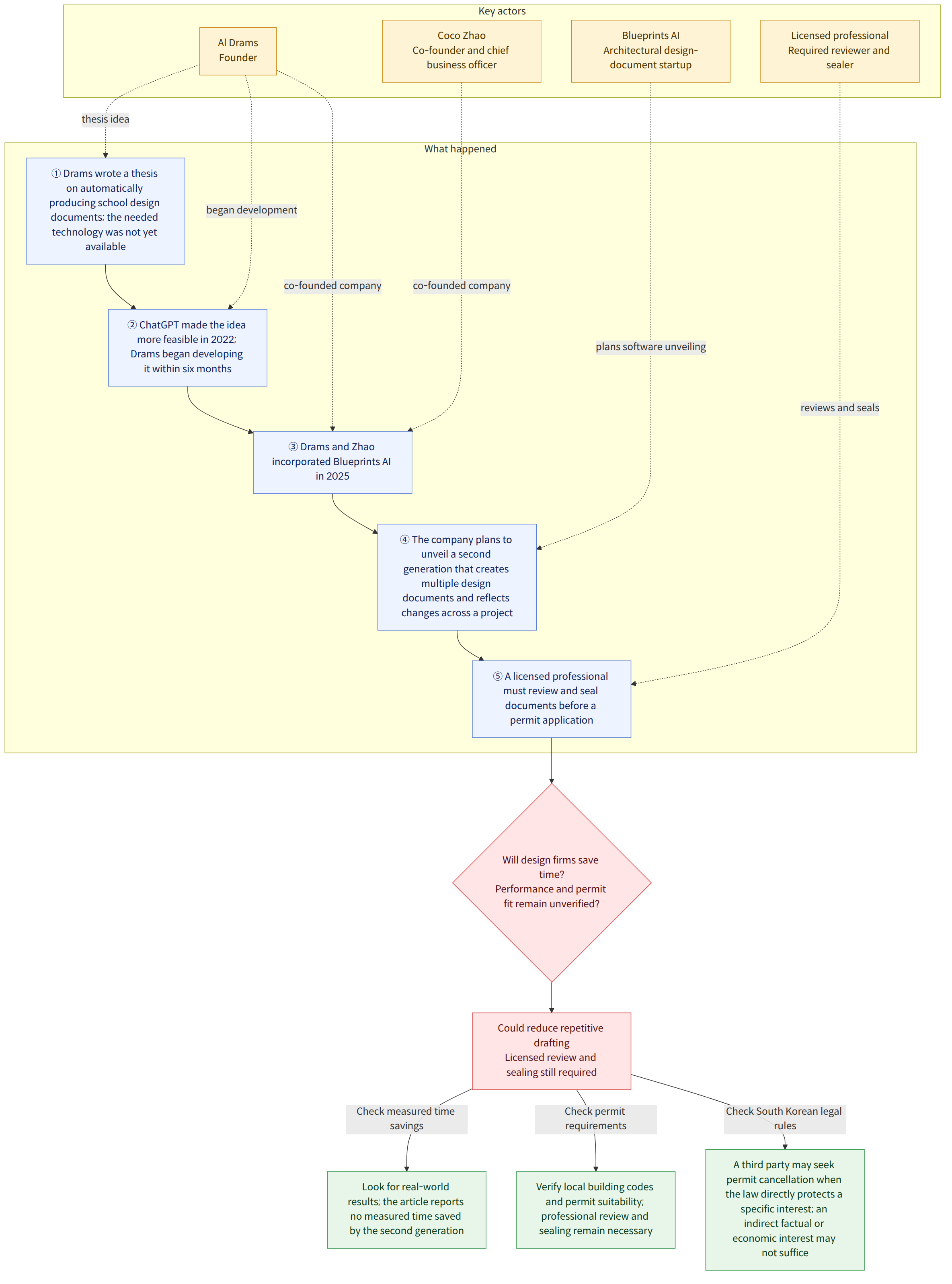
Blueprints AI, a startup that uses artificial intelligence (AI) to generate architectural design documents, said it plans to unveil the second generation of its software. According to the company, users can create architectural, structural, mechanical, electrical, plumbing, and interior design documents from project descriptions or sketches, and changes to a design can be reflected throughout the project. However, the co-founders said a licensed professional must review and seal the documents before a permit application is submitted.
Background and context
As a university student, founder Al Drams wrote his graduation thesis on software that could automatically produce design documents for a school building. He earned bachelor's and master's degrees in architecture from the University of Tehran and completed two years of coursework in a doctoral program in digital design at the European Graduate School in Switzerland. The source says the technology needed to realize the idea was not available at the time.
Drams said the idea became more feasible after OpenAI released ChatGPT in November 2022. He began developing the concept for Blueprints AI within six months. Drams opened an architecture firm, Drams Architects, in 2018, and added a construction business in 2021 after obtaining a general contractor's license. Blueprints AI was incorporated in Santa Monica, California, in 2025 by Drams and co-founder Coco Zhao.
Zhao, a Hong Kong-born data scientist, is the company's chief business officer and oversees sales and go-to-market strategy. The two founders said they trained the model using eight years' worth of approved drawing sets held by Drams's design and construction firm. This describes the scope of the materials the company says it used to develop the software. That fact alone does not establish its accuracy for other regions or for all types of building codes.
Blueprints AI was selected for the 2026 Startup Battlefield 200 and is scheduled to take part in TechCrunch Disrupt, which will be held in San Francisco from October 13 to 15. The event is a venue for startups to showcase their products, but participation itself does not mean that the software's performance or suitability for permit applications has been independently verified.
What this news means
Architectural drawings involve not only conceptualizing spaces but also preparing and coordinating multiple design documents. The founders say Blueprints AI's second generation incorporates design changes throughout a project and checks whether the design complies with local building codes. If these features work as intended, they could reduce repetitive revisions and drafting work and potentially free up more time for design.
Drams said architects spend about 80% of their time on drafting and 20% on design, and that he wants to reverse the ratio to 20% drafting and 80% design. This is the founder's goal, not a measured result showing that the software has actually changed how people spend their working hours. In particular, the source provides no results on use of the second-generation software before or after its release, or on how much time it saves.
The intended users are architecture, engineering, and design firms, as well as developers and property owners. The company offers the service on a subscription basis and is also considering a one-time pricing plan for customers who want a single project. The first-generation software costs $3,200–$8,500 per month, depending on the plan, while enterprise customers receive separate pricing. There is no basis for assuming that the same prices will apply to the second generation.
For example, if an architectural design firm used the tool on a project requiring multiple revisions, the feature that applies changes throughout all the documents could help reduce repetitive work. Even in that case, however, the company says a professional must review whether the resulting documents are suitable for an actual permit application. The founders stressed that the software does not replace a licensed architect.
Related regulations and support information
For readers in South Korea, it is important to check the domestic standards that apply to actual building permits and administrative procedures, regardless of an AI tool's capabilities. According to internal legal guide L1, a third party adversely affected by a building permit may file a lawsuit seeking its cancellation if the underlying law directly protects a specific interest of that party. An indirect factual or economic interest alone, however, may not be sufficient. Therefore, concern about possible harm to nearby properties does not by itself determine whether a lawsuit can be brought.
Also, if construction has been completed and restoring the original state would be impossible even if the permit were cancelled, there may be no legally recognized interest in seeking cancellation of the permit. The fact that a route has long been used for passage does not, by itself, make the land a road under the Building Act (건축법); the statutory requirements, such as a notice under relevant laws or the designation and public announcement of a road, must be considered. A building permit within a zoning area may also have the character of a development permit, giving the administrative authority discretion. However, there may be grounds to challenge the decision if the authority exceeded or abused its discretion, for example by making an error of fact or violating the principles of proportionality or equality.
This guidance concerns South Korean building administration and does not verify Blueprints AI's suitability for permits or its legal effect under the laws of the United States, where it was developed. When applying it to an actual project or dispute in South Korea, readers should check the laws currently in force and the specific facts. It is also important to note that permit cancellations, corrective orders, and changes to the name of a registered building owner may differ in their legal nature and in the methods available to challenge them.
What is confirmed and what remains unknown
Confirmed facts
- Blueprints AI creates construction-related blueprints based on 2D sketches or PDFs. The company describes these as documents that comply with regulations and can be used for permit applications.
- The founders said the second generation creates design documents across multiple disciplines from project descriptions or sketches, and applies a single change throughout the project.
- Early customers are already using the second-generation software, and Drams said he plans to make that version generally available during the week referenced in the article.
- The company is developing third-generation software that will add structural analysis and electrical panel design.
- The co-founders say a licensed professional must review and seal the documents before a permit application is submitted.
What remains unknown
- The source does not say how the software's accuracy against building codes in different regions is verified.
- It is not clear who would bear legal or practical responsibility if an error in an AI-generated drawing caused a problem.
- The price of the second-generation software has not been disclosed.
- No results have been presented showing how much actual adoption reduces drafting time or increases time spent on design.
What readers should check
- Architecture and engineering firms or clients considering the software should check whether it complies with the rules in the relevant area and who will review and seal the resulting documents.
- For issues involving building permits or nearby construction in South Korea, readers should not draw conclusions from the general explanation in the legal guide alone. They should check current laws, the status of the permit and construction, and whether they have an interest that is directly protected.
- Anyone seeking to challenge a permit cancellation or corrective order should distinguish the type of administrative action and the parties involved, and consider whether the original state can actually be restored if the action is cancelled.
References
- Other coverage consulted: techcrunch.com