


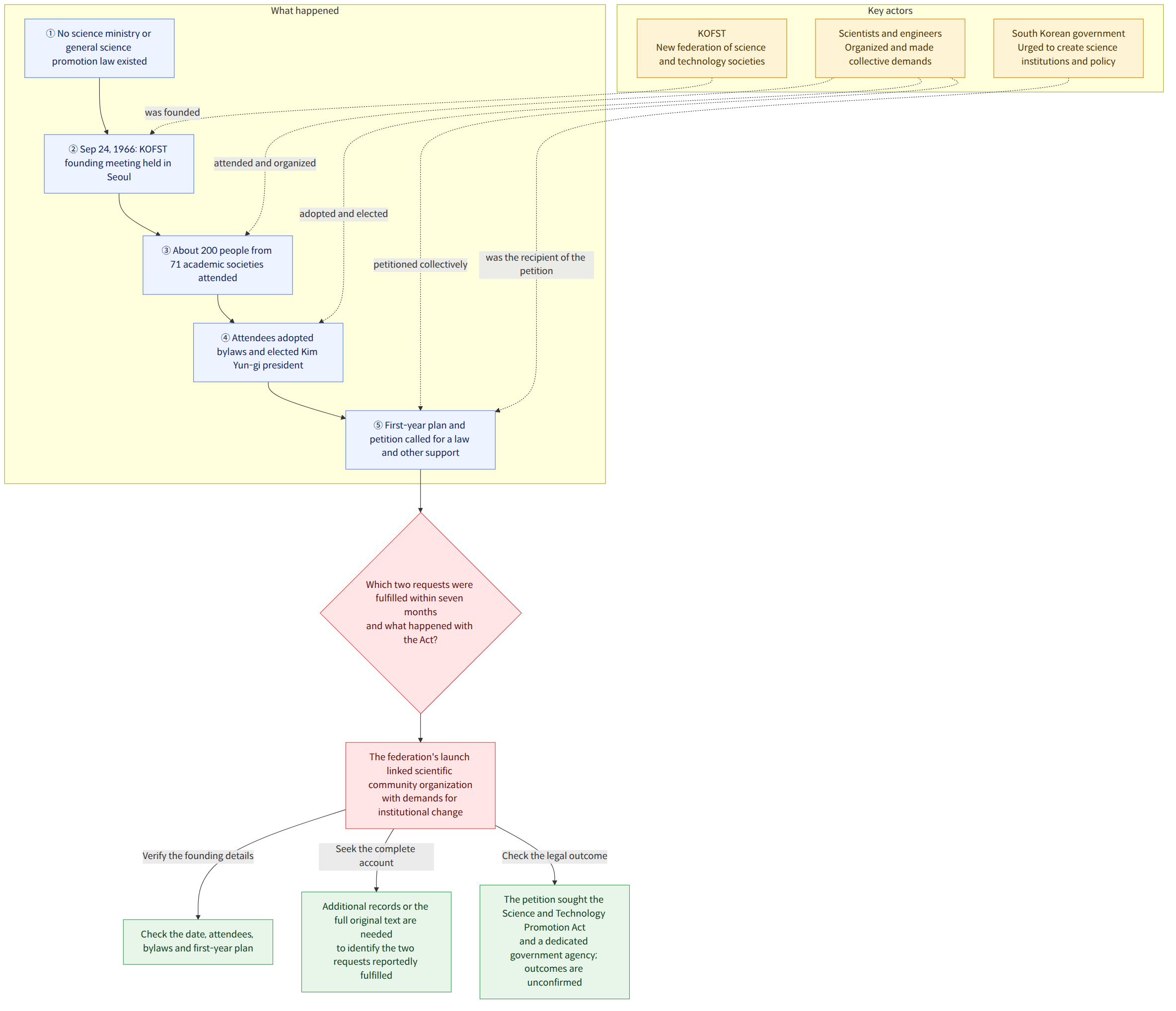
On September 24, 1966, the founding meeting of the Korean Federation of Science and Technology Societies (한국과학기술단체총연합회, KOFST) was held at the former Press Center in downtown Seoul. About 200 scientists and engineers from 71 academic societies attended, adopted the bylaws, and elected Kim Yun-gi as the first president. They included efforts to enact the Science and Technology Promotion Act (과학기술진흥법) in their first-year plan and adopted a petition urging the government to enact the law and improve the treatment of scientists, among other measures.
Background and context
At the time, South Korea had neither a government ministry responsible for science nor a general law promoting science and technology. Amid this institutional vacuum, the founding meeting was where the scientific community organized a federation and called on the government to develop science and technology policy.
A black-and-white photograph taken that day shows a banner announcing KOFST’s founding in Chinese characters and the national flag behind the podium. The program also included singing the “Science and Technology Promotion Song” (과학기술진흥의 노래) after the national anthem. The adoption of the bylaws and election of the first president, together with the inclusion of efforts to enact a law in the first-year plan and the petition to the government, show that the federation’s launch involved not only creating an organization but also calling for institutions to be established.
What this news means
Given that there was no government ministry responsible for science and technology and no general law when KOFST was founded, the scientific community’s demands focused on creating the institutions and administrative structures needed to support policy. The petition also called for improving the treatment of scientists and supporting the construction of a building for the scientific community. In other words, it raised the view that advancing science and technology required both conditions that supported researchers and their community and a role for the government.
This means that the starting point of South Korea’s science and technology policy can be traced not only through government actions but also through the process by which the scientific community established an organization and called for institutional change. For example, someone who belonged to the scientific community at the time could have used the federation to convey collective demands for relevant laws and a dedicated government agency, in addition to raising issues concerning the treatment of individual researchers. This is a hypothetical scenario based on the petition’s contents and does not describe the experiences of actual participants.
What is confirmed and what remains unknown
Confirmed facts
- The founding meeting was held on September 24, 1966, at the former Press Center in downtown Seoul.
- About 200 scientists and engineers from 71 academic societies attended.
- Attendees adopted the bylaws and elected Kim Yun-gi as the first president.
- The first-year plan included efforts to enact the Science and Technology Promotion Act (과학기술진흥법), and the petition called for the law’s enactment, improved treatment of scientists, support for the construction of a building for the scientific community, and the establishment of a dedicated government agency for science.
What remains unknown
- The original account says that two of the petition’s requests were fulfilled within seven months, but the next sentence ends with “the Science and Technology Promotion Act …,” so the specific details cannot be confirmed. On the basis of this source alone, it is therefore not possible to determine which two requests were fulfilled or what happened in relation to the law.
What readers should check
- When considering the significance of KOFST’s founding, readers should distinguish between verifiable facts—the founding date, attendees, and adopted plan—and subsequent achievements that the original account leaves unfinished.
- To establish which petition requests were fulfilled within seven months, additional records or the complete original text, neither of which is available in this source, would be needed.