


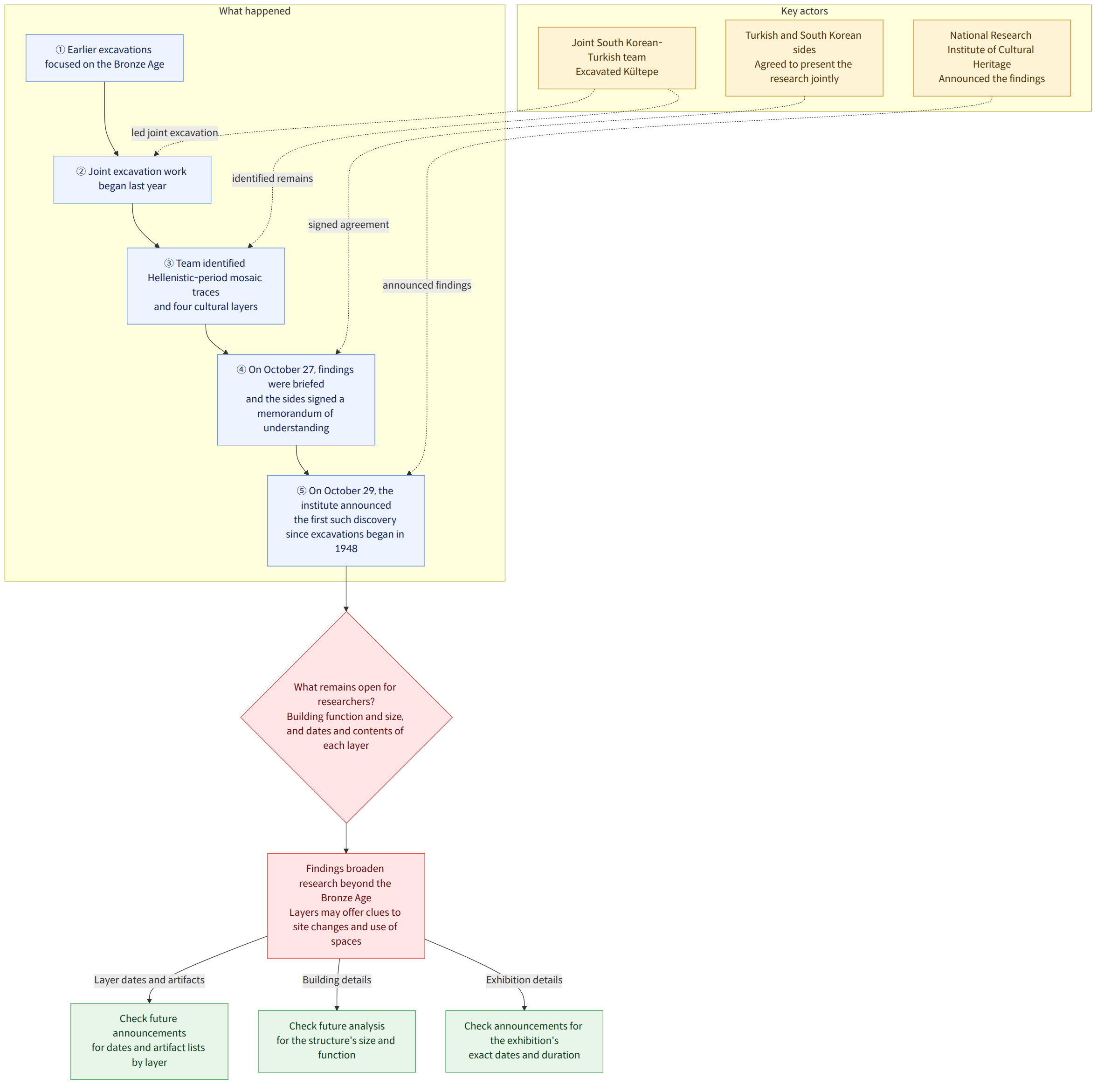
At the Kültepe site in Kayseri, Türkiye, a joint South Korean-Turkish excavation team identified remains of a mosaic structure from the Hellenistic period (323–30 BCE) and four cultural layers. The National Research Institute of Cultural Heritage (국립문화유산연구원) announced on October 29 that this was the first discovery of such artifacts since excavations began there in 1948.
The discovery is about more than finding traces of a single building. The cultural layers uncovered could provide clues to how the site changed at the time and how its spaces were used. However, the information made public so far does not establish the function or size of the building associated with the mosaic, or the specific dates of each cultural layer.
Background and context
Kültepe is the site of an ancient city that flourished from around 3000 BCE through the Roman Empire period. It is also known as a cultural cradle of the Hittite civilization, which was centered in what is now Türkiye’s Anatolia region.
Previous excavations focused on the Bronze Age. Joint excavation work began last year, and this time traces of a mosaic were identified that are thought to belong to a building constructed using Hellenistic-period architectural techniques. The excavation’s chronological scope has broadened, allowing researchers to examine a period that had received relatively little attention.
Cultural layers are strata formed by accumulated traces of different periods or activities at a site. The four layers identified in this excavation could provide material for studying not only the nature of a single structure but also how the surrounding spaces changed. However, the information made public so far does not specify what artifacts were found in each layer or when each was formed.
A briefing on the excavation’s findings was held on October 27 at the Hotel Koreana in Jung-gu, Seoul. The Turkish side praised the South Korean team’s precise and scientific research methods, which used geological surveys and 3D technology to document and analyze artifacts. Fikri Kulakoğlu, a professor at Ankara University who leads the excavation, also praised South Korea’s project achievements.
What this news means
The significance of these findings is that they open the way to understanding Kültepe not as a site limited to a particular period, but as a place shaped by changes over many periods. Studying the mosaic traces alongside the cultural layers could raise questions not only about the appearance of buildings but also about how spaces were used at the time. These are research possibilities that will need to be verified through future analysis; they do not mean that the building’s function or the use of its spaces has already been established.
It is also notable that the Turkish side recognized the South Korean team’s methods for geological surveys and 3D documentation and analysis. Research methods for precisely documenting and analyzing artifacts can be used to interpret and share excavation findings. The joint excavation also demonstrates that cooperation is extending beyond fieldwork to include the two countries’ joint presentation of research findings.
For example, if researchers examine additional data from each cultural layer, this could help them compare construction and the use of spaces across different periods. However, it is not yet known what additional data will be made public or what conclusions comparative research might reach.
What is confirmed and what remains unknown
Confirmed facts
- The joint excavation team identified mosaic traces thought to belong to a building constructed using Hellenistic-period architectural techniques at Kültepe.
- Four cultural layers from the Hellenistic period were discovered, which could offer clues to changes at the site and how its spaces were used.
- The National Research Institute of Cultural Heritage said this was the first discovery of such artifacts since excavations began in 1948.
- The two sides signed a memorandum of understanding on October 27 and agreed to hold an exhibition of the joint excavation’s findings next year at the National Palace Museum of Korea in Seoul to mark the 70th anniversary of diplomatic relations.
What remains unknown
- The exact size of the mosaic structure and the function of the building have not been announced.
- The specific dates of the four cultural layers and the artifacts identified in each layer have not been provided.
- The exact dates and duration of next year’s exhibition have not been announced.
What readers can check
- Readers can look for further announcements on the Kültepe excavations to see whether dates for each cultural layer and lists of artifacts are made public.
- Exhibition information from the National Palace Museum of Korea can provide details on the dates, duration and materials actually on display.
- The planned exhibition will also include a clay tablet from Kültepe dating to around 4,000 years ago. It is expected to be presented as evidence of trade and everyday life in Anatolia.