


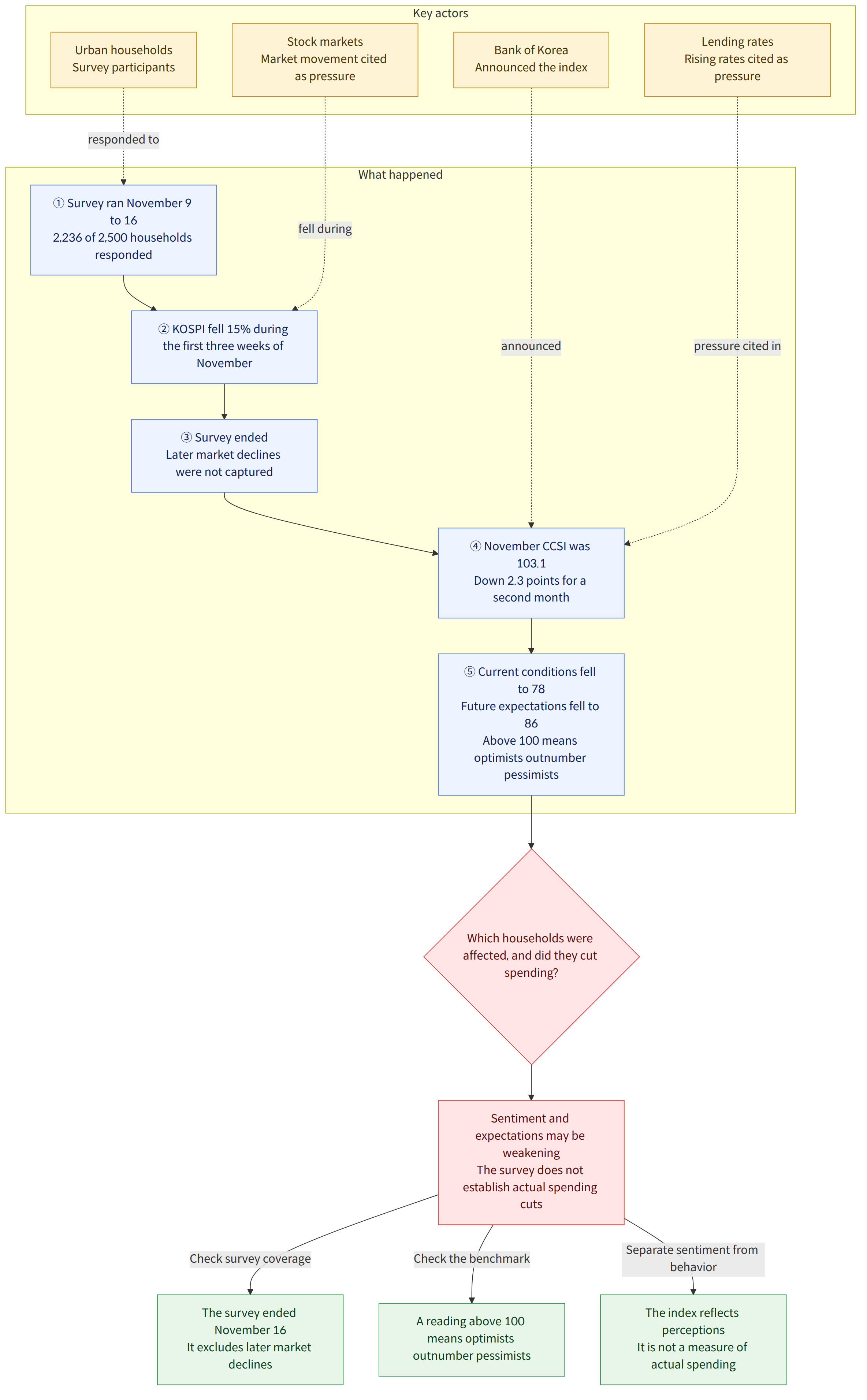
The Bank of Korea (한국은행) announced that the November Consumer Sentiment Index (CCSI; 소비자심리지수), a composite measure of consumers’ perceptions of the economy, stood at 103.1. It fell 2.3 points from the previous month, declining for a second consecutive month. The Bank of Korea said pessimistic outlooks had become more common as the stock-market correction and rising lending rates weighed on consumer sentiment.
The decline is notable because households’ assessments of the current economy and their expectations for the future both worsened. However, under the benchmark that a reading above 100 means optimists outnumber pessimists, the November figure does not indicate that pessimism was dominant.
Background and context
The index measuring consumers’ assessment of current economic conditions was 78, down 4 points from a month earlier. The index measuring expectations for future economic conditions also fell, by 2 points, to 86. The decline in both indicators shows that consumers’ perceptions of the economy now and their expectations for the economy ahead weakened at the same time.
Stock-market movements were also cited as a factor. The Korea Composite Stock Price Index (KOSPI; 한국종합주가지수) fell 15% during the first three weeks of November, and one report attributed the decline in part to growing concerns, after the US midterm elections, about the profitability of large-scale investment in artificial-intelligence (AI) infrastructure. Another report cited corrections in domestic and overseas stock markets and growing uncertainty in the semiconductor industry as factors behind the deterioration in assessments of current economic conditions.
The survey was conducted from November 9 to 16 among 2,500 urban households nationwide, of which 2,236 responded. As a result, the index does not capture the impact of any further stock-market declines after the survey period ended. This is why the figure should not be taken as reflecting all market movements in November.
What this news means
Consumer sentiment is an indicator of how households perceive economic conditions; it is not a measure of actual spending or a definitive forecast of the economy. Still, the simultaneous declines in assessments of current conditions and expectations for the future, along with the cited pressures of the stock-market correction and rising lending rates, may suggest that households’ spending conditions and economic expectations are weakening.
When stock prices fall, households that own stocks may feel the loss in asset value, while rising lending rates can increase interest payments for households with loans. However, this material alone does not show which households were affected or by how much, or whether they actually cut their spending.
For example, a household that owns stocks and also has loans might feel both the market decline and higher lending rates as burdens and reconsider its spending plans. This is a hypothetical example of a possible situation; it does not mean the survey established that all households changed their spending behavior.
Differences in how reports presented the news
Both reports highlighted the decline in consumer sentiment and the stock-market correction and higher interest rates. However, they differed in what they emphasized as the reasons for the decline. One linked the KOSPI’s fall to concerns about the profitability of large-scale AI infrastructure investment after the US midterm elections, while the other cited corrections in domestic and overseas stock markets and growing uncertainty in the semiconductor industry as factors behind the deterioration in assessments of current economic conditions.
The reports also explained the index’s benchmark of 100 differently. One said that a reading above 100 means optimists outnumber pessimists; the other described it as a more optimistic level than the average from 2003 to 2025. These can be understood as different ways of explaining the same index, separate from the fact that the reading of 103.1 was down from the previous month.
What is confirmed and what remains unknown
Confirmed facts
- The November CCSI was 103.1, down 2.3 points from the previous month.
- The index of assessments of current economic conditions was 78, down 4 points, and the index of expectations for future economic conditions was 86, down 2 points.
- The KOSPI fell 15% during the first three weeks of November.
- The survey was conducted from November 9 to 16 among 2,500 urban households nationwide, and 2,236 responded.
- Further stock-market declines after the survey ended were not reflected in this survey.
What remains unknown
- This material alone cannot show how stock-market movements after the survey period ended will affect the next consumer sentiment reading.
- The information presented here does not show whether the decline in consumer sentiment led to changes in actual household spending.
- Changes in other detailed indicators mentioned in the reports do not make it possible to determine the extent of the burden felt by individual households.
What readers should check
- If you have a loan, check whether your own lending rate has actually changed and what that means for your repayment burden. The index shows that rising rates were cited as a factor weighing on consumer sentiment, but it does not provide information on changes in individual borrowers’ rates.
- If you own stocks, distinguish between the period covered by the survey and market movements afterward. The survey did not reflect stock-market declines after November 16.
- Do not equate a month-to-month change in the index with an actual change in household spending; consider it alongside assessments of current economic conditions and expectations for the future.
References
- Other coverage consulted: en.yna.co.kr
- Other coverage consulted: hani.co.kr