

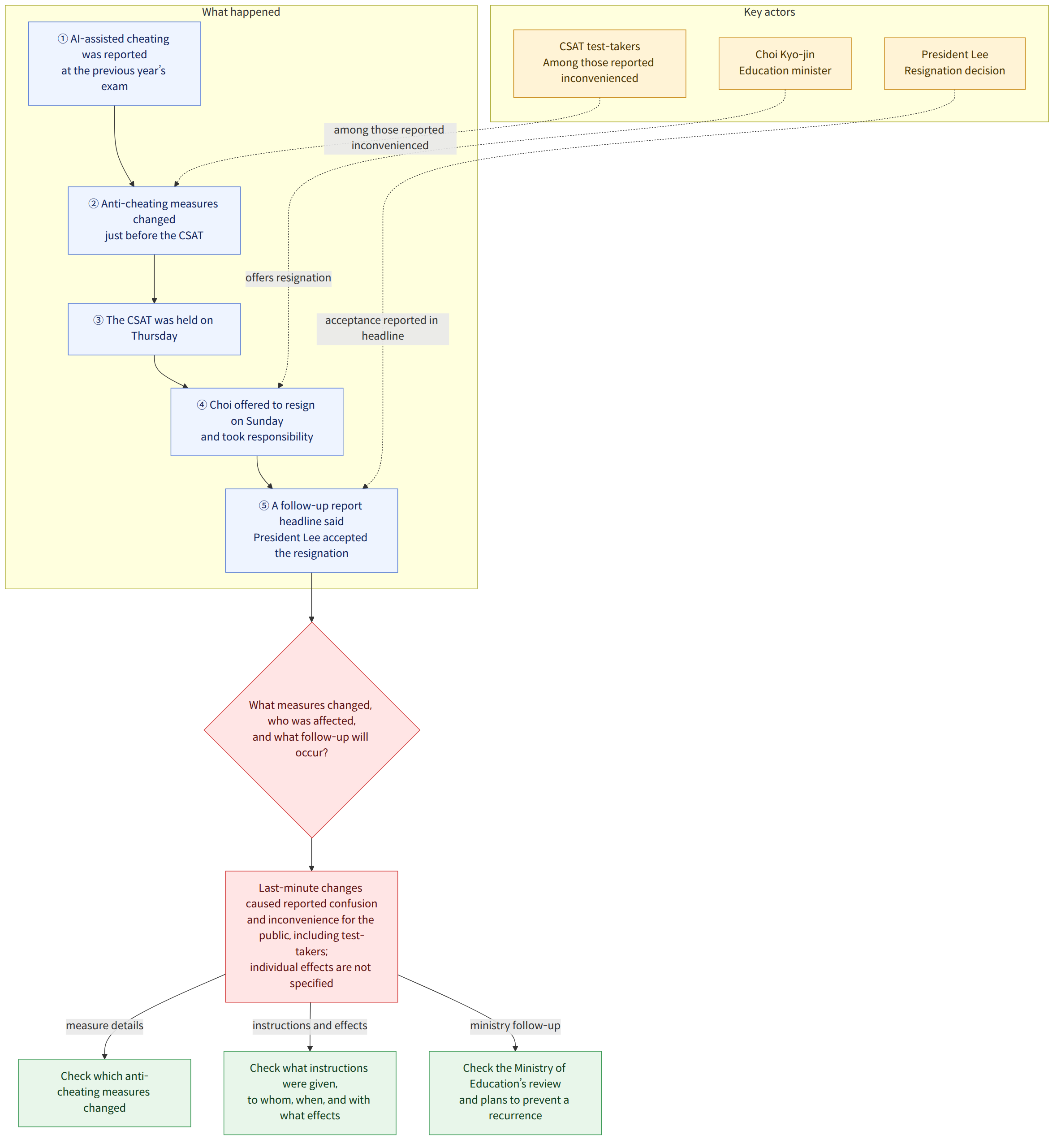
Education Minister Choi Kyo-jin offered to resign on Sunday, saying he would take responsibility for the confusion and inconvenience caused by last-minute changes to measures intended to prevent artificial intelligence (AI)-assisted cheating ahead of the College Scholastic Ability Test (대학수학능력시험, CSAT). The CSAT is South Korea’s annual college entrance exam, and this year’s test was held on Thursday. Choi said that, as the minister in charge, he could not avoid criticism that preparations had been inadequate, and that now that the exam was over, he felt a deep sense of responsibility and was offering to resign.
Background and context
Choi explained that several changes were made just before the exam, causing inconvenience for the public, including test-takers.
One report said AI-assisted cheating had also been detected last year, and that there had been criticism over a delayed response despite there being time to prepare measures to prevent it. This shows that the controversy was framed not only as a matter of confusion just before the exam, but also as a question of whether preparations had been sufficient in advance.
What this news means
Last-minute changes can increase uncertainty for test-takers about what to prepare and which instructions to follow. This report conveys Choi’s explanation that there had been inconvenience, but does not specify the changes or their effects on individual test-takers. It therefore cannot be concluded that all test-takers were affected in the same way.
From the perspective of education administration, the need for measures to prevent AI-assisted cheating is in focus alongside questions about when and how those measures should be communicated. For example, a test-taker who received new instructions just before the exam might have had to work out how they differed from the procedures they already knew. This is a hypothetical example; the reports provided do not establish what instructions, if any, were changed.
Offering to resign is a step by the minister acknowledging responsibility, and the headline of a linked follow-up report said President Lee had accepted the resignation. However, a change in the minister alone does not establish the specific causes of the problems raised about exam preparations or the measures to prevent them from recurring.
What is confirmed and what remains unknown
Confirmed
- Education Minister Choi Kyo-jin offered to resign, taking responsibility for the confusion and inconvenience caused by changes just before the CSAT.
- Choi said the changes had caused inconvenience for the public, including test-takers, and that it would be difficult to avoid criticism over inadequate preparations.
- The CSAT was held on Thursday.
- The headline of a related follow-up report said President Lee had accepted Choi’s resignation.
What remains unknown
- What specific measures to prevent AI-assisted cheating were changed just before the exam.
- What instructions were communicated during the changes, when and to whom, and what effects they had on test-takers.
- How the Ministry of Education (교육부) will review and respond to the issues following acceptance of the resignation.
What readers should check
- When further instructions are issued, test-takers and parents should distinguish between the content of the changed measures, who they apply to, and when they take effect.
- Readers can look to see whether the Ministry of Education’s follow-up explanation provides specific details about its review of inadequate preparations and plans to prevent a recurrence.
References
- Other coverage consulted: en.yna.co.kr
- Other coverage consulted: hani.co.kr