



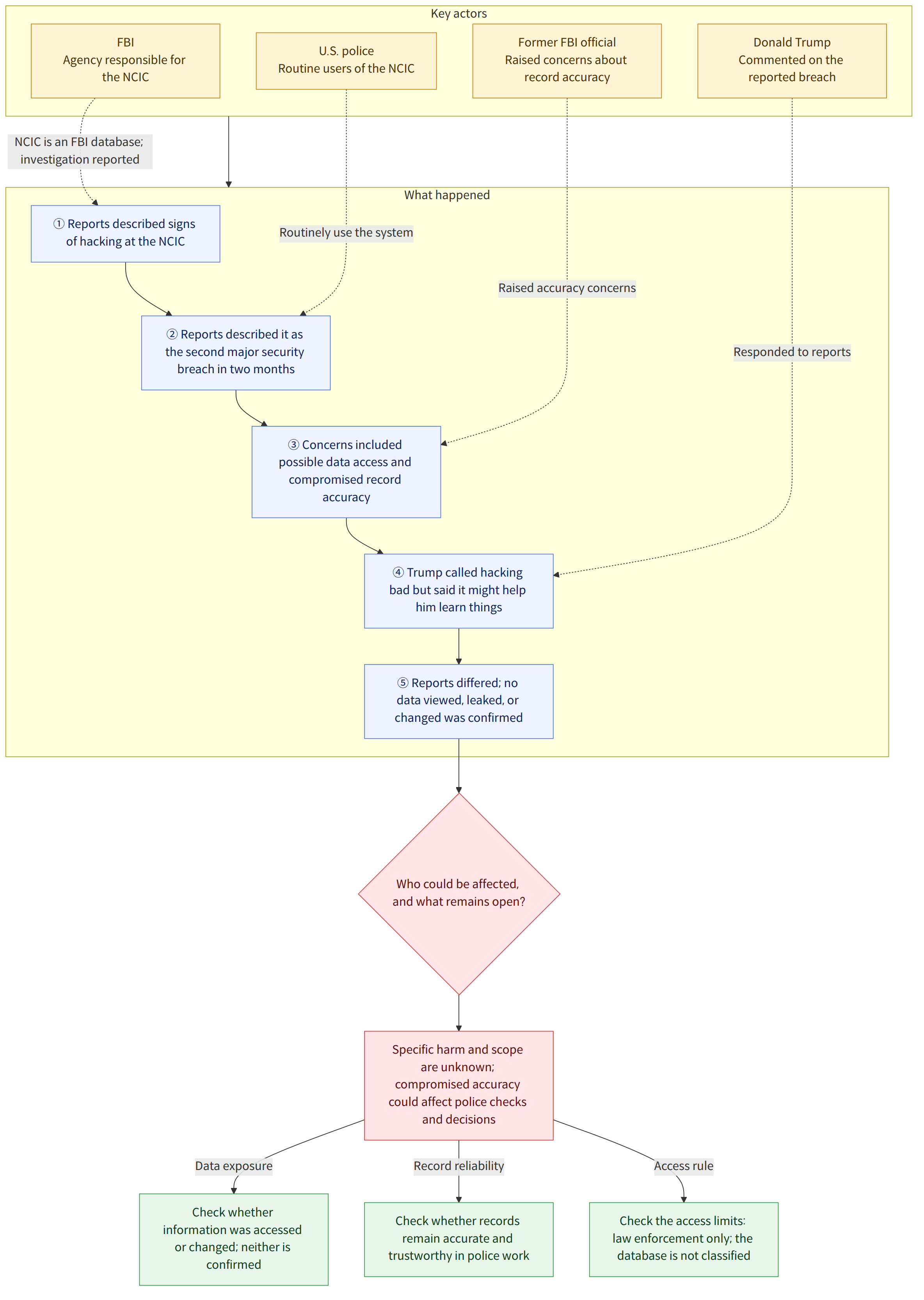
The Federal Bureau of Investigation’s (FBI) National Crime Information Center (NCIC), which U.S. police use routinely, was reportedly hacked. The incident was described as the second major security breach in two months. The NCIC contains FBI fingerprint records and information on wanted people, violent felons and missing people, among other data, drawing attention to the scope of the breach and whether information was actually accessed.
President Donald Trump said on Saturday, responding to reports, that hacking was a bad thing, but also suggested it could be helpful to him. In a phone interview with Fox News, he said, “You get to learn things that you never would have known otherwise,” adding that he tries to look at the situation positively.
Background and context
The NCIC is a database used by law enforcement agencies across the United States. It is an online system for sharing information used for wanted-person searches, criminal histories and identity checks, and has been described as an information network routinely used by police.
Access is restricted to law enforcement agencies, but the data is not classified. Regardless of its classification status, the fact that it contains fingerprint records and information related to wanted people and crimes means the reported signs of hacking raise questions not only about data security but also about the reliability of records used in field operations.
A former FBI official was reported to have said the concern is not limited to whether hackers accessed sensitive information; there is also the possibility that the accuracy of information officers rely on could be compromised. This does not mean that any records were actually altered. Based on the reports so far, it has not been confirmed whether any information was accessed or changed.
What this news means
Because the NCIC is used by police to check and share information, if a breach is confirmed, assessing its impact would require looking beyond whether information was taken outside the system. Whether records remained accurate and whether the information can still be trusted in police work could also be important questions. However, the information currently available does not say what data, if any, was actually viewed, leaked or changed, so specific harm cannot be established.
The scope of the impact also cannot yet be determined. The fact that system access is restricted to law enforcement agencies means the general public does not use the database directly. That does not mean concerns about data security are confined to the police. If the accuracy of records used in police work is in question, that could also affect the reliability of checks and decisions based on that information.
For example, if an officer checks wanted-person information in the NCIC, it could matter whether that record was accessed during the hack or whether its accuracy was compromised. This is a hypothetical illustration of possible issues, not evidence that any actual wanted-person information was affected.
Trump’s response has also drawn attention separately from the security incident itself. He acknowledged that hacking was a bad thing but said it could help him learn things he had not known. He went on to refer to allegations related to Russia as the “Russia, Russia, Russia hoax” and called allegations related to Ukraine the “Ukraine hoax.” He also brought up his call asking Ukrainian President Volodymyr Zelensky to investigate Joe Biden, who was a presidential candidate in 2019. These remarks do not explain the cause or scale of the hack, nor do they confirm any technical facts about this breach.
Details reported differently across outlets
Reports differed in the sources they cited for information about the signs of hacking and in the agencies they mentioned. Some reports covered the NCIC hack and cited CNN and NBC, while others, citing CNN and the Associated Press, said the FBI was investigating signs of a breach. Another report, citing two people briefed on the investigation, reported signs that the FBI’s nationwide crime information database had been compromised.
One report conveyed concerns that sensitive information may have been accessed and that the accuracy of information may have been compromised, but it did not confirm what data, if any, was exposed or changed.
What is confirmed and what remains unknown
Confirmed facts
- The NCIC is an FBI database used by law enforcement agencies across the United States.
- The NCIC contains fingerprint records and information on wanted people, violent felons, missing people and related matters.
- Access to the NCIC is restricted to law enforcement agencies, but the database is not classified.
- The reported signs of hacking were described as the second major security breach in two months.
- President Trump said the breach was a bad thing but also said it could be helpful to him.
What remains unknown
- Who was behind the hack?
- What information was actually accessed, and was any information leaked or changed?
- When did the FBI become aware of the breach, and what response did it take?
What readers should watch for
- In follow-up announcements and reports, it is worth distinguishing whether the incident is confirmed as “access,” “leak” or “alteration.” These are separate issues, and none can be confirmed based on the information currently available.
- Watch for disclosures about the FBI’s investigation and response, as well as any measures to verify the accuracy of information used by police.
- Take care not to confuse earlier reports of cyber incidents involving the FBI with the reported signs of this NCIC breach. Separate reports mentioned breaches involving FBI employee information or an FBI recruitment website, but those reports alone do not establish what information, if any, was exposed in the NCIC.
References
- Other coverage consulted: techcrunch.com
- Other coverage consulted: koreatimes.co.kr