



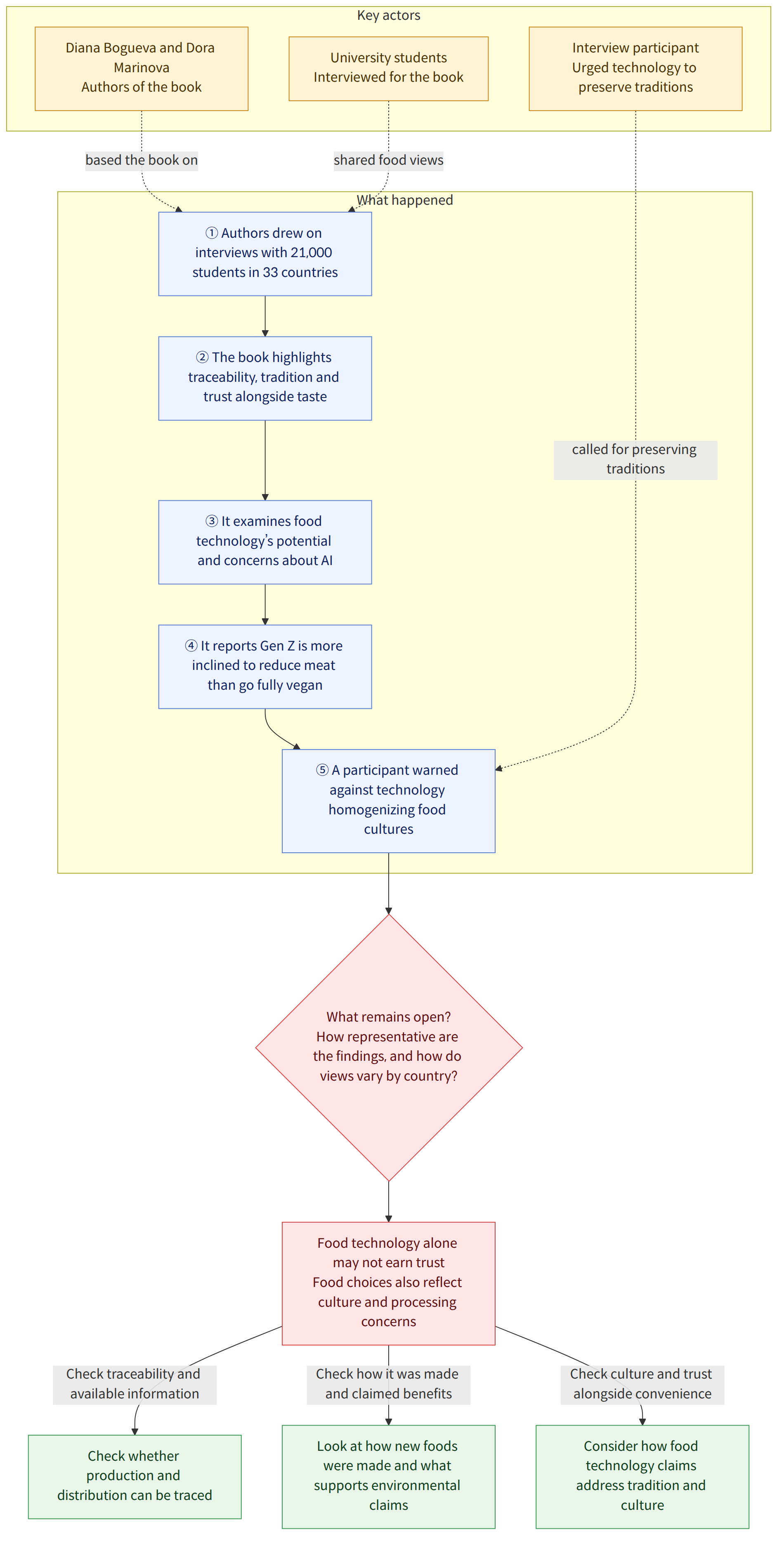
Gen Z, defined as people born between 1995 and 2010, accounts for one-third of the world’s population. In their book 《Gen Z and the Future of Food》, Diana Bogueva and Dora Marinova draw on interviews with 21,000 university students in 33 countries to highlight that this generation’s food choices are about not only sustainability and technology but also tradition and trust. Their choices may offer clues to the values future food systems will reflect.
Background and context
Based on interviews with university students in countries including Australia, China, Brazil, Germany, Lebanon, Russia and the United States, the book examines where Gen Z’s attitudes toward food intersect with issues facing the global food system. Against a backdrop of challenges surrounding food systems—including climate change, biodiversity loss and dependence on fossil fuels—it addresses debates about what to eat and how food should be produced.
The book emphasizes that taste is not the only criterion guiding food choices. Traceability—the extent to which a food’s production and distribution can be tracked—as well as tradition and trust are also important, and food choices can be an expression of one’s values. In other words, food is both a matter of personal preference and an expression of culture and responsibility.
What this news means
The book covers a range of innovations in food culture, including cultured meat, fungi and algae, personalized nutrition and milk alternatives. Precision fermentation is a technology that redesigns microorganisms to produce proteins usually found in animal products. Technology could help create new foods or track and reduce food waste, but it does not, by itself, earn consumers’ trust.
Alongside the expectation that AI could help develop foods aligned with consumer values, the book also examines concerns about algorithmic bias, cultural erasure and greenwashing—the practice of making something appear environmentally friendly. In other words, the issue is not just how useful a technology is, but also whose food culture it reflects and whose it leaves out.
Changes in Gen Z’s diets may also differ from the commonly assumed picture. According to the book, they are more inclined to reduce meat consumption than to adopt a fully vegan diet. A key reason is their wariness of the fact that many meat alternatives are highly processed. This suggests that even when sustainability matters, judgments about the authenticity of familiar foods and how they are processed can influence choices.
One interview participant said technology should help preserve traditions rather than homogenize food cultures. This perspective shows why even alternatives considered environmentally desirable cannot be assumed to gain broad acceptance without regard for culture and history. For example, if a consumer wants to reduce meat consumption while also caring about how meat alternatives are processed or about their own cultural food traditions, that person’s choices may not be explained simply by whether they “eat meat alternatives.”
The reviewer who discussed the book criticized its lack of clearer guidance on national and transnational food cultures, as well as its use of AI-generated images that did not support its arguments.
What is known and what is not yet known
What is known
- The book is based on interviews with 21,000 university students in 33 countries.
- The book emphasizes traceability, tradition and trust, as well as taste, in relation to food choices.
- The book addresses both the potential and the concerns surrounding various new food technologies and AI.
- According to the article, Gen Z is more inclined to reduce meat consumption than to adopt a fully vegan diet.
What is not yet known
- When were the interviews conducted, and how were participants selected?
- How did attitudes toward food choices and technology differ by country?
- To what extent do the results of interviews with university students represent the attitudes of Gen Z as a whole?
What readers can check
- When choosing food, readers can consider not only taste and price but also whether its production and distribution can be traced and whether enough information is available.
- When trying meat alternatives or new foods, readers can check how the product was made and what evidence supports its environmental claims.
- When considering claims about food technology or food information encountered on social media, readers can look at how tradition, culture and trust are addressed, alongside convenience and sustainability.