

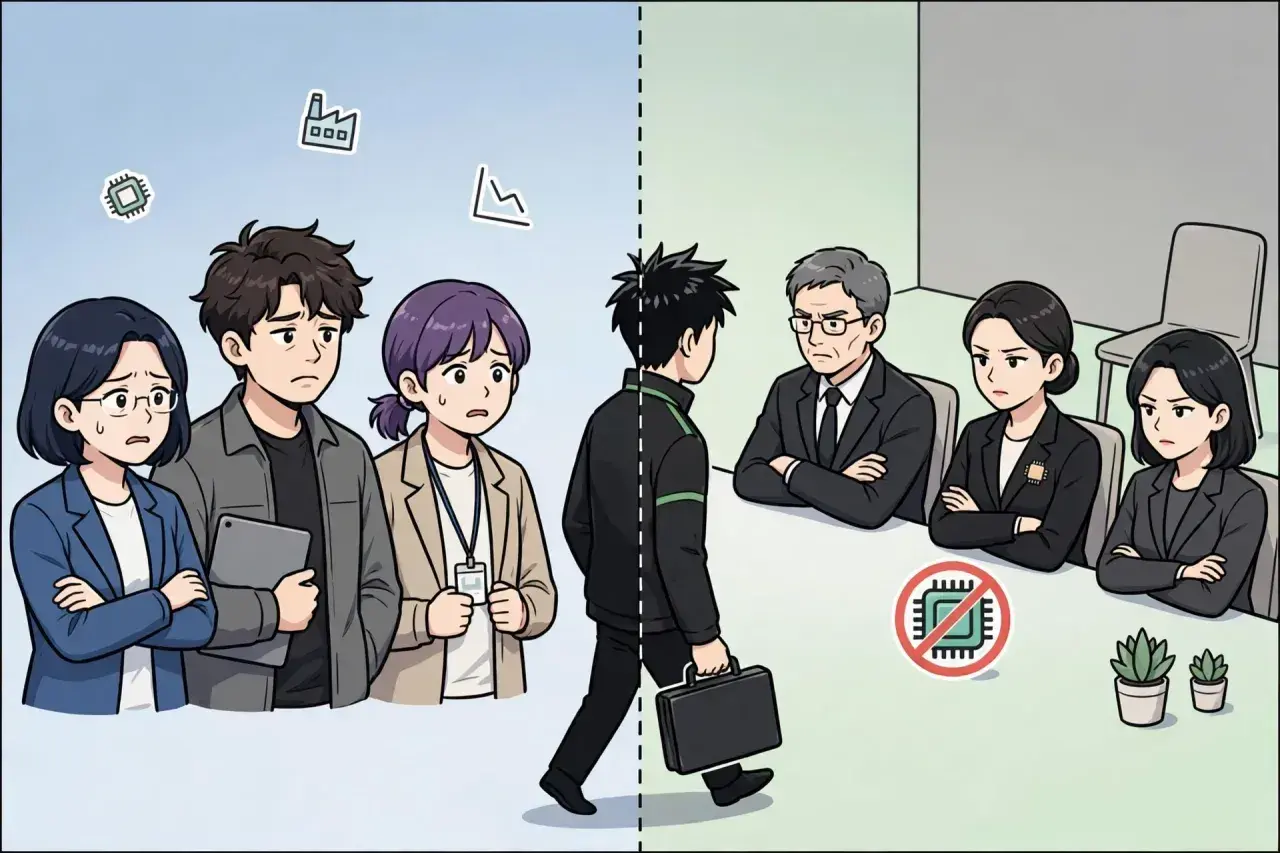
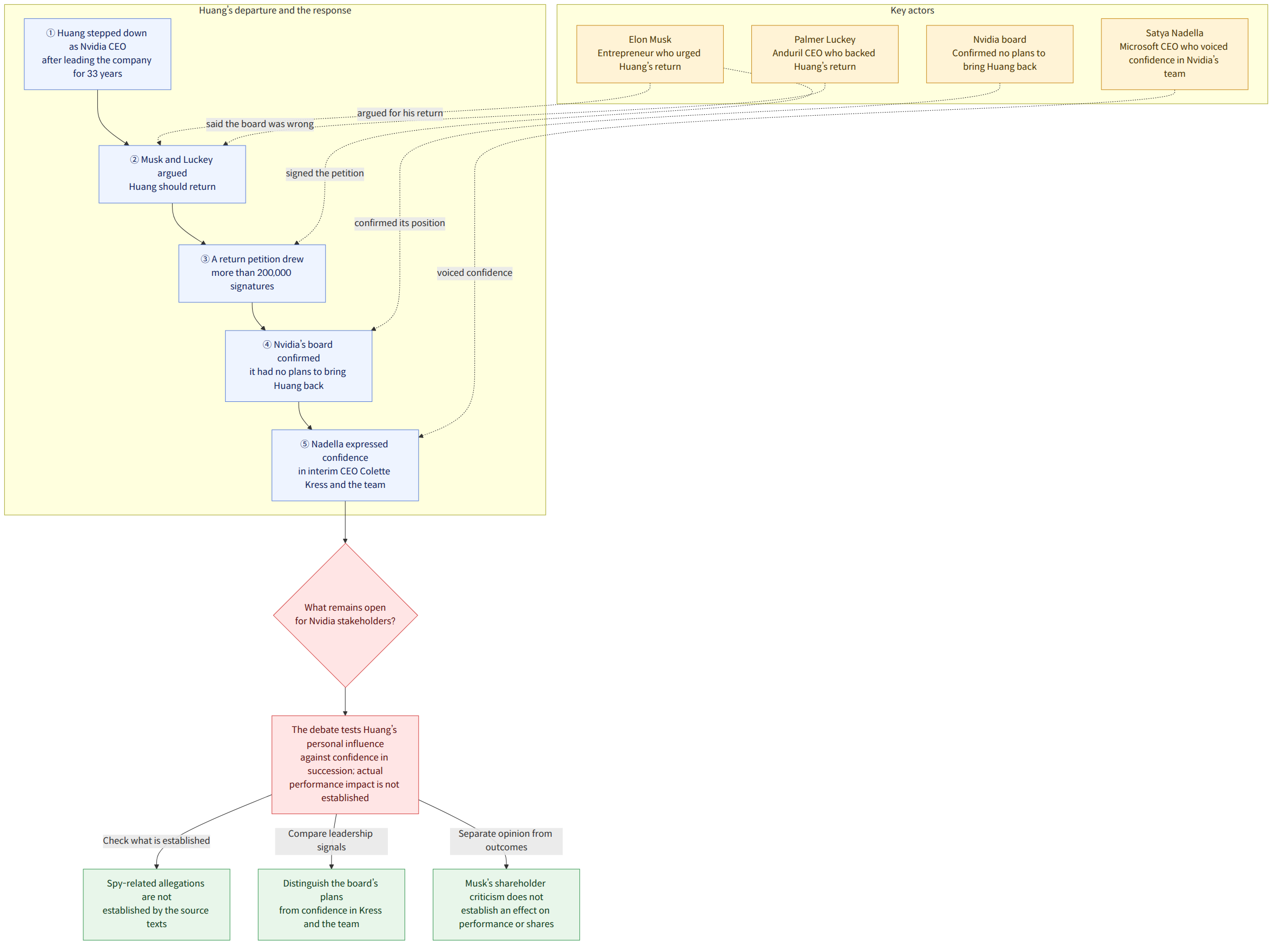
After Jensen Huang stepped down as CEO of Nvidia, which he had led for 33 years, prominent industry figures have offered differing assessments. On Wednesday at the New York Times DealBook Summit, Elon Musk compared Huang to Michael Jordan in his prime and voiced support for his return. Nvidia’s board, however, confirmed it has no plans to bring Huang back. Microsoft CEO Satya Nadella expressed confidence in Nvidia interim CEO Colette Kress and the team, regardless of Huang’s departure.
Background and context
Musk called Huang a longtime friend and said that, in terms of his influence on the team, he was like Michael Jordan in his prime. On X, the social media platform he owns, Musk said he would hire Huang and described him as one of the most talented entrepreneurs and CEOs in history. He also signed a petition calling for Huang’s return, which drew more than 200,000 signatures.
Musk’s argument rests not only on Huang’s personal abilities but also on the relationships he has built within the company and his influence on the organization. Musk said Huang had built relationships over decades and had a deep understanding of technology. He also claimed that some employees had stayed at the company out of personal loyalty to Huang, despite receiving offers of higher pay elsewhere.
Palmer Luckey, CEO of Anduril, also said the board was wrong not to bring Huang back. He claimed China welcomed Huang’s departure and said Huang’s departure would weaken the United States. Nadella, by contrast, said he had confidence in the capabilities of Nvidia interim CEO Kress and the Nvidia team. In other words, calls for Huang’s return have come alongside expressions of confidence that the company can continue without him.
The controversy over Huang’s departure is also intertwined with reporting about his relationship with a person identified as a Chinese spy. One source text reported that U.S. officials consider the person a Chinese spy; another raised the possibility that sensitive information had been passed to China. Musk did not express concern about what this relationship might mean for U.S. national security and said he did not believe Huang was disloyal to the United States. However, these source texts alone do not establish the facts behind the allegations or the outcome of any investigation.
What this news means
The debate is notable because it puts both the influence of a founder who led the company for a long time and confidence in the company’s ability to operate after his departure to the test. The two positions show that holding Huang’s personal role in high regard and having confidence in the organization’s ability to manage succession are distinct judgments.
Musk said he did not think the decision was good for shareholders. That is Musk’s assessment, however, and the source text does not establish how the board’s decision affected the share price or the company’s performance. His criticism should therefore not be equated with the company’s actual performance or investment outcomes.
For example, someone who does business with Nvidia or owns its shares could distinguish between the basis for confidence in the interim CEO and team, and the board’s plans for leadership, rather than judging the company’s future operations solely on expressions of support for Huang. This is not a confirmed subsequent outcome, but a perspective readers can use to assess differing reported views.
What differs across reports
Reports use different terms to describe Huang’s departure. Some said he stepped down, while others described the board as having removed him. The source texts provided do not make it possible to establish whose decision it was or what process led to his departure.
Reports also differ slightly in how they describe the no-return policy and who announced it. One report said the board had confirmed it had no plans to bring Huang back; another said Nvidia executives stated at an earnings announcement that they had no plans to reappoint him. The broader picture is the same: a petition calling for Huang’s return was circulated, and the company indicated it had no plans to bring him back.
Confirmed facts and what remains unknown
Confirmed facts
- On Wednesday at the New York Times DealBook Summit, Musk compared Huang to Michael Jordan in his prime and also said he would like to hire him.
- More than 200,000 people signed a petition calling for Huang’s return, and Musk also signed it.
- Nvidia’s board confirmed it has no plans to bring Huang back.
- Luckey supported Huang’s return, while Nadella expressed confidence in interim CEO Kress and the Nvidia team.
- Reporting on Huang’s departure included his relationship with a person identified as a Chinese spy, but Musk said he did not believe Huang was disloyal to the United States.
What remains unknown
- What specific reasons and process led Nvidia’s board to decide on Huang’s departure?
- What facts have been confirmed, and what are the findings of any investigation, concerning Huang’s relationship with the person identified as a Chinese spy?
- What positions have Huang himself and Nvidia taken on his departure and the petition calling for his return?
- The source text does not establish how Nvidia’s long-term operations and business performance will change without Huang.
What readers should check
- When describing Huang’s departure, distinguish between “stepped down voluntarily” and “was removed by the board,” and watch for follow-up reporting that clarifies who made the decision and what process was followed.
- A petition calling for his return or expressions of support from industry figures are separate from the board’s official position. Readers can check how the company’s subsequent announcements describe the interim CEO arrangement and succession plans.
- The allegations concerning a Chinese spy should be distinguished from confirmed investigation findings. The source text does not provide evidence establishing the facts behind the allegations.
References
- Other coverage consulted: techcrunch.com
- Other coverage consulted: techcrunch.com