

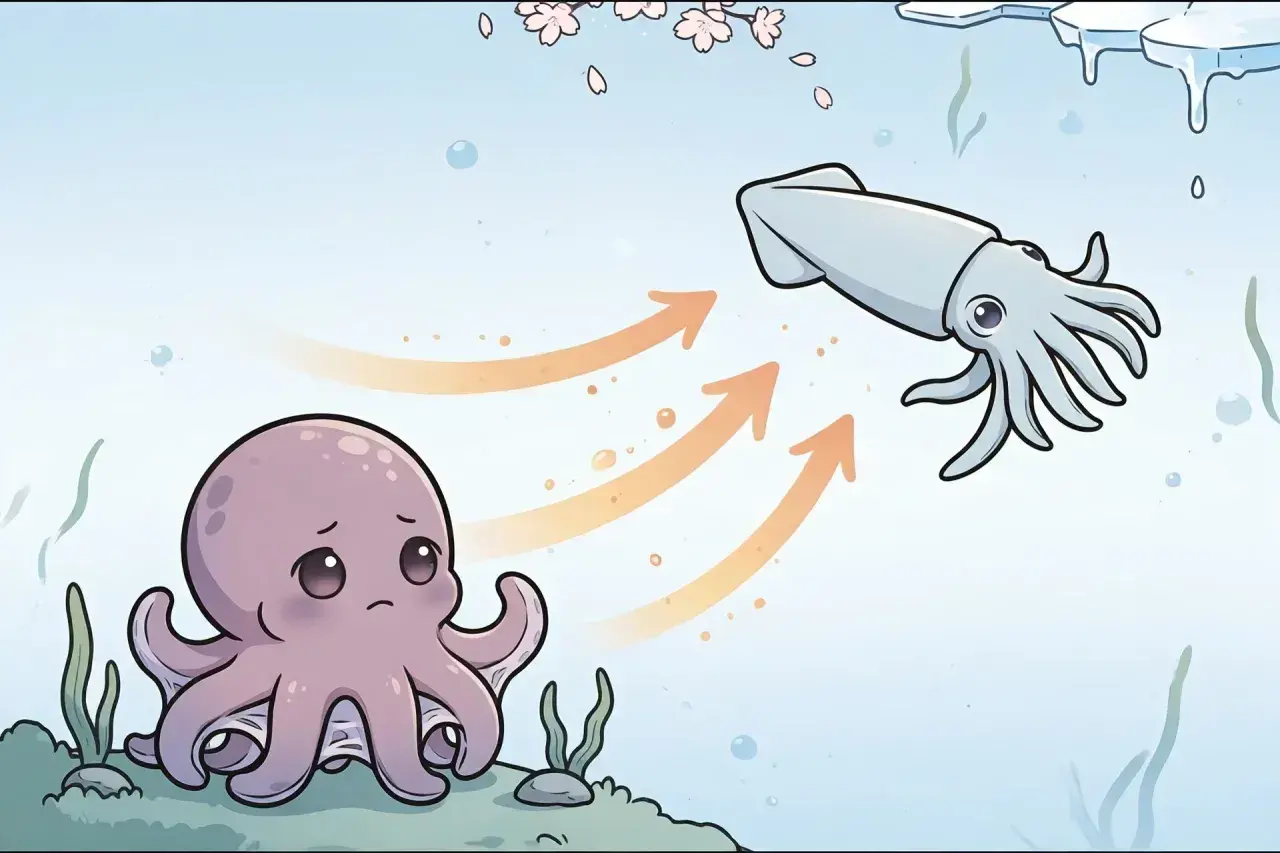
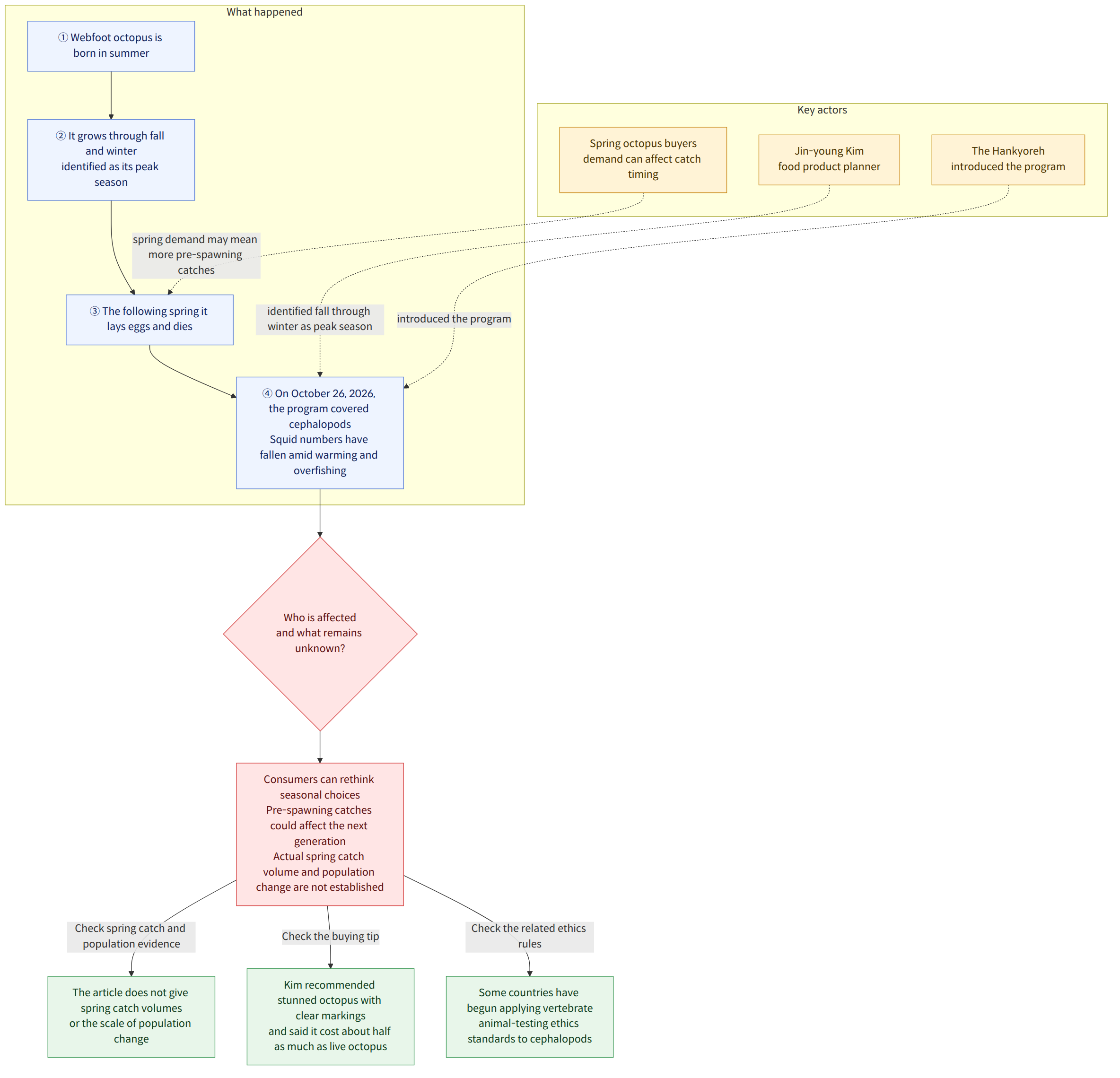
Webfoot octopus is commonly thought to be in season in spring, when it is full of roe. But one explanation says that, based on its life cycle, fall through winter is its peak season. Webfoot octopus is born in summer, lays eggs the following spring and dies; its lifespan is just over a year. Spring is, in effect, the final stage of its life. Squid populations have fallen sharply amid rising water temperatures in the East Sea and overfishing, and squid farming is difficult to commercialize because the ideal water temperature varies at each stage of growth.
The Hankyoreh (한겨레) introduced the YouTube program “Seasonal Obsession” (제철과몰입) on October 26, 2026. The program covered cephalopods including webfoot octopus, squid, octopus and long-arm octopus. In the program, food product planner Jin-young Kim identified fall through winter, when webfoot octopus grows and fills out, as its peak season. That period was described as “from the time you take out your coat until the time you take it off.”
Background and context
The reason to reconsider when webfoot octopus is in season is not just its flavor and texture. Demand for it in spring can lead to more being caught before they lay eggs. According to the article, if many webfoot octopuses are caught before spawning, the number born the following year could fall. This suggests a possible link between catching them before reproduction and the size of the next generation.
So “in season” can be a guide for consumers choosing when to eat something, as well as a way to consider when a species grows and reproduces. Rethinking the custom of treating only roe-filled spring webfoot octopus as in season prompts consideration of the relationship between spawning time and fishing. However, the article alone does not reveal the volume caught in spring or the scale of any actual population change.
The program also presented information about cephalopods’ bodies and behavior. Teacher Ju-hyeon Ahn explained that cephalopods’ limbs are technically “arms,” because they use them to grab food. Octopuses have nerve cells extending into their arms and three hearts, and their blood is bluish because they use copper to carry oxygen. The program also explained that inferring intelligence merely from the movement of an arm is a leap; the remaining nerve cells are responding to stimuli.
Experiments on octopus pain and memory were presented as examples that suggest cephalopods cannot be viewed simply as food. An octopus injected with dilute acetic acid wrapped another arm around the injection site and rubbed it, and became calm after receiving a pain-relieving substance. An experiment later found that even when it was not injected, the octopus chose the space where it had received the painkiller, suggesting the possibility of pain experience and spatial memory. The article said that, as research of this kind has accumulated, some countries have begun applying to cephalopods the animal-testing ethical standards used for vertebrates. It did not identify the researchers behind the experiment or when it was published.
The issue of squid highlights the connection between what is on our tables and the marine environment. According to the article, the ideal water temperature for squid differs at each stage, from hatching to maturity. As water temperatures in the East Sea have risen, it has become harder for young squid to survive, while overfishing has also contributed to a sharp decline in their numbers. The article also said that the recent large squid catches in the Yellow Sea are not unrelated to changes in ocean temperatures.
What this news means
For consumers, this is a reason to rethink when and how to choose webfoot octopus. In contrast with the custom of seeking out roe-filled webfoot octopus in spring, the explanation that fall and winter are when it grows and fills out makes it difficult to conclude that “spring alone is the season.” Since catching them before spawning could affect the next generation, choosing based on season may be a way to consider not only flavor but also the species’ life cycle.
When buying webfoot octopus, consumers do not have to assume that only live ones are fresh. Jin-young Kim recommended “stunned webfoot octopus,” whose markings remain distinct, instead of live octopus; its price was said to be about half that of live ones. The article also noted that freshness declines when the markings disappear and the body turns whitish. This is a buying tip presented in the article, however, and does not verify the condition of products at any particular seller.
For squid consumers, price changes are difficult to view only as a personal grocery-shopping issue. The article says climate change is behind the year-on-year rise in squid prices, and that rising water temperatures in the East Sea and overfishing have both contributed to declining squid populations. Squid farming is not a simple solution, either. The article says that water temperature must be carefully adjusted to suit each growth stage, making it difficult to achieve the efficiency needed for commercial production even if farming succeeds.
For example, consumers choosing webfoot octopus in fall and winter could look beyond the idea that only roe-filled spring products are in season, and consider the fact that this is when the octopus grows and fills out, along with its markings and price. The article does not say how much such choices might change population numbers. The point is noteworthy, however, because it shows that the timing of food consumption can be considered alongside a species’ growth and breeding cycle.
What is confirmed and what remains unknown
What is confirmed
- Webfoot octopus is born in summer, lays eggs the following spring and dies, with a lifespan of just over a year, according to the article.
- Jin-young Kim identified fall through winter, when webfoot octopus grows and fills out, as its peak season.
- The article said that if many webfoot octopuses are caught before spawning, the number born the following year could decline.
- The article reported that rising water temperatures in the East Sea and overfishing have made it harder for young squid to survive and have led to a sharp decline in their numbers.
- Teacher Ju-hyeon Ahn explained that differences in ideal water temperatures at each growth stage make it difficult to farm squid efficiently on a commercial scale.
What remains unknown
- Which researchers conducted the experiment on octopus pain and memory, and when did they publish it?
- What are the specific figures and survey period for recent squid populations and changes in water temperatures in the East Sea?
- To what extent does catching webfoot octopus before spawning affect the population the following year?
What readers can check
- When buying webfoot octopus, consumers can check not only whether it is alive but also whether its markings are distinct and whether its body has turned whitish. The “stunned webfoot octopus” mentioned in the article cost about half as much as live octopus.
- Rather than limiting webfoot octopus season to spring, consumers can consider the explanation that it grows and fills out from fall through winter, as well as its spawning cycle.
- When considering squid prices or changes in supply, it is important not to assume that price alone explains the cause, but to distinguish among rising water temperatures in the East Sea, overfishing and the temperature requirements at different growth stages. The article does not provide specific figures or a survey period for these factors.