


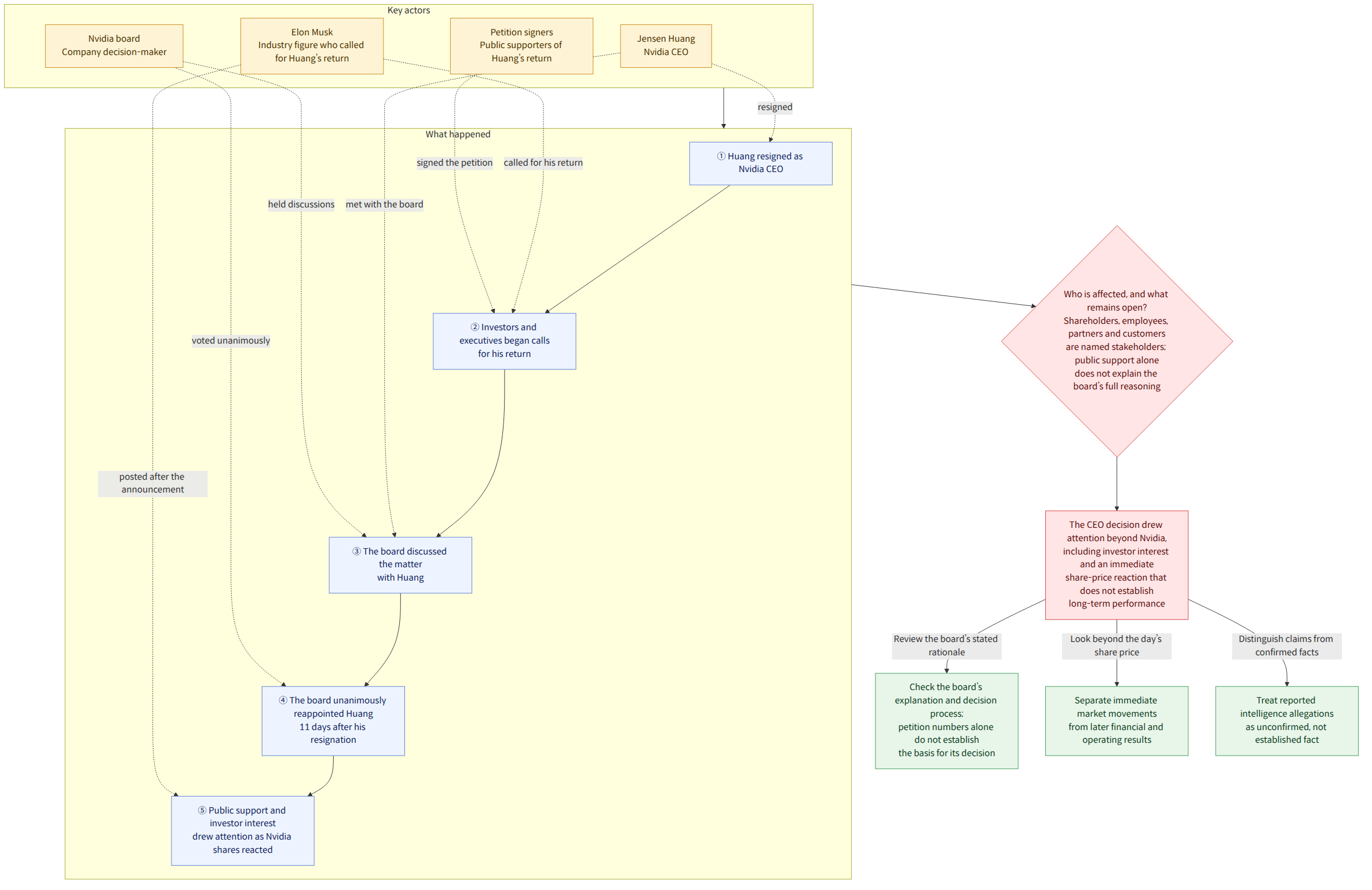
Jensen Huang returned as Nvidia chief executive officer (CEO) on the 23rd (local time), 11 days after resigning. Nvidia’s board decision was reported to have been unanimous. Elon Musk, the CEO of Tesla and SpaceX, who had called for Huang’s return, wrote on X immediately after the announcement: “That’s that” and “A mistake has been corrected.” More than 200,000 people signed an online petition, and a related post on Nvidia’s internal message board received more than 1,600 comments.
The decision shows that appointing a company’s CEO can become an event that attracts public support from industry figures and investor interest, rather than remaining an internal personnel matter. However, the scale of public support does not, by itself, explain all the reasons behind the board’s decision.
Background and context
Calls for Huang’s return quickly became a public issue after his resignation. One report said that investors and business executives began a campaign to bring him back after he resigned on November 12, and that the board reappointed him CEO 11 days after accepting his resignation. According to the same report, the board chair had told investors six days earlier that there were no plans to bring Huang back.
Another report said Huang resigned after acknowledging extramarital relationships, and that a woman involved in one of those relationships was suspected by the U.S. government of being a Chinese intelligence operative. The report also addressed controversy over national security issues as part of the context surrounding the return. These are claims and explanations contained in the reporting; they do not mean that actual intelligence activity has been confirmed.
Nvidia reportedly said that, after several discussions and meetings with Huang, the board was satisfied with his candor and ability to lead the company. Board Chair Harvey Jones reportedly said Huang was the right person to lead the company and that his return was in the interests of shareholders, employees, partners, and customers. The company also expressed gratitude for the role Chief Financial Officer Colette Kress played while serving as interim CEO.
Support from the industry took several forms. Musk signed the petition calling for Huang’s return and had earlier argued that Nvidia could lose major deals Huang had secured with a “handshake.” Brad Gerstner, founder of Altimeter Capital, wrote that the board vote was unanimous and said he had directly urged the board to bring Huang back. OpenAI CEO Sam Altman also posted “Jensen!” on X.
Online responses and voices within the company also drew attention. More than 200,000 people signed the petition for Huang’s return. A post on Nvidia’s internal message board asking the board to consider employees’ views received more than 1,600 comments, and the U.S. technology news outlet Wired reported that most of the comments it reviewed supported Huang’s return. This indicates the scale of the publicly visible response, but it cannot be assumed to represent the views of all employees or investors.
What this news means
First, a CEO change can prompt widespread interest in a company’s direction and credibility. Dan Ives, an analyst at Yorkville Ives, initially considered Huang’s return unlikely, but told CBS News that the board “had no choice but to bring him back.” He explained that the issue surrounding the resignation was spreading beyond Nvidia and becoming one that affected the economy and global financial markets. This is the analyst’s interpretation, not the same as the reasons the board publicly gave for its decision.
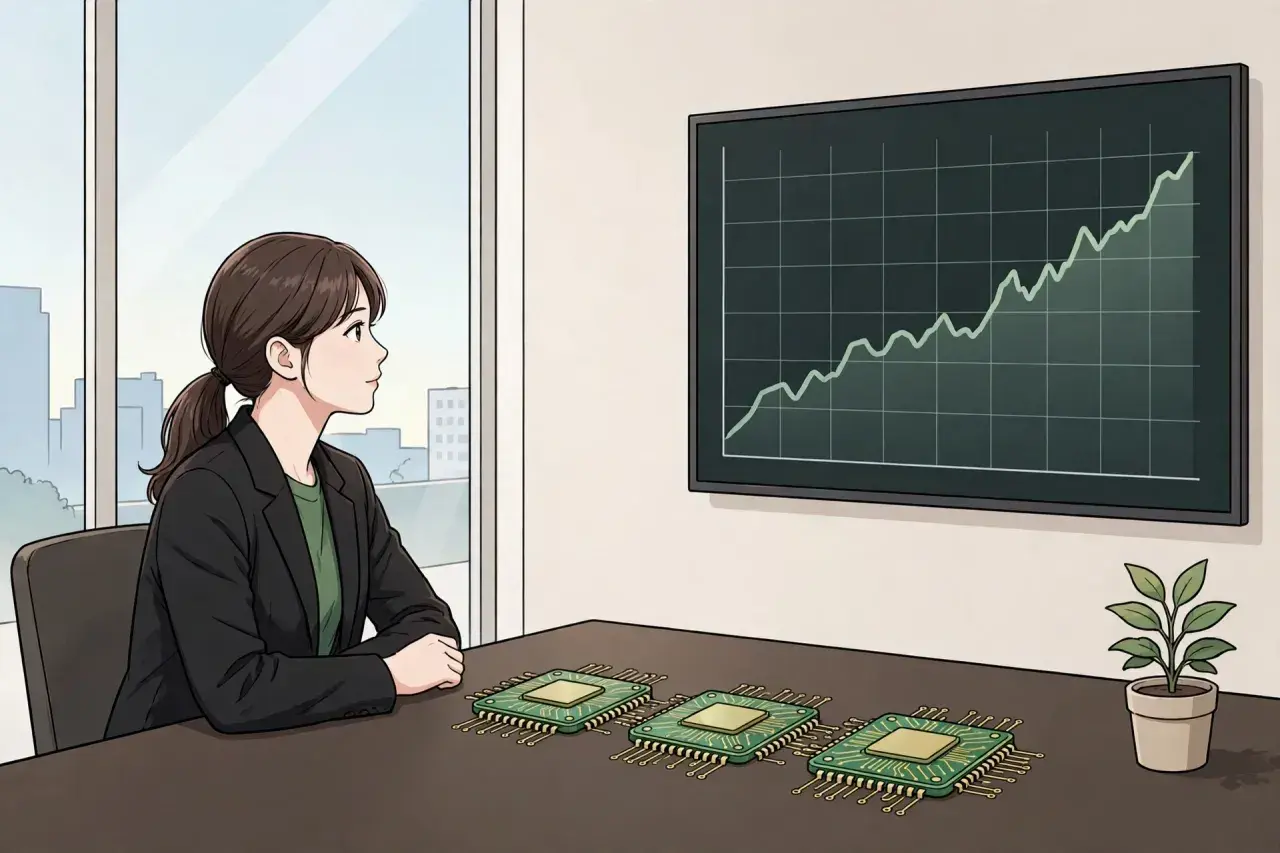
Second, share-price movements can offer clues about how the market received the news, but they do not guarantee long-term corporate performance. One report said Nvidia shares had already risen sharply in premarket trading and were up 30% early in the session. According to the same report, at 9:51 a.m. Eastern Time, shares were up 27% at $159.95 each. The immediate price reaction should be distinguished from the company’s subsequent financial and operational results.
Third, the petition and statements by industry figures show the public pressure on the board, but they do not, in themselves, establish what process or evidence the board used to reach its decision. For example, if an investor is following a petition and share-price movements, it is important to consider the board’s explanation and subsequent business results rather than drawing conclusions about the merits of the CEO’s return or the company’s future performance from the number of petition signers and the day’s share price alone.
Points reported differently by different outlets
Reports emphasized different aspects of the return. One focused mainly on the welcome from Musk and industry figures, petition signatories, and responses on Nvidia’s internal message board. Another highlighted founder-led management (창업자 중심 경영)—the view that a founder should continue to lead the company directly—and the background to the campaign for Huang’s return. Yet another covered Huang’s acknowledgment of extramarital relationships, the national security controversy, discussions with government officials, and share-price movements.
Share-price figures also differed depending on the time reported. The 30% rise early in the session and the 27% rise at 9:51 a.m. Eastern Time were reported at different times. They should therefore be treated as figures from separate trading periods, rather than combined as a single price movement.
What is confirmed and what remains unknown
Confirmed facts
- Huang returned as Nvidia CEO on the 23rd (local time), 11 days after resigning.
- More than 200,000 people signed an online petition calling for his return.
- A related post on Nvidia’s internal message board received more than 1,600 comments, and Wired reported that most of the comments it reviewed supported his return.
- Gerstner said the board vote was unanimous. According to information shared by the company, the board held several discussions with Huang and was satisfied with his candor and leadership ability.
What remains unknown
- What were the specific reasons Huang resigned, and what were the circumstances at the time?
- What process did the board actually follow before deciding on his return, and what specific evidence did it rely on?
- To what extent did support from industry figures and the petition influence the board’s decision?
- Current reporting does not establish how the company will perform or how its share price will move after Huang’s return.
What readers should check
- When looking at share prices, distinguish among trading periods such as immediately after the announcement, premarket trading, and intraday trading. Do not equate short-term reactions with long-term performance.
- Petition signatures and comments on the internal message board are evidence of the scale of publicly visible support. It is important not to treat them as representing the views of all employees, shareholders, or investors.
- Review the board’s public explanation and subsequent business-related announcements. Current reporting does not disclose all the details of the process or the grounds for the decision to bring Huang back.
References
- Other coverage consulted: koreatimes.co.kr
- Other coverage consulted: techcrunch.com