



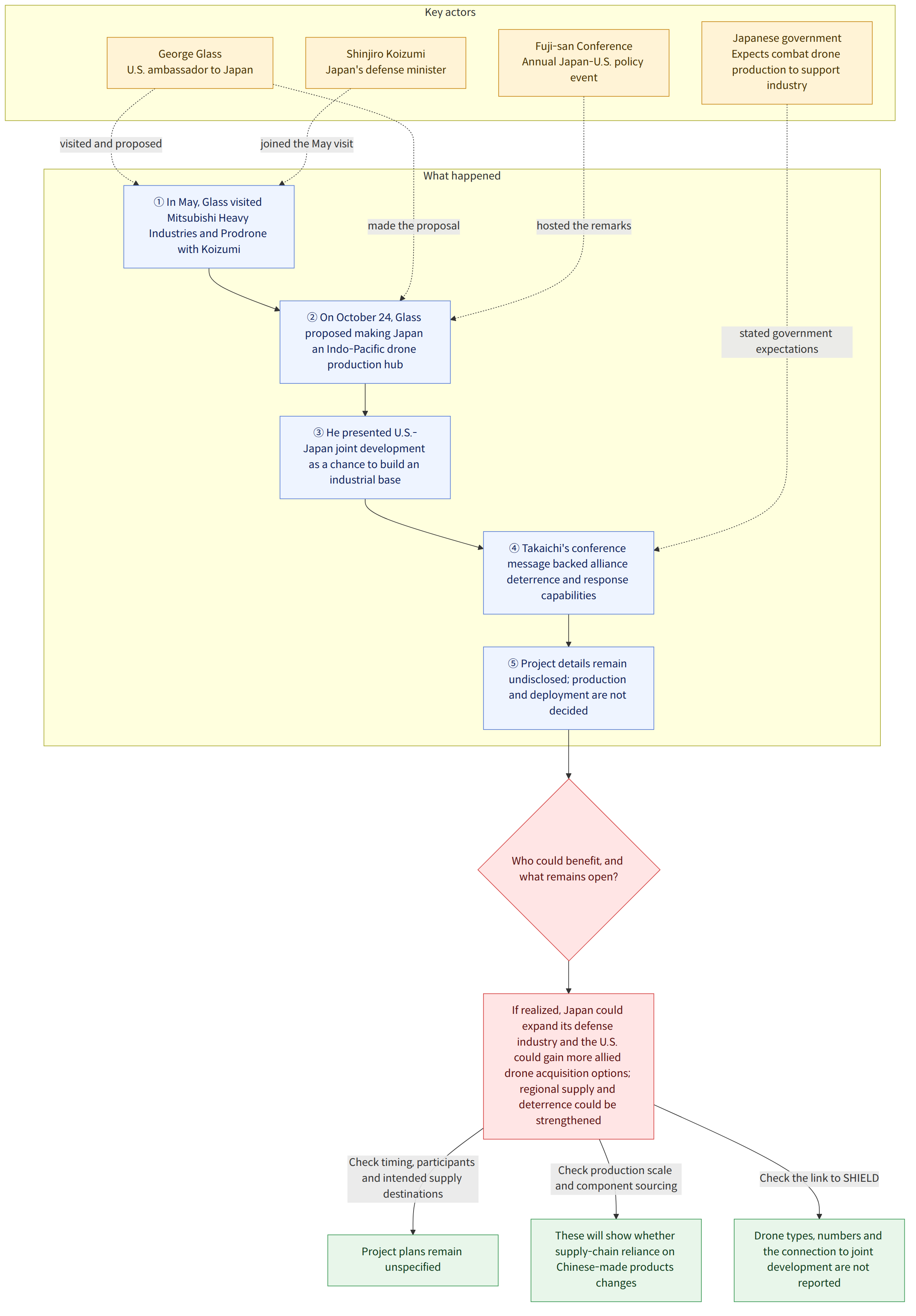
At the Fuji-san Conference in Tokyo on October 24, U.S. Ambassador to Japan George Glass said Japan should become an Indo-Pacific drone production hub. He described U.S.-Japan joint development as an opportunity to build an industrial base and production hub. However, no specifics were provided on when production would begin, which companies and organizations would be responsible, or where the products would be supplied.
The proposal addresses both the military acquisition of drones and the strengthening of Japan’s manufacturing base. Referring to developments in Russia, China, and North Korea, Ambassador Glass said the provocative actions of hostile forces were becoming more overt. The idea of making Japan a production hub can therefore be seen as an effort to secure a stable supply of defense equipment for the region and strengthen deterrence, but it does not mean that actual production or deployment has been decided.
Background and context
The Fuji-san Conference is an annual event co-hosted by the Japan Center for Economic Research and the Japan Institute of International Affairs. Experts in Japanese and U.S. politics, diplomacy, and security discuss bilateral cooperation and international affairs. Ambassador Glass’s remarks at the conference presented U.S.-Japan cooperation as extending beyond security to the development of a production base.
In May, Ambassador Glass visited a Mitsubishi Heavy Industries plant in Aichi Prefecture and the drone manufacturer Prodrone with Japanese Defense Minister Shinjiro Koizumi. However, there is no basis for concluding from the visit and this proposal alone that either company has agreed to participate in joint development or production.
The Japanese government expects production of combat drones to contribute to the expansion of its defense industry. In a video message to the conference, Prime Minister Sanae Takaichi also described the U.S.-Japan alliance as a cornerstone of Japan’s foreign and security policy and said she would strengthen the alliance’s deterrence and response capabilities. This shows that the drone production concept aligns with the Japanese government’s interest in the defense industry and its policy of strengthening the alliance, but the prime minister’s message did not finalize the details of a production project.
Market forecasts were cited to explain the economic context for the proposal. According to reports, the global drone market is projected to grow to $83 billion by 2035, while Japan’s domestic market is expected to exceed 1 trillion yen by 2030. These are forecasts, not confirmed sales or production volumes. It has also been pointed out that a substantial share of the Japanese market still relies on Chinese-made products, leaving a gap between the concept of establishing a production hub and actually changing supply chains.
What this news means
If the United States and Japan move toward joint development and production, Japan could expand its defense industrial base, while the United States could have more options for acquiring drones alongside an ally. The proposal is drawing attention because, if it becomes reality, producing equipment in an allied country for use in a regional crisis could affect both supply capacity and deterrence. This is a possible outcome if the proposal leads to an actual project, not a confirmed production plan at this point.
Japan’s Ministry of Defense is pursuing SHIELD, a “large-scale, multilayered coastal defense system” using unmanned equipment. “Multilayered” can be understood to mean operating several types of equipment and defensive measures in overlapping layers. A drone production base could potentially tie in with this concept, but the reported information does not indicate how many drones of what types would be deployed under SHIELD or how it would relate to joint development.
For example, if drone production expands in Japan, it could create production opportunities for the country’s defense industry and prompt interest in whether reliance on Chinese-made products can be reduced. However, increased production would not necessarily eliminate that reliance immediately or mean that Japanese-made equipment would be supplied to other countries. The effects can be assessed only once production volumes, component sourcing, and intended recipients are known.
What is confirmed and what remains unknown
Confirmed facts
- On October 24, Ambassador Glass proposed making Japan an Indo-Pacific drone production hub at the Fuji-san Conference.
- He said U.S.-Japan joint development would be an opportunity to build an industrial base and production hub.
- The Japanese government expects production of combat drones to contribute to the expansion of its defense industry.
- Japan’s Ministry of Defense is pursuing the SHIELD concept using unmanned equipment, and reports have said that a substantial share of Japan’s drone market relies on Chinese-made products.
- The figures for the global and Japanese domestic drone markets are projections for 2035 and 2030, respectively.
What remains unknown
- Have specific timelines and methods been set for U.S.-Japan joint development and establishing a production hub in Japan?
- How much will it cost, and which companies and organizations will participate?
- Which countries or regions are Japanese-made drones actually intended to be supplied to?
- How will joint development be connected to the SHIELD concept?
What readers should watch for
- Follow-up announcements should be checked for details on the timeline, production locations, and participating companies and organizations.
- Whether production costs and procurement and supply destinations are disclosed will help distinguish market forecasts from the scale of an actual project.
- How expanded drone production in Japan affects reliance on Chinese-made products and the SHIELD concept should be assessed only after separate plans and results are made public.