


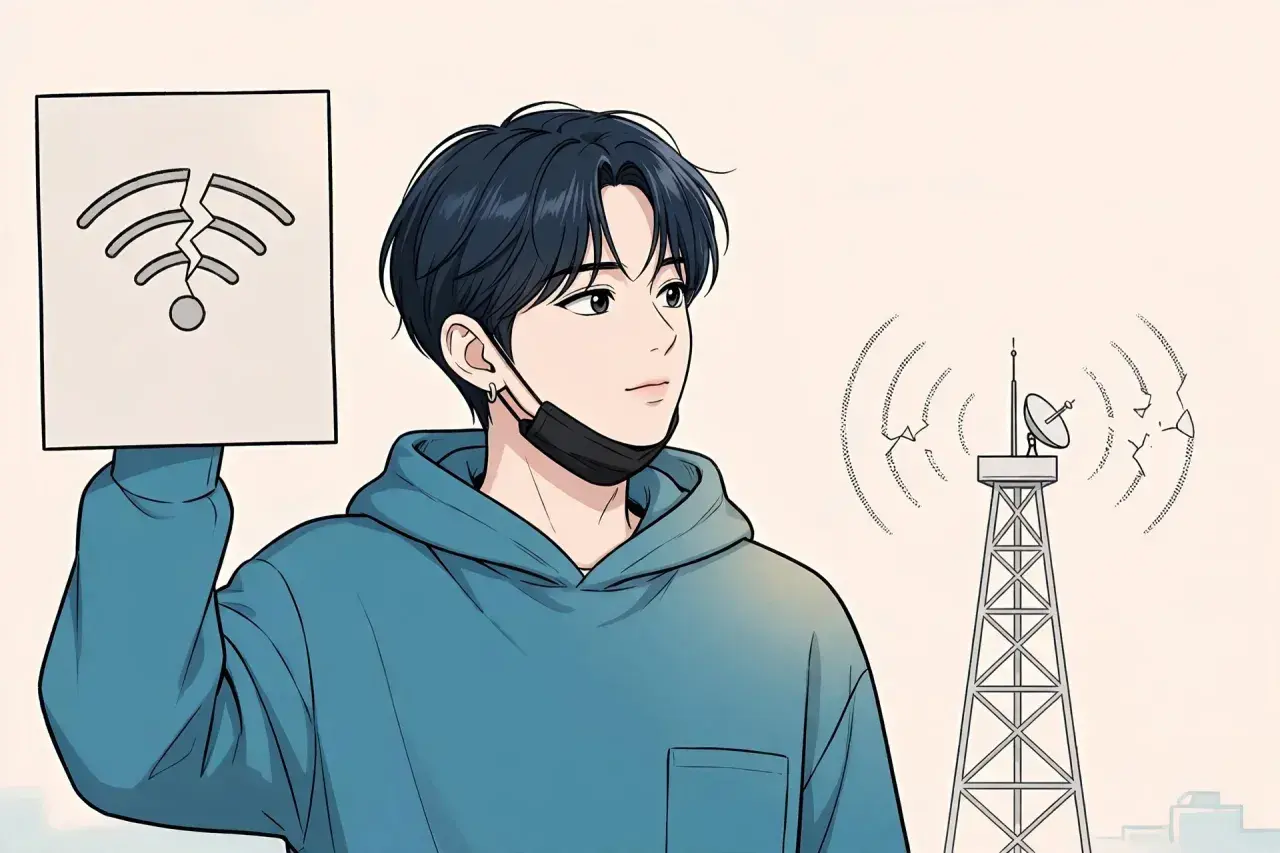
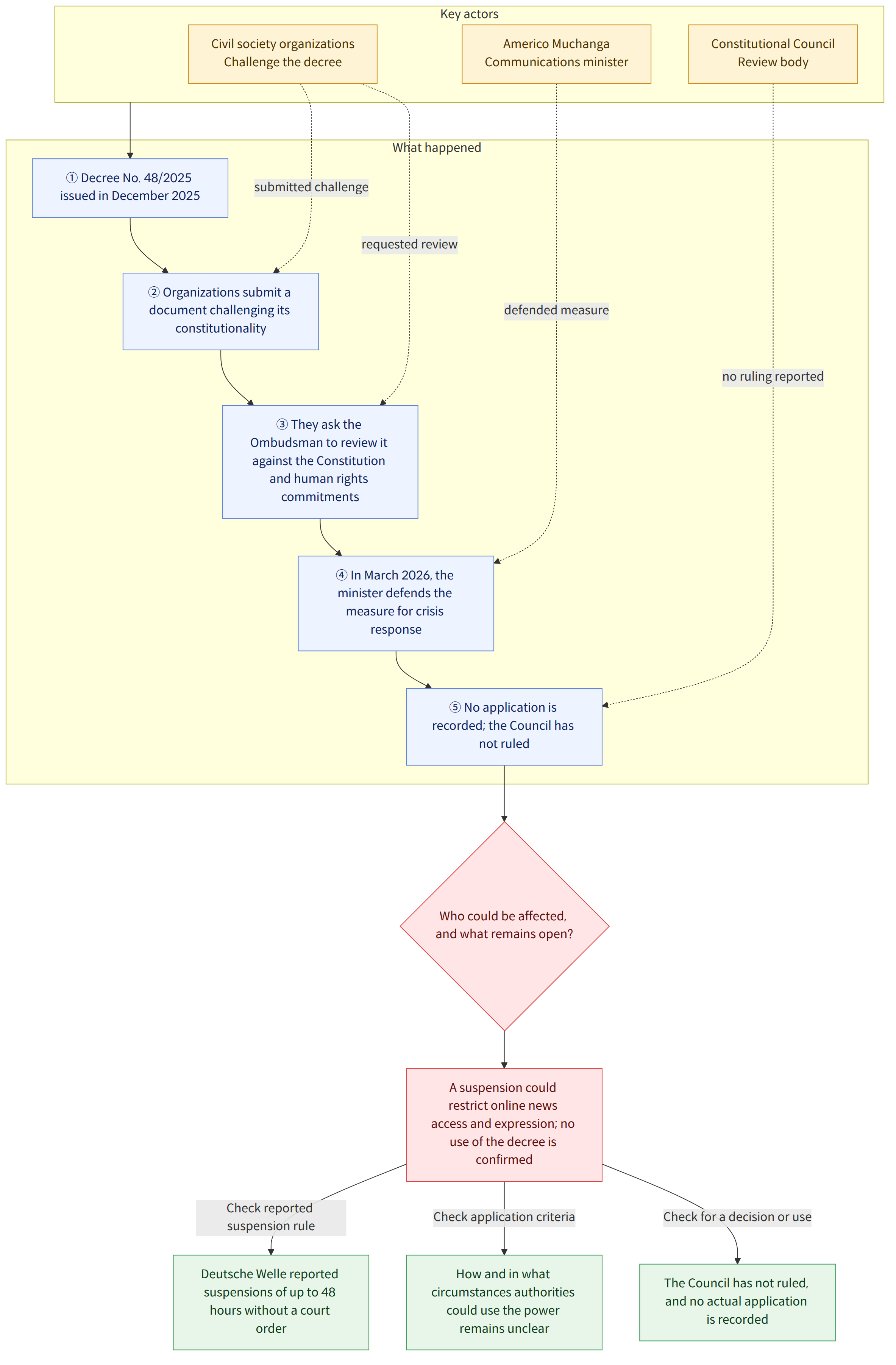
Mozambican civil society organizations have submitted a document to the Ombudsman (옴부즈맨), challenging the constitutionality of Decree No. 48/2025 (제48/2025호 법령), issued in December 2025. The decree establishes mechanisms for controlling and blocking access to communications networks. According to Deutsche Welle, the approved decree allows communications services to be suspended for up to 48 hours without a court order.
The organizations have asked for a review of whether the decree complies with the Constitution of Mozambique (모잠비크 헌법) and international commitments on human rights and freedom of expression. However, no cases of the decree’s actual application have been recorded, and the Constitutional Council (헌법위원회) has not ruled on the claim that it is unconstitutional.
Background and context
The debate over the decree is taking place in an environment where communications networks serve not only as technical infrastructure but also as tools for disseminating information and mobilizing society. According to the article, journalists and experts are concerned that the measure could affect freedom of expression, access to information and communication in situations involving social mobilization or political tensions. Civil society organizations say the authorities have broad powers to intervene in communications networks on grounds of national security or public order.
Americo Muchanga, the Minister of Communications and Digital Transformation (통신·디지털전환부 장관), denied in March 2026 that the measure restricts rights. He defended it as a way to protect society in crisis situations and safeguard critical communications infrastructure. The debate therefore centers on the government’s stated aim of responding to crises and concerns about how far the authorities could exercise that power in practice.
Past protests in which communications tools were used for mobilization also provide context for the debate. According to the article, large-scale protests in Maputo and Matola in 2008 and 2010 were sparked by rising living costs, particularly increases in transport fares and the prices of essential goods. At the time, mobile phones and text messages were widely used to mobilize and coordinate protest participants. These cases alone cannot establish the purpose of the new decree or how it will be applied in the future, but they show why communications restrictions can be a sensitive issue during protests.
What this means
If communications services are actually suspended, those affected would not be limited to protest participants. Media outlets that deliver news online and the readers who rely on that information could also be affected. Activist and journalist Nádio Taimo said that many media outlets had moved to digital platforms because of the cost of print, and that internet shutdowns could restrict access to information and the space for expression.
Taimo argued that internet shutdowns had already been carried out without a legal framework and that the new decree formalizes this practice. This is his claim; the article says that no cases of the decree’s actual application have been recorded. Meanwhile, a researcher who asked to remain anonymous said the issue was not the mechanism for restricting communications itself, but how the decree would be applied to social protests. Both perspectives underscore the importance of actual application criteria and circumstances in assessing the decree’s effects.
For example, if communications services were suspended during a protest or a period of political tension, people who get their news through online media could find it harder to access relevant information. This describes a possible impact; it does not mean that the decree has already been applied in such a situation.
What is confirmed and what remains unknown
Confirmed facts
- Civil society organizations submitted a document to the Ombudsman, challenging the constitutionality of Decree No. 48/2025, issued in December 2025.
- The decree establishes mechanisms to control and block access to communications networks; Deutsche Welle reported that it allows communications services to be suspended for up to 48 hours without a court order.
- The organizations have asked for a review of whether the decree complies with the Constitution and international commitments on human rights and freedom of expression.
- In March 2026, the minister denied criticism that the measure restricts rights and defended it as a way to protect society and critical communications infrastructure during crises.
- According to the article, no cases of the decree’s actual application have been recorded, and the Constitutional Council has not yet ruled on the claim that it is unconstitutional.
What remains unknown
- In what circumstances and according to what specific criteria will the decree be applied?
- What procedures and safeguards for rights must be in place before a decision to suspend communications is made?
- When will the Constitutional Council rule on the civil society organizations’ claim that the decree is unconstitutional?
What readers should watch for
- It is worth watching to see whether the criteria for applying the decree and the procedures for deciding on communications suspensions are made public or clarified.
- Checking the status of the Ombudsman’s review and the Constitutional Council’s ruling can help show how the current legal uncertainty is changing.
- Rather than drawing conclusions on the assumption that communications restrictions have occurred, readers should distinguish between whether any cases of application have been confirmed and what effects they had on access to information.