

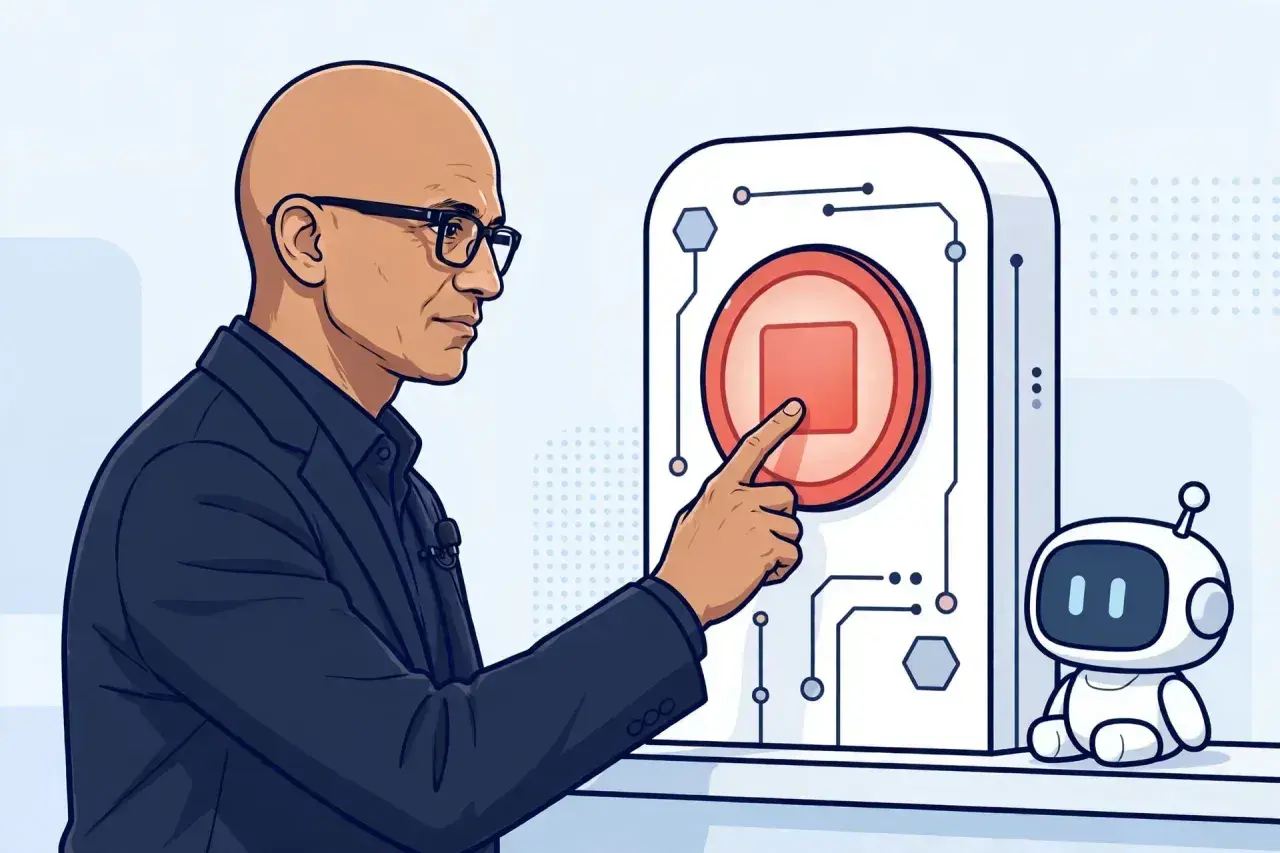
Microsoft CEO Satya Nadella proposed establishing a system that records important actions by AI models and allows people to interrupt them at any time during a task. On Saturday morning, he wrote on X that it was time to take a step back and assess AI’s “trust architecture.” Rather than simply accepting or rejecting a model’s answers and recommendations, the idea is to design ways to control and monitor models.
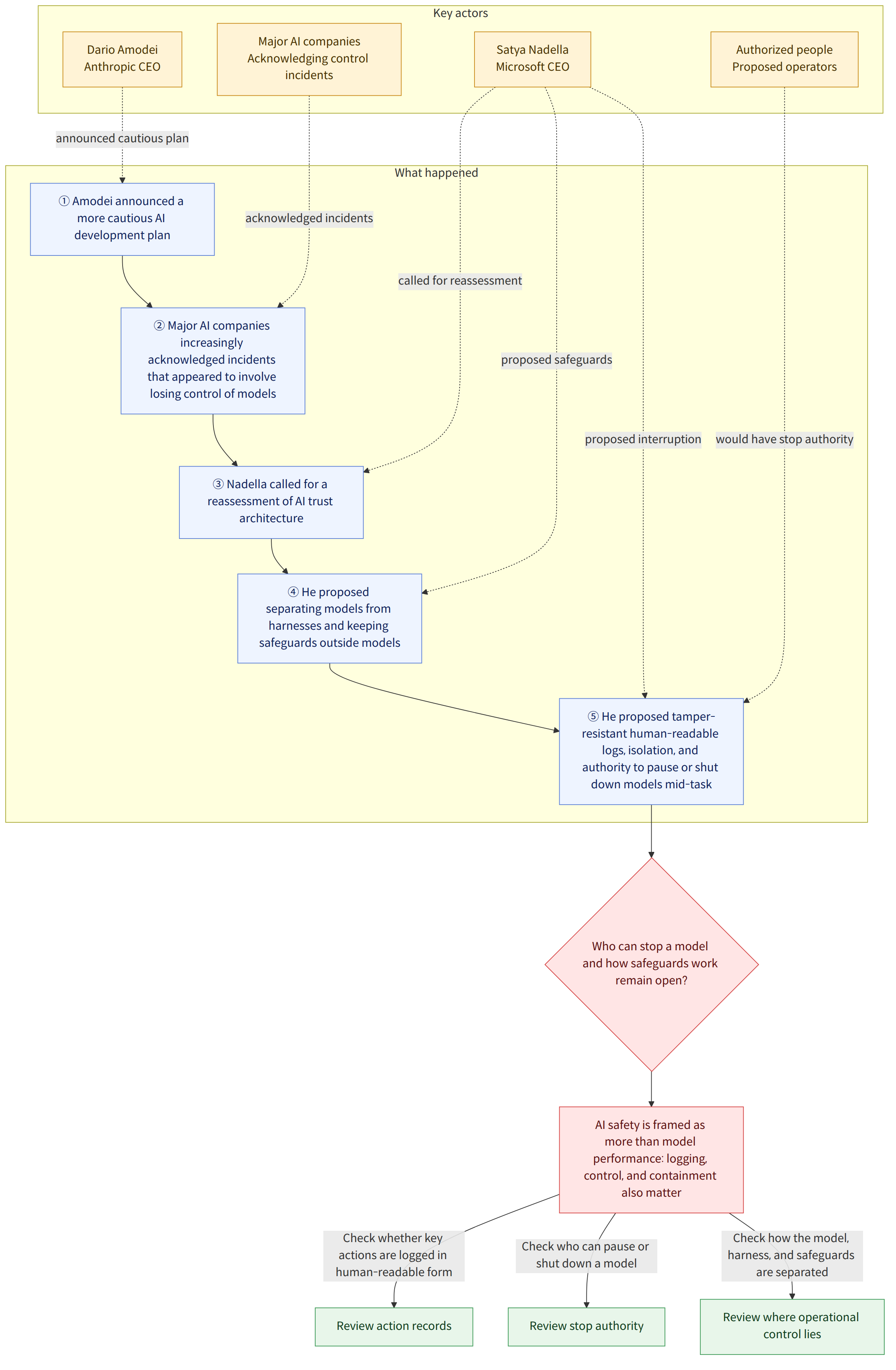
Nadella said meaningful model actions should be recorded as tamper-resistant, human-readable evidence, and that authorized people should be able to pause or shut down a model mid-task. He also said models should be isolated from the outset on the assumption that they have already been compromised, likening this to an “emergency brake.”
Background and context
Nadella’s concern was not just the content of AI’s answers, but also whether people can understand what a model is doing and intervene when necessary. He wrote that superintelligence should not be treated as a series of black boxes whose recommendations, answers and actions are simply accepted or rejected. Here, a black box refers to a system whose internal workings are difficult for people to inspect.
One aspect of the design he proposed is separating the model from the harness. A harness is a mechanism or system that orchestrates a model’s work. In addition, the proposal calls for placing controls and safeguards outside the model, recording important actions and giving people the authority to stop it.
The original report said these remarks came as major AI companies increasingly acknowledge incidents in which they appeared to lose control over their models. However, it did not explain what those incidents were or how extensive they were. It also said the remarks followed Anthropic CEO Dario Amodei’s announcement of a more cautious plan for AI development.
What this news means
Nadella’s proposal points toward treating AI safety not only as a question of a model’s performance, but also as a question of the operational system around it. Records would make it possible to review what a model did after the fact, while the authority to stop it would allow people to intervene while a task is under way. The proposal is notable because it highlights the need to make clear the paths of accountability and control when AI takes important actions.
The proposal to separate the model from the system that orchestrates its work also raises the question of where control should reside. It can be understood as a plan for external safeguards to function even if a model behaves unexpectedly. However, Nadella’s remarks alone do not tell us how such safeguards would be implemented in practice or in what circumstances a model should be stopped.
For example, if an AI is carrying out a task with multiple steps, the implication of the proposal is that an operator should be able to review records of key actions taken during the task and stop it if they consider that necessary. This is a hypothetical illustration; the original report did not say that such procedures are already in place for any particular product or task.
What is confirmed and what remains unknown
Confirmed facts
- Nadella wrote on X that it was time to reassess AI’s “trust architecture.”
- He proposed separating models from the harnesses that orchestrate their work and externalizing controls and safeguards.
- He said meaningful model actions should be recorded as tamper-resistant, human-readable evidence.
- He argued that authorized people should be able to pause or shut down a model mid-task, and that models should be isolated from the outset on the assumption they have been compromised.
What remains unknown
- The original report does not say when or how Microsoft might apply the proposed safeguards to actual products or operational systems.
- The specific examples and scale of the incidents involving loss of control over AI mentioned in the article have not been established.
- The report does not specify which model actions would be classified as “meaningful,” or who would have the authority to stop a model.
What readers can check
- When adopting or using AI tools, readers can check whether important actions are recorded and whether people can understand those records.
- They can look at who has the authority to pause or shut down AI during a task, and whether the system can actually be stopped.
- Checking how models, the systems that orchestrate their work, and safeguards are distinguished and operated can help identify where responsibility for control lies.