



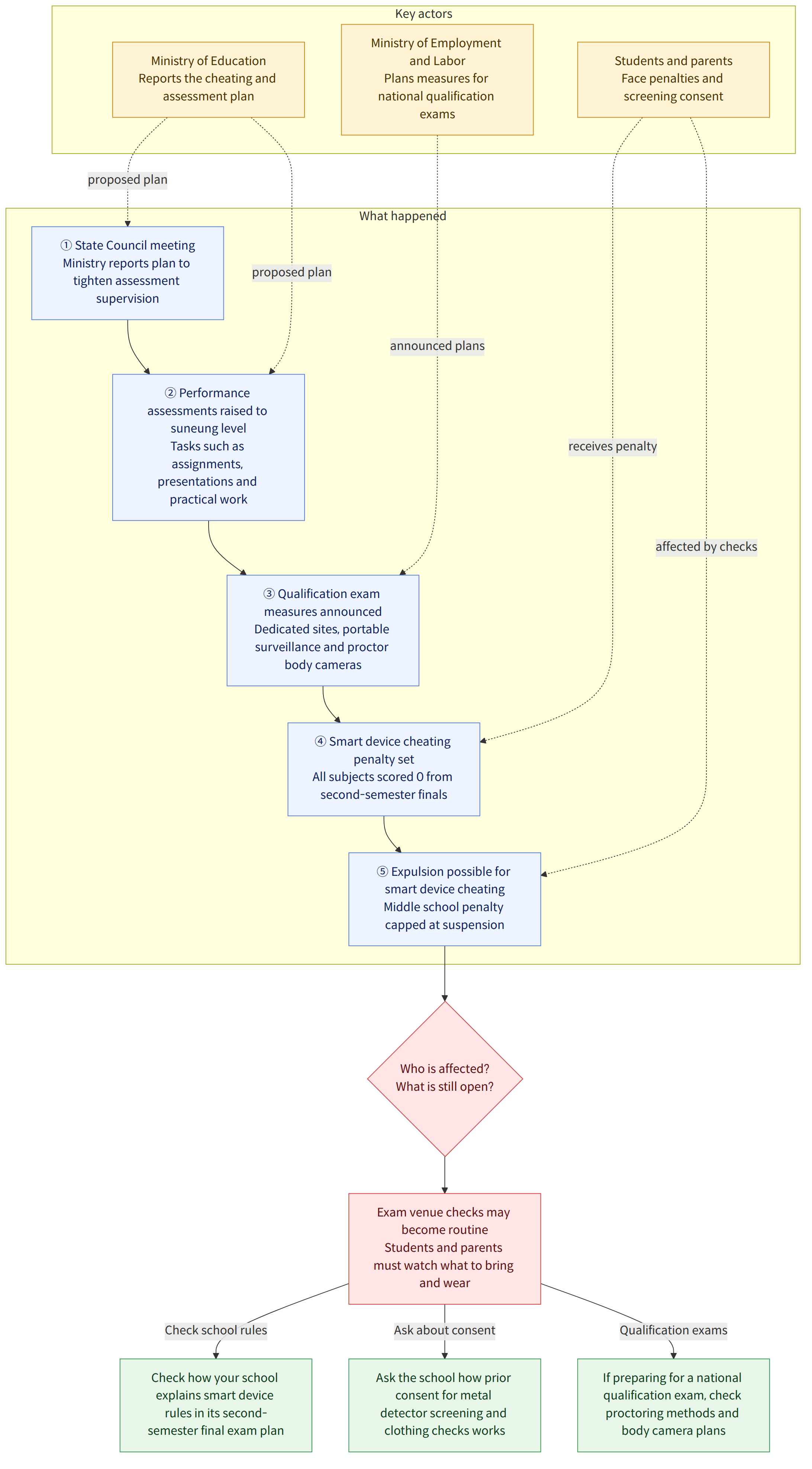
Starting with the final exams of the second semester this year, students caught using smart devices to cheat in regular middle and high school exams will have all subjects for that day's exam scored at 0 points and may face penalties up to and including expulsion. The way students take exams and the way schools assess them are both set to change.
Background and Context
This measure is part of the government's broader effort to more firmly prevent cheating in exams. At a State Council meeting, the Ministry of Education reported a plan to strengthen the management and supervision of school performance assessments (assessments conducted by schools through tasks such as assignments, presentations, and practical work) to the level of the College Scholastic Ability Test (suneung, Daehak Suhak Neungnyeok Siheom), the national university entrance exam.
However, because middle school is compulsory education, the most severe penalty that can be imposed on middle school students is suspension, not expulsion. It is important to understand that the upper limit of penalties differs by school level, even for the same act of cheating.
Responses are also moving forward in national qualification exams. The Ministry of Employment and Labor and the Korea Human Resources Development Service of Korea (Hanguk Sanup Inryeok Gongdan) announced plans to add dedicated test sites, introduce portable surveillance systems, and equip proctors at leased test sites with body cameras (small wearable cameras).
What This News Means
The plan includes a requirement for all test-takers to pass through metal detectors, on the condition that students and parents give prior consent. It also includes inspecting glasses and clothing in every exam session and attaching stickers to the buttons of students' clothing.
This means that checks at exam venues could become a routine procedure. For students and parents, more attention may need to be paid than before to what to bring, what to wear, and the entry procedures on the day of the exam.
The following is an example of general precautions a household might consider.
Related Systems and Support Information
No internal materials were provided, so this section does not cover specifics. Detailed implementation guidelines and disciplinary procedures for each school were not confirmed in the source, so they should be checked through school notices.
Where Reports Differ
Only one source was confirmed, so no differences between reports could be identified.
Confirmed Facts and Unknowns
Confirmed facts
- Starting with the final exams of the second semester this year, students caught cheating with smart devices in regular middle and high school exams will have all subjects for that day's exam scored at zero and may face expulsion as a penalty.
- Because middle school is compulsory education, the highest penalty is suspension.
- The Ministry of Education reported to the State Council a plan to strengthen the management and supervision of performance assessments to the level of the suneung.
- The plan includes metal detector screening conditioned on prior consent from students and parents, inspection of glasses and clothing in every exam session, and attaching stickers to clothing buttons.
- The Ministry of Employment and Labor and the Korea Human Resources Development Service of Korea announced plans to prevent cheating in national qualification exams.
Unknowns
- How teachers will detect and prove possession or use of smart devices.
- How the process will work if a student refuses metal detector screening.
- How many past exams have been investigated for cheating, and on what scale.
What Readers Should Check
- Check how the school your child attends explains smart device rules in its second-semester final exam plan.
- Ask the school what procedure it will use to obtain prior consent for metal detector screening and clothing checks.
- If preparing for a national qualification exam, check the proctoring methods and whether body cameras will be introduced in the announcements of the administering agency.