



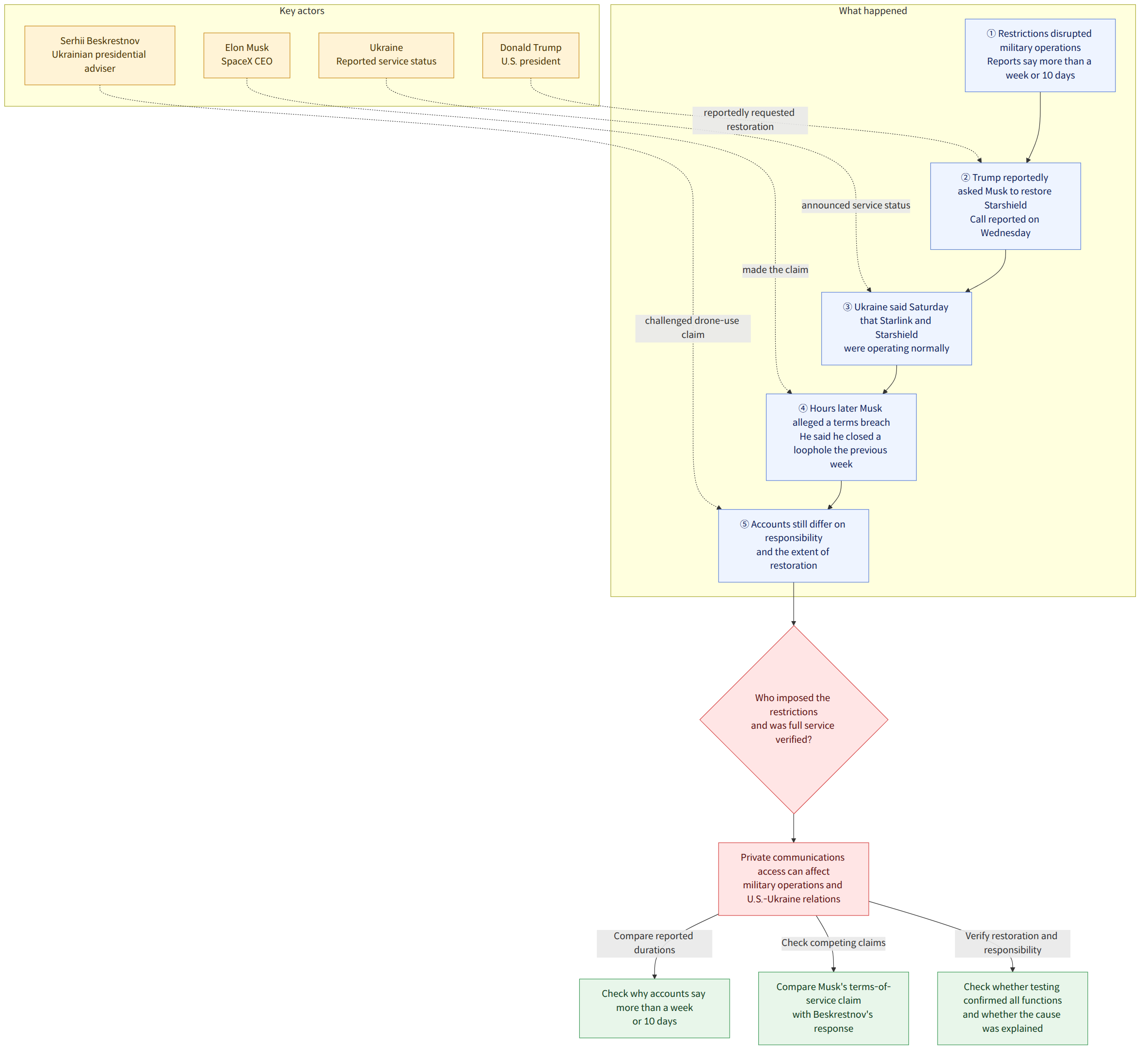
Ukraine said Saturday that Starlink and Starshield, a military satellite system, were both operating normally after restrictions lasting more than a week disrupted military operations. But hours later, SpaceX CEO Elon Musk claimed that Ukraine’s military had violated the company’s terms of service. How the restrictions were imposed and who made the decision remain unclear.
Background and context
Starlink is SpaceX’s satellite internet system, while Starshield is a military system that uses Starlink technology. Restrictions on these services, which are used in Ukrainian military operations, are drawing attention because they could affect not only communications but also military operations and U.S.-Ukraine relations.
Musk wrote on X that Ukraine’s military had used Starlink for attack drone strikes intended to kill people, and that he had closed that loophole last week. By contrast, Ukrainian presidential adviser Serhii Beskrestnov said on Telegram that Ukraine could not physically use Starlink for long- and medium-range attack drone operations. The two claims differ, but the reports available do not provide enough evidence to determine which is correct.
Accounts of who was responsible for the restrictions also conflict. One report said neither Musk nor the U.S. government, which operates Starshield, had accepted responsibility for the restrictions. Another reported that Musk had directed SpaceX to restrict Ukraine’s access to Starlink, and said some sources claimed he had discussed the matter with the Trump administration beforehand. Reports therefore differ on who imposed the measures.
The duration of the restrictions also varies by report: one said they lasted “more than a week,” while another put the period at 10 days. The latter report said drones lost their internet connection while flying at about 100 miles per hour, causing the military to lose control of some drones or forcing others to fly more slowly and become vulnerable. However, the reports do not specifically establish how the restrictions were applied or how they affected individual operations.
What this news means
The episode shows how decisions about access to communications technology provided by a private company can affect operations on the ground when that technology is used for military purposes. Ukraine’s announcement that service was operating normally suggests it had been restored, but another report said the military was still testing it and had not received an explanation for the restrictions. It is therefore difficult to conclude that “normalization” means all functions have been verified and the cause has been established.
Tensions between the United States and Ukraine are also worth watching. The Starshield issue arose after U.S. President Donald Trump announced an agreement to purchase Russian diesel and pressed Kyiv to stop attacking Russian oil refineries. The timing alone does not establish a direct connection between the two matters, but the fact that restrictions on military communications services occurred amid heightened tensions between the two countries could magnify the political fallout.
For example, if the Ukrainian military relies on satellite internet connections for drone operations, restrictions on access or the restoration of service could affect drone control and use. This is a hypothetical explanation of possible effects; it has not been established whether the restrictions actually changed the outcome of any operation.
Points that differ across reports
- One report said the restrictions lasted “more than a week,” while another said “10 days.”
- Ukraine said both Starlink and Starshield were operating normally, but another report said Starshield appeared to be operating normally while the military continued testing it.
- One report said Musk and the U.S. government had not accepted responsibility for the restrictions. Another reported that Musk had directed SpaceX to restrict Ukraine’s access, and said some sources claimed he had discussed the matter with the administration beforehand.
- Another report said President Trump called Musk on Wednesday and asked him to restore Starshield service. This should be distinguished from evidence confirming who was responsible for the restrictions.
What is confirmed and what remains unknown
Confirmed facts
- Ukraine said Saturday that Starlink and Starshield were operating normally.
- Musk claimed that Ukraine’s military had violated Starlink’s terms of service and used it for attack drone strikes.
- Beskrestnov said Ukraine could not physically use Starlink for long- and medium-range attack drone operations.
- The General Staff of the Armed Forces of Ukraine and the Ministry of Defense did not immediately comment by the time the reports were written.
What remains unknown
- Who imposed the restrictions, when they did so, and how they were implemented.
- What specific terms of service Ukraine’s military allegedly violated and what evidence supports the claim.
- The extent of the restrictions’ impact on military operations and whether the problems were fully resolved after service was restored.
- How Ukraine’s statement that service was operating normally can be reconciled with reports that the military was still testing it.
What readers should watch for
- Follow-up announcements should be assessed by distinguishing Ukraine’s statement that service was restored from reports about the military’s ongoing tests.
- Musk’s claim of a terms-of-service violation should be treated as a claim, and reports about an order to restrict access should be treated as reports; readers should check whether specific evidence or an official explanation emerges.
- Until responsibility for the restrictions and the scale of any damage to military operations are confirmed, it is important not to present them as the decision of a particular party or as a definitively established operational outcome.
References
- Other coverage consulted: techcrunch.com