

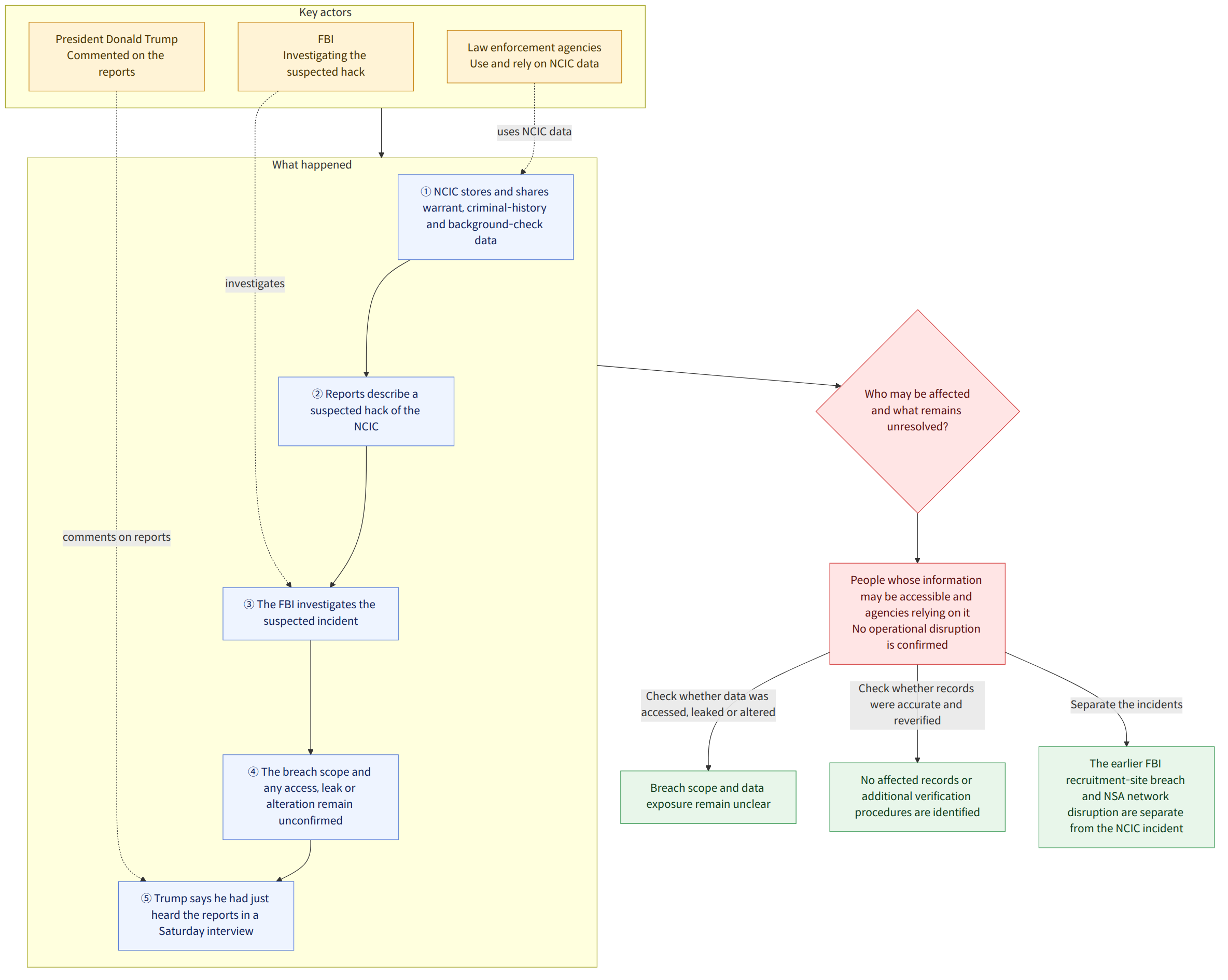
The Federal Bureau of Investigation (FBI; 미 연방수사국) is investigating a suspected hack of the National Crime Information Center (NCIC; 국가범죄정보센터), where federal, state and local law enforcement agencies share warrant and background-check information. According to reports by CNN and the Associated Press, the scope of the breach remains unclear. What is currently known, then, is that an investigation is underway and that law enforcement agencies use the database—not that any particular information was actually accessed, leaked or altered.
Background and context
The NCIC is an online database where law enforcement agencies store and share information related to warrants, criminal histories and background checks. Agencies describe the scope of the information it contains differently, but they agree that it is a criminal information network used by multiple law enforcement agencies. For that reason, if a breach did occur, the issue may go beyond whether data was taken outside the system.
According to CNN, a former FBI official said there were concerns not only about whether hackers had accessed sensitive information, but also about whether the accuracy of information police officers rely on had been compromised. The accuracy issue is distinct from the exposure of information. For example, if records were altered without authorization or became unreliable, the reliability of the information police consult could come into question. However, current reporting does not establish whether anything like that actually happened.
The suspected incident was also mentioned alongside earlier reports of breaches involving FBI systems. According to reports, in September the digital extortion group “Shiny Hunters” (샤이니 헌터스) accessed the FBI recruitment website, affecting information about current and former employees, and the FBI reportedly told agents and support staff that their personal information had been stolen in a cyberattack. The reported breach involving the recruitment website and the NCIC incident concern different systems, so there is no basis to conclude that the earlier incident explains the cause or scope of the current breach.
What this news means
In a typical data breach, the main concern is what personal information was exposed. But in a system like the NCIC, where law enforcement agencies check warrant or background-check information, it may also matter whether the information remains accurate. A leak and an alteration pose different risks, and current reporting has not established that either actually occurred.
This could affect not only the protection of people whose information is accessible, but also law enforcement agencies that rely on the data to do their work. If the accuracy of records had been compromised, it would be difficult to rule out the possibility of confusion when agencies checked or used that information. This is a concern arising from the role the database plays, not a confirmed fact that operations in the field have been disrupted.
For example, hypothetically, if an agency were consulting an NCIC record while considering what action to take, it might need to verify that the record was up to date and accurate, regardless of whether it had been leaked. However, reports do not say which records, if any, were affected, or whether agencies are carrying out additional verification procedures.
President Donald Trump said in a Saturday interview with Fox News that he had just heard about the reports and that it was “not good.” He also suggested that the breach might reveal things he would not otherwise have known because of the Russia-related “hoax.” These were the president’s comments on the incident and should be distinguished from investigative findings that would confirm the scope of the hack or whether information was leaked.
Differences in how reports described the incident
Reports on the NCIC breach differ in how they attribute their information: some articles cite both CNN and the Associated Press, while others say CNN cited two people briefed on the investigation. Reports also described the range of agencies using the database differently: one referred to federal and local law enforcement agencies, while another specified federal, state and local agencies. However, they do not differ on the point that the scope of the breach remains unclear.
A disruption to internal communications networks at the National Security Agency (NSA; 국가안보국), which also appeared in reports from the same period, was a separate incident from the NCIC breach. Reports said the disruption was not believed to have been caused by an external cyberattack and was thought to have occurred during a software update. No basis has been presented for treating the two incidents as a single attack.
What is confirmed and what remains unknown
Facts confirmed in reports
- The FBI was reported to be investigating a suspected hack of the NCIC.
- The NCIC is a database where law enforcement agencies share crime-related information, including warrant and background-check information.
- The scope of the breach remains unclear.
- A former FBI official raised concerns about both access to sensitive information and the possibility that data accuracy had been compromised.
- There was a separate report in September that personal information about FBI employees had been stolen in a cyberattack.
What remains unknown
- What information, if any, was accessed or leaked from the NCIC?
- What was the scope and cause of the suspected hack?
- Was the accuracy of any records actually compromised?
- How are the FBI and agencies that use the database checking whether any information was affected?
What readers should watch for
- In follow-up announcements, look for whether “access,” “leak” and “data alteration” have each been confirmed. It is important not to assume that these distinct issues all occurred as part of the same hack.
- When following the work of agencies that use the NCIC or related news, check whether the information affected and the scope of its use have actually been confirmed. Current reports do not specify the scope of any harm or any procedures that members of the public can directly check.
- Watch for further findings from the FBI’s investigation and additional guidance about employees’ personal information. Take care not to confuse reports about the earlier September incident with the results of the current NCIC investigation.
References
- Other coverage consulted: koreatimes.co.kr
- Other coverage consulted: hani.co.kr