


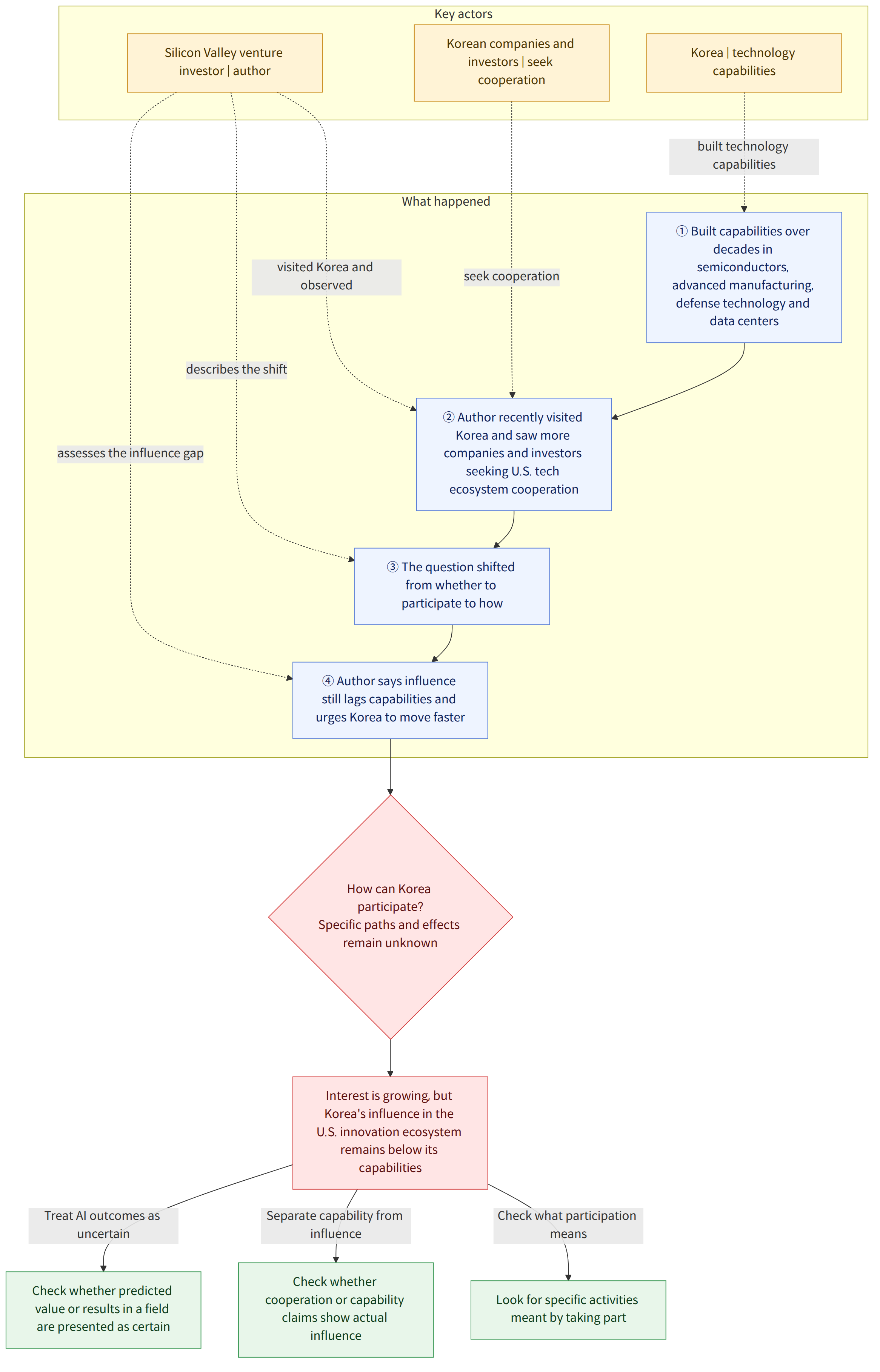
The author, a Silicon Valley-based venture investor, says they recently visited Korea and saw a growing number of companies and investors seeking to cooperate with the U.S. tech ecosystem. The questions being asked in Korea have also changed from five years ago: instead of whether to take part in the U.S. ecosystem, the focus is now on how to do so. The author calls this change encouraging, while also arguing that Korea needs to move faster.
Background and context
The author says Korea has built world-class capabilities in semiconductors, advanced manufacturing, defense technology and data center infrastructure over several decades. The author also says Korea could become a leader in this technology cycle, thanks to its technology talent, industrial expertise and resources.
But in the author’s assessment, capability and influence are not the same thing. The central concern of the piece is that Korea has yet to achieve influence within the U.S. innovation ecosystem commensurate with its technological capabilities. The original text does not explain specifically why this gap exists or how to close it.
What this means
The piece points to both the growing interest in Korea in the U.S. tech ecosystem and the assessment that Korea lacks influence within that ecosystem. The key point, then, is not only that willingness to participate is increasing, but also that how to participate is becoming a practical issue for discussion. However, the author does not explain specific ways to take part or how cooperation with the United States could lead to greater influence.
The author says artificial intelligence (AI—a technology that performs tasks based on human instructions or data) is changing nearly every major industry, and that no one knows exactly where technology will create the most value. Given this uncertainty, it is possible to interpret Korea’s capabilities across a range of technology fields as an opportunity, but that is a projection; the original text does not guarantee results in any particular industry.
For example, if Korean companies or investors are considering taking part in the U.S. tech ecosystem, the question raised by this piece is not limited to whether to participate, but also concerns how to do so. The original text alone, however, does not make it possible to determine which choices would be effective or whether participation would lead to greater influence or industrial results.
What is established and what remains unknown
What is established
- The author says they are a Silicon Valley-based venture investor who works with advanced technologies and development teams around the world.
- The author says they recently visited Korea and saw a growing number of companies and investors seeking to cooperate with the U.S. tech ecosystem.
- The author says Korea has built capabilities in semiconductors, advanced manufacturing, defense technology and data center infrastructure.
- The author says Korea still lacks influence in the U.S. innovation ecosystem commensurate with its capabilities.
What remains unknown
- The original text does not say what steps Korea should take to increase its influence in the U.S. innovation ecosystem.
- The proposed ways for Korea to cooperate with the United States, and their expected effects, are also not established.
- The provided original text cuts off before the end of a sentence about companies, investors and institutions close to the people building artificial intelligence technology, so its conclusion cannot be known.
What readers should check
- In follow-up discussions about taking part in the U.S. tech ecosystem, it is worth examining what specific activities the phrase “take part” refers to. The original text does not specify the form participation would take.
- It is worth distinguishing claims about Korea’s technological capabilities or willingness to cooperate from claims that it has actually gained influence in the U.S. innovation ecosystem. The author says the two do not currently align.
- Keeping in mind the author’s explanation that no one yet knows exactly where artificial intelligence will create the most value, readers can check whether results or effects in a particular field are being presented as certain.