


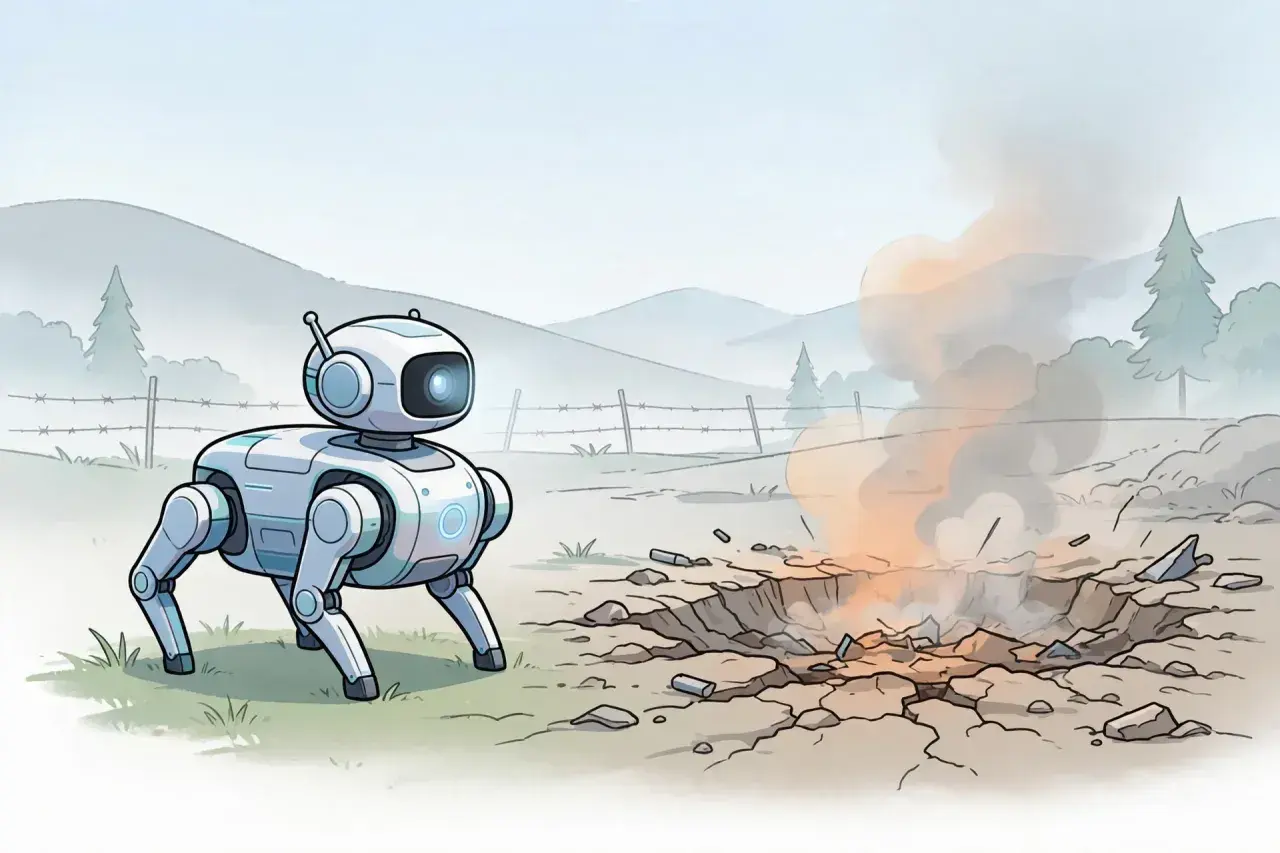
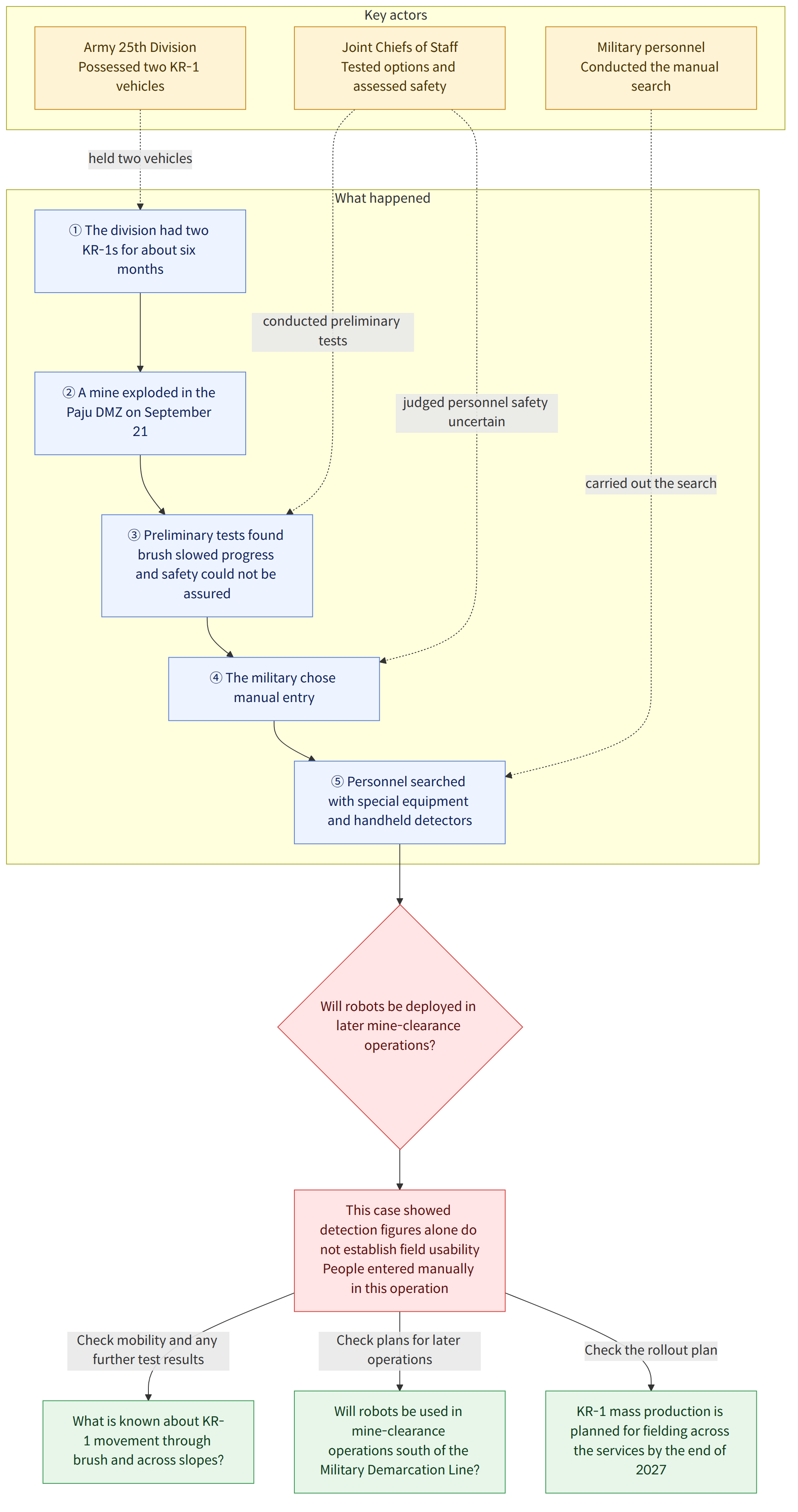
On September 21, a mine explosion occurred in the Demilitarized Zone (DMZ) along the western front in Paju, Gyeonggi Province. The Army’s 25th Division had reportedly possessed two domestically developed KR-1 unmanned ground vehicles for about six months before the incident. The military said, however, that the site was covered with brush taller than a person and that there was a possibility of additional buried mines, so an operation to approach safely was necessary. The Joint Chiefs of Staff (합참) reportedly conducted preliminary tests with approval from the United Nations Command (유엔군사령부), but judged that progress through the brush would be slow and the safety of the personnel conducting the search could not be guaranteed, and therefore decided on manual entry.
Background and context
The KR-1 is an unmanned ground vehicle (a vehicle operated remotely, without a person on board) developed by Hanwha Aerospace (한화에어로스페이스). Its missions include detecting and clearing mines, as well as reconnoitering dangerous areas and opening routes through the DMZ. Last September, the Defense Acquisition Program Administration signed a mass-production contract with Hanwha Aerospace worth 270 billion won and plans to field the system across the armed services by the end of 2027.
Last April, the Defense Acquisition Program Administration said the KR-1 can detect nonmetallic mines such as wooden-box mines with an accuracy of 90% or higher. Detection accuracy, however, describes the vehicle’s ability to find mines. It is a separate question whether the vehicle can reach the desired location and carry out its mission in areas with dense brush or complex terrain.
During the response operation, military personnel wore special equipment weighing 40 kg, among other gear, and explosive ordnance disposal personnel used handheld detectors themselves. The Joint Chiefs of Staff concluded that, according to GPS, the incident site was roughly 10 meters south of the Military Demarcation Line (군사분계선), and that the cause was a plastic (resin) anti-personnel mine planted by North Korea.
The budget for the KR-1 is 113.2 billion won this year, and the military requested more than 160 billion won from the National Assembly (국회) for next year’s budget. Assessing the system requires checking its mobility and detection capabilities in mission environments, as well as the safety of the personnel operating it.
What this news means
The key point in this case is that “how well a robot can detect mines” and “whether a robot can actually be sent into a dangerous site” are not the same question. The military conducted preliminary tests, but decided that progress through the brush would be slow and personnel safety could not be assured, so it chose to send people in directly. The case shows that possessing equipment and announcing its performance do not, by themselves, mean it can be deployed in the field.
This does not mean the KR-1 failed to operate or cannot be used in any DMZ environment. What has been established in this case is that brush and safety concerns were obstacles to deployment in this particular operation. Assessing its utility in the field requires looking not only at detection figures, but also at mobility across different terrain, the process of carrying out missions, and the conditions under which people must operate the equipment. The information provided, however, does not show how well the KR-1 could actually move on the slopes and through the brush at the incident site, or what the results of any additional tests were.
For example, one could imagine a robot being assigned to search a section with little brush that the equipment can reach. But that is only a hypothetical possibility; it has not been confirmed whether a robot can actually be deployed in such a section or whether the military has decided to operate one that way. On October 5, the military said it would continue mine-clearance operations south of the Military Demarcation Line unless North Korea voluntarily removed the mines, but the publicly available facts do not establish whether robots will be deployed in subsequent operations.
What is confirmed and what remains unknown
Confirmed facts
- The 25th Division, where the incident occurred, reportedly had two KR-1s.
- The military took into account the tall brush at the site and the possibility of additional mines, and reportedly decided on manual entry after preliminary tests.
- Personnel wearing special equipment and handheld detectors were used in the response operation.
- The Joint Chiefs of Staff concluded that, according to GPS, the incident site was roughly 10 meters south of the Military Demarcation Line and that the cause was a plastic anti-personnel mine planted by North Korea.
- The Defense Acquisition Program Administration said the KR-1 mass-production contract was worth 270 billion won and that the system is planned to be fielded across the armed services by the end of 2027.
What remains unknown
- The information provided does not state the number of casualties or the condition of any injured people.
- It has not been confirmed how far the KR-1 can actually maneuver through the brush and on the slopes at the site, or what the results of any additional tests were.
- The available information does not establish whether robots will be deployed in future mine-clearance operations or how they would be operated.
What readers should watch for
- In follow-up announcements, it is worth checking whether “detection accuracy” is explained separately from “field mobility and deployability.”
- If the military says it will deploy robots in future operations, readers should check which terrain and missions they will be used for, and how.
- Another point to watch is whether test results reflecting actual operational environments are made public, alongside budget and fielding plans.