

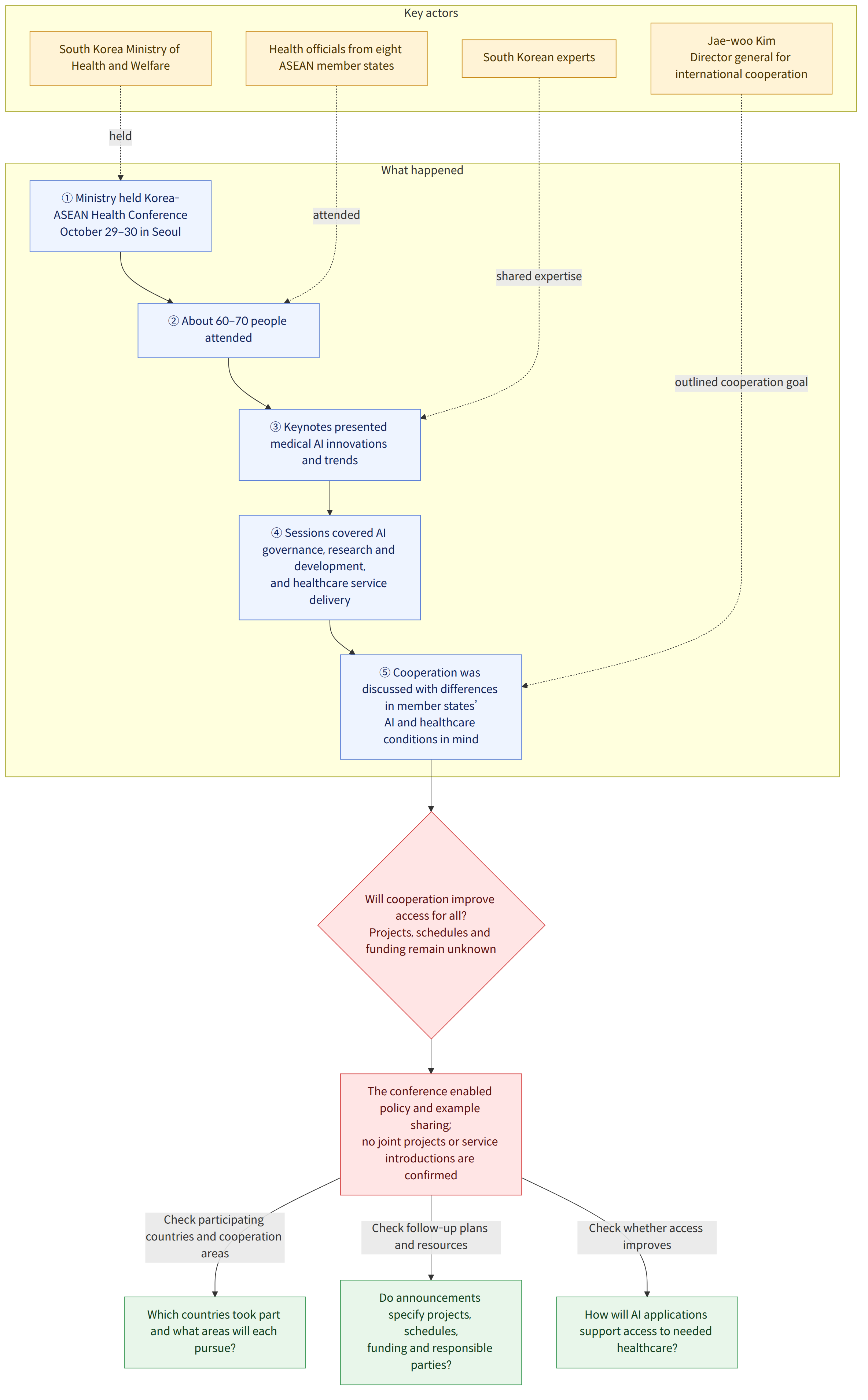
The Ministry of Health and Welfare (보건복지부) and ASEAN explored cooperation on the use of artificial intelligence (AI) and digital medicine in healthcare. The ministry held the Korea-ASEAN Health Conference (한-아세안 보건 콘퍼런스) on October 29–30 at Sebitseom (세빛섬) in Seocho-gu, Seoul. Approximately 60–70 people attended, including health officials from eight ASEAN member states and South Korean experts.
Background and context
The conference theme was “Advanced Technology for Human Dignity.” It was organized to examine AI policy in healthcare, share examples of its practical application and discuss ways to strengthen cooperation.
Keynote speeches introduced AI-driven innovation in clinical settings, as well as trends and examples of advanced technology in medical AI and related industries. Subsequent presentations and panel discussions addressed AI policy and governance (the systems for managing technology and ensuring accountability), experience using AI in medical research and development, and the delivery of healthcare services.
Jae-woo Kim, director general for international cooperation at the Ministry of Health and Welfare, said that cooperation within ASEAN would continue to be strengthened so that AI could be used as a tool to ensure universal access to needed healthcare, taking into account differences in AI and healthcare conditions among member states. This shows that a key part of the discussion was not simply adopting AI, but using it in ways suited to each country’s circumstances and healthcare access.
What this news means
Even when medical AI is used to support healthcare professionals or deliver healthcare services, its benefits do not automatically reach everyone. Discussing cooperation on the premise that AI and healthcare conditions differ among member states can be interpreted to mean that how the technology is applied and how healthcare services are delivered need to be considered in light of each country’s circumstances.
For example, if one member state seeks to apply AI in healthcare services, it may need to consider its own healthcare environment and access to needed care rather than simply adopting another country’s example. However, there is no available information confirming that the conference established specific criteria or projects for such considerations.
The meeting was an opportunity to share policies and examples and explore cooperation. Therefore, attendance and discussion alone do not mean that services have actually been introduced or that joint projects among member states have begun. The forms of cooperation and follow-up measures put in place will be important if the goal of a “healthcare system that leaves no one behind” is to be put into practice. However, based on the information currently available, it is difficult to know whether discussions have reached that stage.
What is confirmed and what remains unknown
Confirmed facts
- The Ministry of Health and Welfare held the Korea-ASEAN Health Conference on October 29–30 at Sebitseom in Seocho-gu, Seoul.
- Approximately 60–70 people attended, including health officials from eight ASEAN member states and South Korean experts.
- The theme was “Advanced Technology for Human Dignity,” and the conference addressed medical AI policy and applications, as well as strengthening cooperation.
- Presentations and discussions covered AI policy and governance, the use of AI in medical research and development, and the delivery of healthcare services.
What remains unknown
- The publicly available information does not identify which eight ASEAN member states attended.
- It is unknown whether specific joint projects or schedules for follow-up cooperation were agreed upon as a result of the discussions.
- The amount of funding or other resources allocated to medical AI cooperation projects has not been confirmed.
What readers should look for
- If follow-up announcements are made, readers can check whether they identify the participating countries and the areas of cooperation for each member state.
- It will be important to see whether actual joint projects move forward and, if so, whether schedules, funding and responsible parties are specified.
- Follow-up information can show whether AI applications do more than serve as examples to share, and how they support access to needed healthcare.