

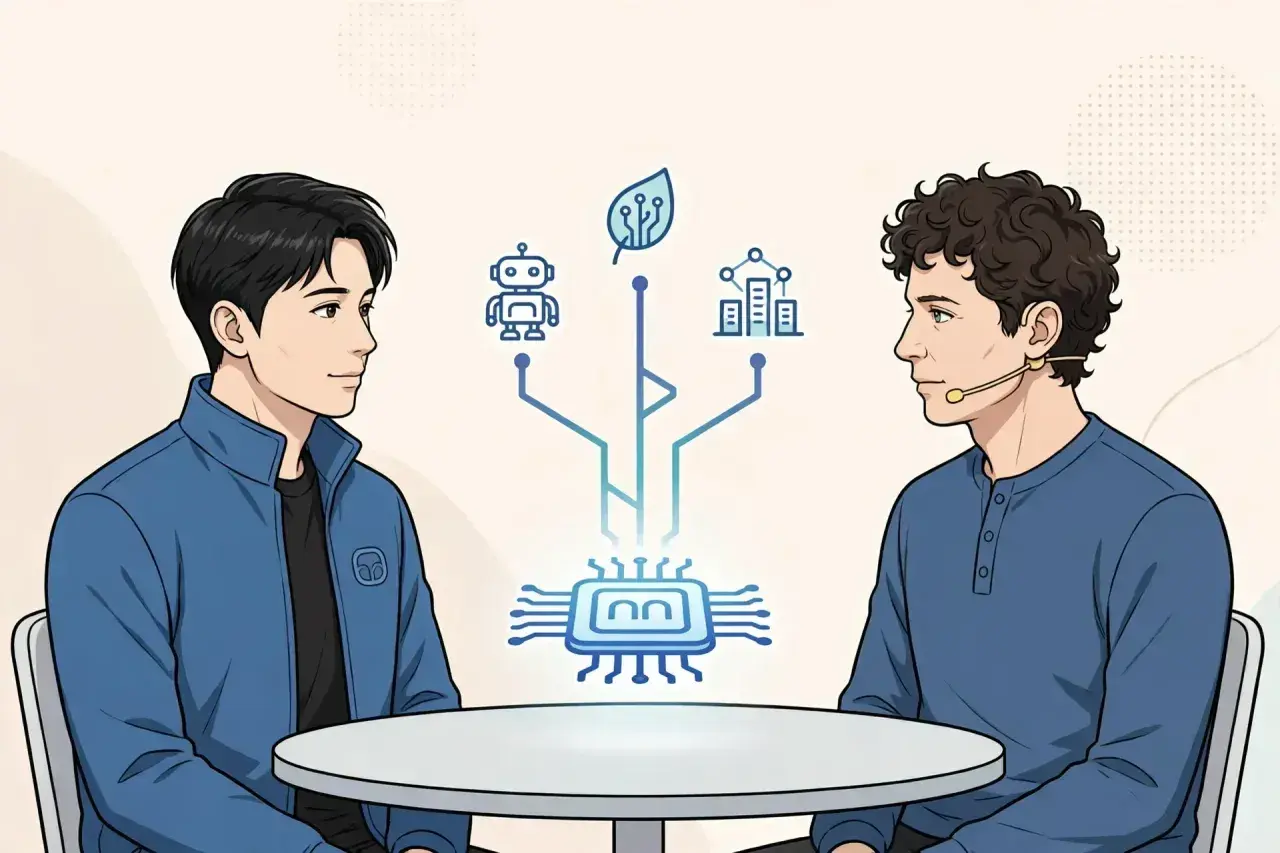
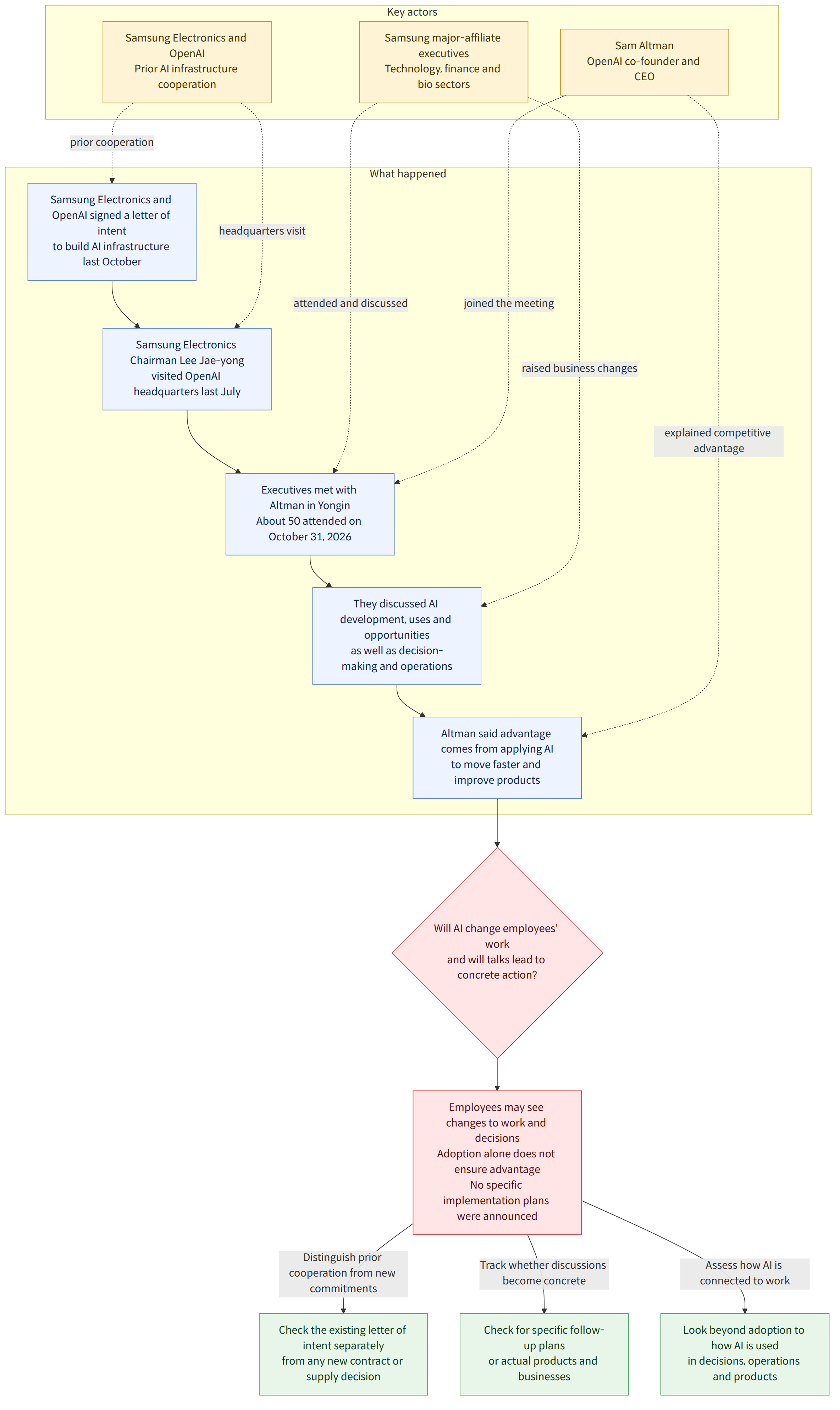
Samsung’s top executives from its major affiliates met with OpenAI co-founder and CEO Sam Altman on Saturday at the Samsung Human Resources Development Institute (삼성인력개발원) in Yongin, Gyeonggi Province, to discuss AI transition strategies. According to Samsung, about 50 executives from the technology, finance and bio sectors attended, and the discussion covered the direction of AI technology’s development, its potential uses and business opportunities in related fields. According to reports, the event was held on October 31, 2026.
Background and context
The meeting was part of a series of leadership seminars Samsung is holding as it pursues its AI transition. One report said the meeting’s theme was “The Next 10 Years AI Will Change: Choices for Businesses.” The discussion went beyond explaining AI technology itself to address how it could change corporate decision-making and operations, and what capabilities executives need in a rapidly changing environment.
Samsung and OpenAI have also held cooperation discussions in the past. According to one report, Samsung Electronics and OpenAI signed a letter of intent (a document recording an intention to cooperate) last October to build AI infrastructure, and have been working to supply the memory semiconductors needed for OpenAI’s Stargate Project (스타게이트 프로젝트). The same report said Samsung Electronics Chairman Lee Jae-yong visited OpenAI’s headquarters in San Francisco last July. However, this existing context of cooperation does not mean a new agreement was reached at the meeting.
What this news means
Altman said that competitive advantage does not come simply from adopting AI, but from using it to move faster, create better products and get ahead of competitors. The point is that “whether a company has AI” may matter less as a measure of corporate competitiveness than “how it has connected AI to its work and products.” The changes to decision-making and operations discussed by Samsung’s executives relate directly to this question.
For employees, the AI transition is notable because it may involve changes to how they work and make decisions, not just the addition of new tools. For example, even if a company adopts AI, it may be difficult to gain a competitive advantage from that fact alone if it cannot connect the technology to actual workflows and product improvements. This does not mean that specific implementation plans were announced at the meeting; it is an implication that can be drawn from Altman’s remarks and the topics discussed.
What is confirmed and what remains unknown
Confirmed facts
- Executives from Samsung’s major affiliates and Altman held a meeting at the Samsung Human Resources Development Institute in Yongin.
- According to Samsung, about 50 executives from the technology, finance and bio sectors attended.
- They discussed the future direction of AI technology, its potential uses and business opportunities in related fields.
- Changes to corporate decision-making and operations, as well as the capabilities executives need, were also topics of discussion.
- Samsung held the meeting as part of its leadership seminars to advance its AI transition.
What remains unknown
- The names of the Samsung affiliates and executives who attended have not been confirmed in the publicly available information.
- It is not known whether new cooperation plans or specific follow-up actions were agreed during the discussion.
- It has not been confirmed whether the business opportunities discussed at the meeting will lead to actual businesses or products.
What readers should check
- It is important to distinguish this meeting from the existing letter of intent. The fact that cooperation was already being pursued does not, by itself, establish that a new contract was signed or a supply decision was made.
- If further announcements are made, it will be important to check whether the discussion has led to actual business plans, product applications or specific cooperation.
- When following news about companies’ AI transitions, readers can look beyond whether AI has been adopted to consider how it is being used in decision-making, operations and products.
References
- Other coverage consulted: en.yna.co.kr
- Other coverage consulted: hani.co.kr