



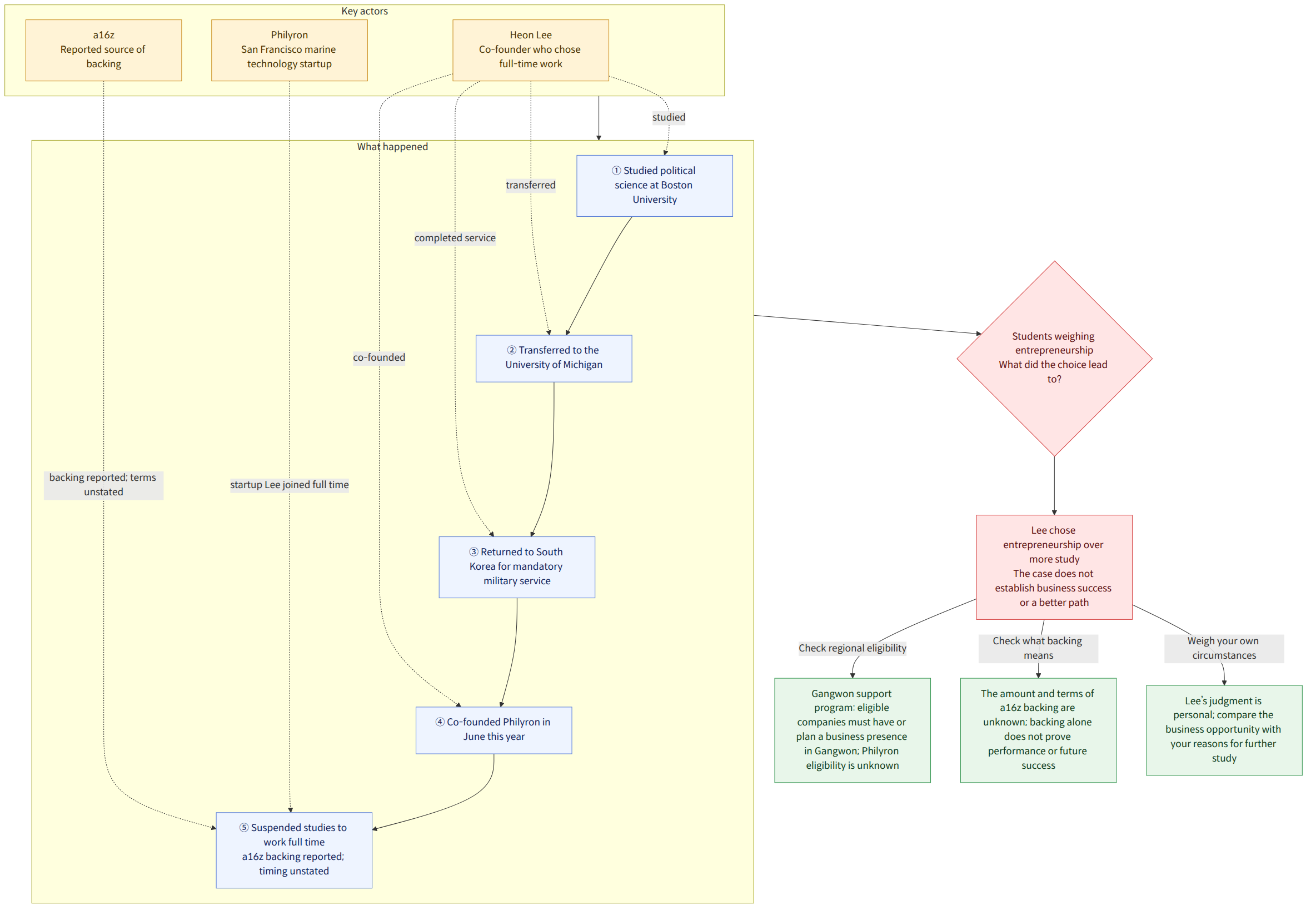
At 24, Heon Lee, who uses the name Heon Lee in the United States, dropped out of college to work full time at Philyron, a San Francisco-based marine technology startup he co-founded in June this year. He is reported to have received backing from a16z. However, the available information does not establish how the backing was provided or on what terms.
The case illustrates one entrepreneur’s choice while also raising the question of whether to prioritize higher education or business experience. Lee said he concluded that school does not teach people how to start and grow a business, and that spending three more years at college would not be worthwhile for him. This was his personal judgment; it cannot be generalized to mean that higher education is unnecessary for all entrepreneurs.
Background and context
Lee initially studied political science at Boston University. After completing his first year, he transferred to the University of Michigan’s Ann Arbor campus and returned to South Korea to complete mandatory military service. He later suspended his studies to work at Philyron, which he co-founded in June this year.
He said South Korean students and parents feel pressure when choosing a career path over higher education. By contrast, he said he had met many young Americans in Silicon Valley who had dropped out of prestigious universities to start businesses. Drawing on these experiences, Lee cited cultural differences between the two countries surrounding higher education to explain his decision.
The core of his choice, as he described it, was not simply that he left college, but that he decided not to spend more time on his studies so he could focus on entrepreneurship. a16z’s backing shows that his choice was connected to outside support, but that alone does not establish that the business has succeeded or that dropping out of college is a better path.
What this news means
For students considering entrepreneurship, this case raises the question of whether education and business must be treated as an either-or choice. Lee decided that focusing on his business was the better option, but that judgment was based on his own circumstances and plans. The information presented in the article is not enough to assess what effect leaving college had on the business.
Lee’s comment that students and parents face real pressure when making career choices is also noteworthy. His experience, however, is that of one person. It cannot be taken as evidence that all South Korean students or parents feel the same pressure, nor can it establish that staying in college or focusing on entrepreneurship is the better choice.
For example, rather than simply following Lee’s decision, a student considering entrepreneurship could weigh the business they hope to build against their reasons for pursuing further studies at college. This case shows that someone chose entrepreneurship; the information needed to assess the costs and results of that choice is not yet sufficient.
The fact that a16z provided backing is confirmed, but the amount and terms are unknown. It should therefore not be interpreted as proof of the company’s current performance or future success.
Related programs and support information
Gangwon Special Self-Governing Province (강원특별자치도) and Gangwon Technopark (강원테크노파크) operate an Investment-Linked Support Program (투자연계 지원 프로그램) for companies seeking investment, to develop strategic industries in the Gangwon region and activate venture funds in which the province has invested. Eligible companies are those that have, or plan to relocate, their main place of business—including a headquarters, branch office, or factory—to the Gangwon region. Support includes referrals for consideration for investment from the Gangwon Venture Fund (강원 벤처펀드), in-person presentations and in-depth one-on-one consultations at investment events, capacity-building education, and programs connecting businesses with funding.
The announcement says applications are accepted on an ongoing basis, with the deadline listed as ongoing or undetermined. Philyron is described as a San Francisco-based company, but the available information does not say whether it has, or plans to relocate, a place of business to the Gangwon region. It therefore cannot be assumed that Philyron is eligible for this program. The information may be useful to companies with a business presence in Gangwon or considering relocating there as they check the eligibility requirements and application process.
Confirmed facts and what remains unknown
Confirmed facts
- Lee also uses the name Heon Lee in the United States.
- He studied political science at Boston University before transferring to the University of Michigan’s Ann Arbor campus.
- He returned to South Korea for mandatory military service and dropped out of college to work full time at Philyron, which he co-founded in June this year.
- Philyron is a San Francisco-based marine technology startup, and Lee is reported to have received backing from a16z.
What remains unknown
- How much backing did a16z provide, and what were the specific investment or support terms?
- What marine technology product or service is Philyron developing?
- What is the company’s current business performance, and what are its plans for the future?
What readers can check
- If you have started a business in the Gangwon region or are considering relocating your business there, you can check whether you meet the main-place-of-business requirement and review the latest application process for the ongoing announcement.
- Companies preparing to raise investment can review the available support, including referrals for investment consideration, in-person presentations, and one-on-one consultations.
- If you are considering dropping out of college or working full time on a startup, assess your own education and business plans rather than drawing a conclusion based solely on Lee’s case.