A real protest, and a much larger online prediction
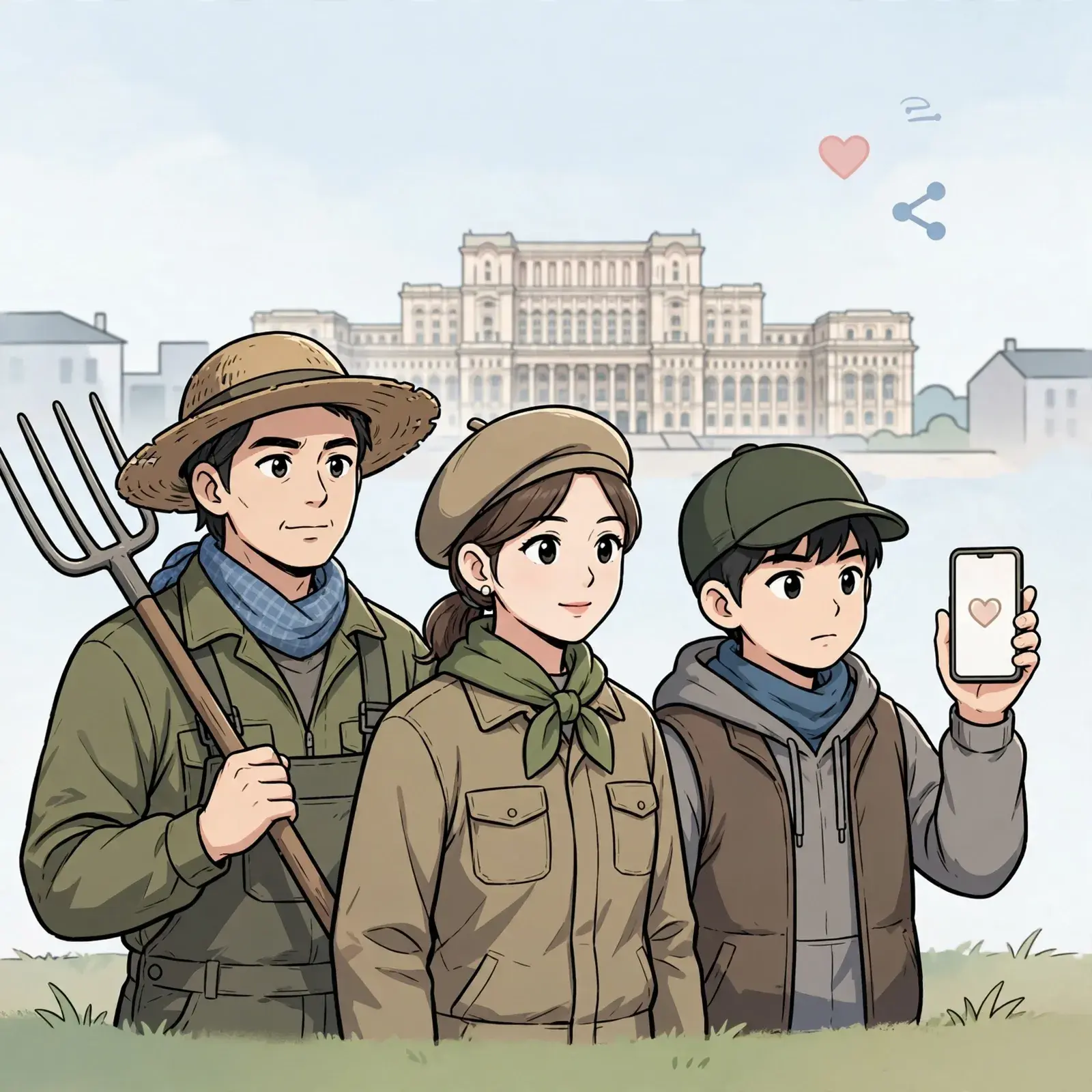
On September 15, shepherds, livestock breeders, and other farmers gathered in Victoriei Square, outside Romania’s government headquarters in Bucharest. They were protesting an EU-wide ban on live sheep and goat exports, extended through the end of 2026 after outbreaks of animal diseases. Their demands also included compensation for animals that had to be culled and crops lost to drought.
Organizers had urged demonstrators to bring sheep, tractors, and hay bales to the square. Restrictions kept live animals and heavy machinery out of the protest area, but the demonstration went ahead without them. It began peacefully before 10 a.m.; later, some protesters pushed through police barriers and threw stones, bottles, and pieces of curb. Gendarmes responded with tear gas.
The online story began before the street confrontation: the night before the protest, dozens of Facebook pages circulated a claim that nearly 200,000 farmers would gather in the square.
Press reports put the actual turnout at more than 3,000 people—far below the online prediction, but still a substantial crowd. The gap between the claim and the reported turnout is central to understanding how the demonstration was presented and discussed online. It does not, by itself, explain who created or spread the claim.
What happened in Victoriei Square
According to the Bucharest Gendarmerie, 24 people needed medical attention that evening, including 10 gendarmes. Four of those officers were hospitalized, and 47 people were taken to police stations. President Nicușor Dan and interim Prime Minister Ilie Bolojan condemned the violence.
Livestock-breeder associations said that people who were not farmers had joined the crowd. The prefect of Bucharest also questioned whether the clashes reflected the behavior of the agricultural workers who had organized the protest. Those statements added to a wider dispute over who was present and how the confrontation began.
The farmers’ grievances were more specific than the confrontations that later dominated coverage. They included the export ban, losses connected to animal disease, drought damage, and the prices farmers receive for their products. For a small livestock producer, for example, a ban on selling animals abroad can mean fewer buyers, lower prices, and less income to cover feed and other costs.
Why the export ban mattered
The restriction on live exports followed outbreaks of diseases affecting sheep and goats, including small-ruminant plague and sheep pox. When animal diseases spread, governments can limit the movement and sale of livestock to reduce the risk of transmission. That may protect other farms, but it can also leave producers unable to sell animals through familiar markets while they wait for restrictions to change.
For farmers already facing drought or the loss of animals, the effects can compound. A producer may lose part of a herd, receive less for the animals that remain, and still need to pay for feed, labor, and equipment. The protesters’ demands for compensation and renewed exports reflected these immediate economic pressures.
A burst of nearly identical posts
Researchers examined 1,186 public Facebook posts and 100 TikTok videos posted in Romanian on September 14 and 15. They tracked the messages used to describe the protest, how similar wording moved between accounts, and what kinds of calls to action appeared. The goal was to map the flow of public posts, not to identify private communications or prove who was behind them.
The clearest pattern appeared between 7 p.m. and 7:15 p.m. on September 14. Dozens of Facebook pages republished almost the same message predicting that “almost 200,000 farmers” would come to Victoriei Square the following day. Researchers treated posts as potentially connected when different pages published identical or near-identical wording within a five-minute window.
That method revealed a dense network of accounts sharing text at nearly the same time. Of the 2,253 account pairs in the final network, roughly 90 percent had already formed during that 15-minute period the evening before the demonstration. In this analysis, an account pair refers to two pages linked because they published closely matching wording within the chosen time window.
What coordinated distribution does—and does not—show
By 3:30 p.m. on September 15, the network included 160 accounts and 12 distinct texts. Two large clusters, each containing about 50 accounts, centered on slightly different versions of the 200,000-person prediction. Together, the clusters accounted for 100 of the 160 accounts and close to 90 percent of the network’s connections.
Some of the most visible pages researchers could identify were content-aggregation or syndication pages—accounts that collect and repost material from elsewhere—rather than openly political organizations. Publishing matching messages within seconds is coordinated distribution in a technical sense. But that pattern alone does not establish who arranged the sharing, whether the pages acted together deliberately, or what any participant intended.
The researchers’ key limitation is important: the posting data show how similar messages spread, but they do not prove who organized the protest or who sought to inflate expectations about turnout.
Four storylines competed for attention
The posts did not tell a single story. Researchers identified four broad strands, each emphasizing a different part of the demonstration and its wider meaning.
- Farmers’ economic demands: messages called for an end to animal slaughter, a resumption of exports, and fair prices.
- The clashes with gendarmes: some posts blamed protesters for breaking through police lines; others criticized police actions. A recurring claim suggested that “provocateurs” had been placed among the demonstrators, though the analyzed posts do not establish that this happened.
- Political arguments: discussion focused on AUR leader George Simion, who called for calm and urged the Gendarmerie to show restraint. Posts disagreed over whether his intervention supported the farmers or drew attention away from their demands.
- Agriculture’s longer-term problems: other posts discussed issues such as delays in EU funding for machinery and the shift toward no-till farming, a method that reduces or avoids plowing the soil.
The last of these topics points to a wider reality: a protest can be triggered by an immediate policy dispute while also reflecting long-running pressures. Farming decisions are shaped by access to equipment, weather, financing, export markets, and public support. A demonstration about one ban can therefore become a space where people argue about the future of an entire sector.
The EU appeared as both a negotiating partner and an enemy
Researchers found 67 posts that mentioned Brussels or the European Union in connection with the protest. Some referred to concrete negotiations with the European Commission over the export restriction. Others portrayed the EU as an adversary, including claims that Europe wanted to leave Romania without livestock or agriculture, or even to starve the country.
These are different kinds of messages. One describes a dispute over a specific policy and the possibility of changing it through negotiation; the other presents the EU as an existential threat. When posts move from a concrete disagreement to sweeping claims about a foreign power, readers may find it harder to distinguish verifiable policy details from political framing.
This distinction matters beyond Romania. Debates about farming rules, trade, and public health often involve genuine costs for particular communities. Those concerns can be discussed alongside broader political claims, making it useful to ask whether a post explains a specific decision or simply assigns blame to an institution as a whole.
From farmers’ grievances to warnings of escalation
Researchers also followed two Telegram channels that had previously been documented by institutions studying propaganda networks active in Romania and Moldova. The channels’ framing changed over the course of the day. One post at 11:56 a.m. listed the farmers’ demands; by 2:06 p.m., another warned that “the usurpers” would use the protest to provoke escalation and impose a state of emergency.
After clashes began, the messaging shifted again, this time toward criticism of how television stations covered the confrontation. Similar sequences appeared in posts using direct mobilization language, including calls to “occupy Bucharest” and claims that a “REVOLUTION” had begun. The changes show how a discussion can move quickly from an economic complaint to a warning of political conflict and then to distrust of news coverage.
The existence of those posts does not mean all protesters shared the same views or took part in the same messaging. A large demonstration brings together people with different priorities, and social media can make the loudest or most dramatic interpretations appear more representative than they are.
TikTok amplified the confrontation
On TikTok, researchers sampled 100 videos from 34 accounts using the hashtag #protest. Thirty-one videos mentioned the Gendarmerie directly in their descriptions. The most-shared video in the sample announced renewed clashes and dozens of arrests, attracting nearly 30,000 interactions on its own.
A short video can make a fast-moving confrontation easy to watch and share, but it may not include the full timeline or explain what happened before the clip began. As a result, viewers may encounter the most dramatic moments without the economic context that brought people to the square. The researchers’ findings document the reach of that content, not how every viewer interpreted it.
The central question is how the protest was represented
The evidence describes three related but distinct things: farmers’ real economic grievances, the online circulation of exaggerated turnout predictions, and political messages that reframed the demonstration as a confrontation with the government or the media. Treating those as the same phenomenon would obscure what the analysis can actually show.
The pattern is familiar in Romania and the wider region: a genuine dispute can be amplified by clusters of accounts sharing the same wording, then absorbed into existing narratives about an illegitimate government, stolen elections, or a political “system” that must be confronted. That context can influence what audiences see, even when the initial complaint is practical and local.
The data do not identify who organized the online sharing or establish their motives. They do show that a dramatic claim about turnout spread rapidly before the protest, and that competing narratives became more prominent as the day’s events unfolded.
Understanding the demonstration therefore means asking not only what happened in Victoriei Square, but also how expectations were built before it, which parts of the story gained attention, and where evidence ends and speculation begins. The farmers’ demands, the violence, the coordinated-looking posts, and the political framing are connected—but they are not interchangeable.