With the 2026 Aichi-Nagoya Asian Games over, South Korea finished third overall with 39 gold medals, 43 silver medals and 68 bronze medals. The final gold medal of the Games came in men's soccer. A look back at the two-week journey in photos shows not only finals won by athletes who reached the top, but also close contests, a draw and advances to the next round.
Background and context
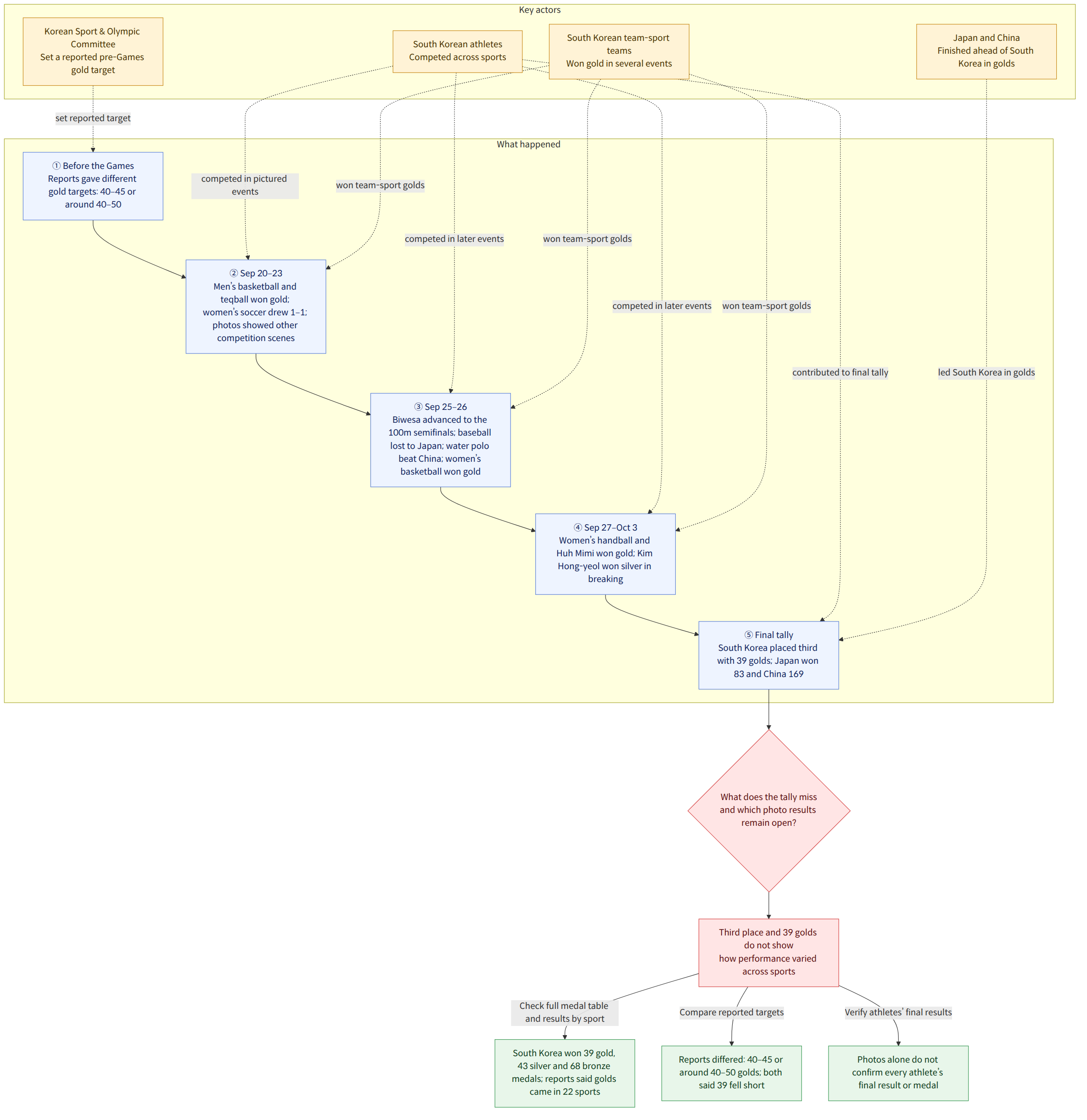
South Korea's men's basketball team won gold in the final against Japan on September 20, and on the same day Lee Jun-seok won gold by defeating Iraq's Al Jalil Mekser Alayawi in the men's singles teqball final. In Group F of the women's soccer tournament on September 21, South Korea and North Korea drew 1-1. These results show that photos from the Games document more than medal ceremonies: they capture different stages of competition.
On September 23, Yeo Seo-jeong competed on the balance beam in the women's artistic gymnastics team final. The photos also show Jeong Ha-seong trying to block the ball in the men's team regu sepak takraw qualifiers, Shin Jae-young competing in the women's 49 kg weightlifting event, and Jo Hyeon-ju in the women's park qualifying round. These scenes alone do not reveal the athletes' final standings or whether they won medals.
Daniel Biwesa advanced to the semifinals in the first round of the men's 100 meters on September 25. On the same day, South Korea's baseball team lost 5-0 to Japan in its first Super Round game. The following day, the men's water polo team beat China 15-14 in a Group B preliminary-round game, and the women's basketball team won gold after defeating Japan 75-70 in the final. On September 27, the women's handball team also beat Japan, 27-23, in the final.
In the latter part of the Games, Huh Mimi won gold in the women's 57 kg judo final on October 1. Kim Hong-yeol (Hongten) won silver after facing Japan's Shigeyuki Nakarai in the men's breaking B-boy gold-medal battle on October 3. Lee So-hee and Baek Ha-na, who competed in the women's doubles badminton final, and An Se-young, who competed in the women's singles semifinals, also appear in the photos, but the photo feature alone does not confirm their final results.
Looking at the overall medal tally, South Korea's gold-medal count fell short of the target set before the Games. Other reports said the country won three gold medals in archery, rather than the five it had expected, and one gold medal in swimming. It won three in taekwondo and two in badminton. By contrast, South Korea performed well in team sports, including men's and women's 5-on-5 basketball, men's 3-on-3 basketball, baseball, men's soccer and women's handball. One report also noted that South Korea won gold in 22 sports, not much different from the 20 sports in the previous Games.
What this means
Read alongside the overall results, the achievements shown in the photos make clear that South Korea's third-place finish alone does not fully explain how performance varied across sports. South Korea held third place with 39 gold medals, but Japan won 83 and China topped the overall standings with 169. The gap between South Korea and Japan in gold medals widened from 10 at the previous Games to 44 this time. The Games included both setbacks in traditionally strong sports and gold-medal wins in several team sports.
The results may suggest that, in preparing for the next Games, it is worth looking not only at the overall standings but also at results and medal distribution by sport. For example, readers following a particular sport can better understand the overall performance by checking not only whether athletes reached the final, but also how the team fared in that sport. However, individual athletes' final results should not be inferred from the photos alone.
This photo collection is a record of the team's competition scenes, not a substitute for every athlete's final result or the full medal table for the Games.
Points reported differently
Reports differed on South Korea's gold-medal target before the Games. One report said the Korean Sport & Olympic Committee (대한체육회) had set a target of 40 to 45, while another said the committee aimed for around 40 to 50. Although the target was described differently, both reports said that South Korea's actual haul of 39 gold medals fell short.
What is confirmed and what remains unknown
Confirmed facts
- South Korea finished third overall with 39 gold medals, 43 silver medals and 68 bronze medals.
- South Korea won gold in men's basketball, men's singles teqball, women's basketball and women's handball.
- Huh Mimi won gold in the women's 57 kg judo event, and Kim Hong-yeol won silver in men's breaking.
- The Group F women's soccer match between South Korea and North Korea ended in a 1-1 draw, and South Korea's baseball team lost 5-0 to Japan.
What remains unknown
- The final results and medal outcomes for all athletes shown in the photos have not been confirmed.
- The photo collection alone does not provide detailed records for each match or the results of every event at the Games.
What readers should check
- When reviewing the team's overall medal count and ranking, check the numbers of gold, silver and bronze medals together.
- To find out the final result for an athlete pictured, consult the event results and the records from the event's final rounds separately.
- Reports gave different ranges for the target, so distinguish the target figure from the actual medal count.
References
- Other coverage consulted: hani.co.kr
- Other coverage consulted: koreatimes.co.kr