
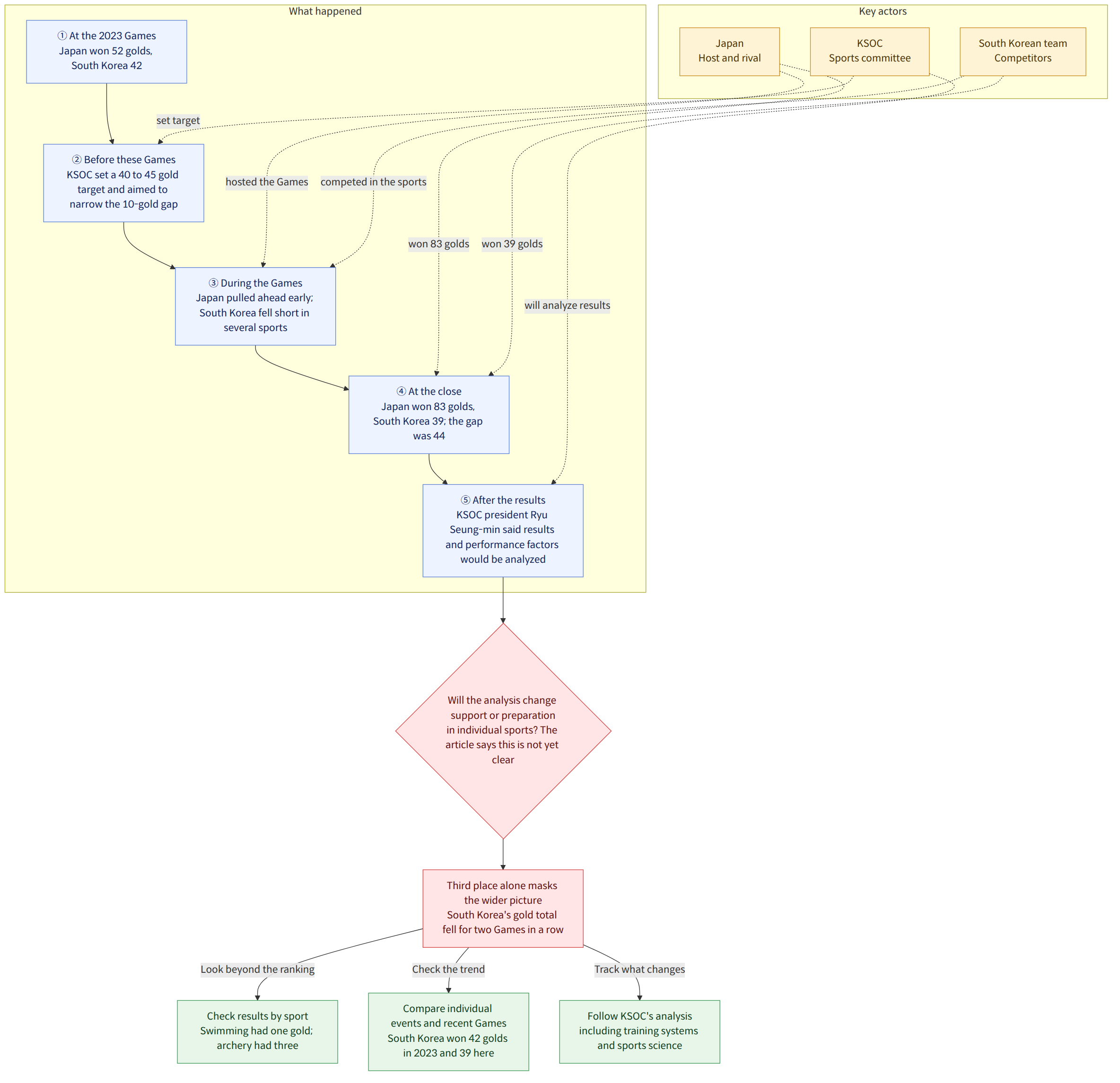
The Aichi-Nagoya Asian Games came to a close with the closing ceremony on Sunday night. South Korea finished third overall, behind China and Japan, with 39 gold medals, but fell short of its pre-Games target of 40 to 45. It was the country’s third consecutive third-place finish, and its gold-medal total was the lowest since 1982. It also failed to meet its goal of narrowing the gap with Japan compared with the previous Games.
Japan won 83 gold medals and South Korea won 39. The gap between the two countries was 44 gold medals, up from 10 at the 2023 Games.
Background and context
The Korean Sport & Olympic Committee (대한체육회; KSOC) expected host nation Japan to benefit from home advantage and projected that South Korea would find it difficult to catch up. Still, after trailing Japan by 10 gold medals at the 2023 Games, South Korea set a goal of further narrowing the gap this time. But Japan pulled ahead from the early stages of the Games, while South Korea won fewer medals than expected in some sports.
The gap becomes clearer when compared with recent results. In 2023, Japan won 52 gold medals and South Korea 42, a difference of 10. In 2018, Japan won 75 and South Korea 49. At these Games, South Korea’s gold-medal total fell to 39 while Japan’s rose to 83, making it difficult to explain the state of competition between the two countries simply by noting that South Korea held on to third place.
The underperformance was particularly evident in some traditionally strong sports. South Korea won just one gold medal in swimming in the first week of these Games, compared with six at the 2023 Games. It won three golds in archery, its lowest total since compound events were introduced at the Asian Games in 2014. South Korea won three golds in shooting, rather than the five it had hoped for, and three in taekwondo, but only one of those was in sparring. It won no gold medals in table tennis or wrestling.
South Korea also came away with just one gold medal in judo, won by Heo Mimi. Japan had decided to send its top athletes to the concurrently held World Championships instead of the Asian Games, but South Korea was unable to turn that into a stronger medal result. By contrast, South Korea won gold in women’s and men’s 5-on-5 basketball and men’s 3x3 basketball, as well as in team sports including baseball, men’s football and women’s handball. That is why it is important to look at which sports brought medals and which did not, alongside the overall ranking.
What this means
The results show that South Korea’s third-place finish should be considered separately from whether it is maintaining its competitiveness in Asian sports. The gap with Japan was much larger than the margin over the countries around fourth place, and South Korea’s gold-medal total has fallen for two consecutive Games. The overall ranking alone therefore does not show where South Korea held on to its competitive edge or where it fell behind its rivals.
The team and the sports federations now face the task of analyzing why medal totals declined in some sports. Ryu Seung-min, president of the Korean Sport & Olympic Committee, acknowledged that results in some sports fell short of expectations and said he would analyze the Games’ results and factors that could affect athletes’ performance, including training systems and sports science. It is not yet clear how this analysis will shape support or preparation in individual sports.
Readers, too, should consider the detailed results alongside the “third-place” finish. For example, if they hear only that South Korea won fewer medals in a sport than it did in the past, they should also look at the sport’s individual events and results in other sports to judge what changed across the Games as a whole. This is also important to avoid drawing conclusions about the entire team’s performance based on underperformance in a single sport.
Points reported differently by different outlets
The gap in gold medals between South Korea and Japan was reported as 44, but reports differed on how they listed the countries around fourth place. One report said India was fourth with 21 gold medals, while another said Uzbekistan and India each won 21 and finished fourth and fifth, respectively.
What is confirmed and what remains unknown
Confirmed facts
- South Korea finished third overall behind China and Japan with 39 gold medals, marking its third consecutive third-place finish.
- The 39 gold medals were the fewest since 1982 and fell short of the pre-Games target of 40 to 45.
- Japan won 83 gold medals, 44 more than South Korea.
- South Korea won one gold medal in swimming, three in archery, three in shooting and three in taekwondo, and no gold medals in table tennis or wrestling.
- South Korea won gold in basketball, baseball, men’s football and women’s handball, among other sports.
What remains unknown
- It has not been confirmed when the Korean Sport & Olympic Committee will publish its detailed analysis or what changes it will lead to in sport-specific preparation or support.
- Based on the evidence currently available, it is not possible to know whether results in individual sports at these Games will continue in future competitions or how the gap will change at the next Games.
What readers should look for
- Readers can see which sports and performance factors the Korean Sport & Olympic Committee focuses on in the analysis of the Games’ results it has announced it will conduct.
- When reviewing results at the next Games, readers can compare not only the overall ranking but also changes in gold-medal totals, results by sport and the gap with Japan.
- For details reported differently by different outlets, such as rankings around fourth place, it is worth checking the medal count and how the rankings were determined.
References
- Other coverage consulted: en.yna.co.kr
- Other coverage consulted: hani.co.kr