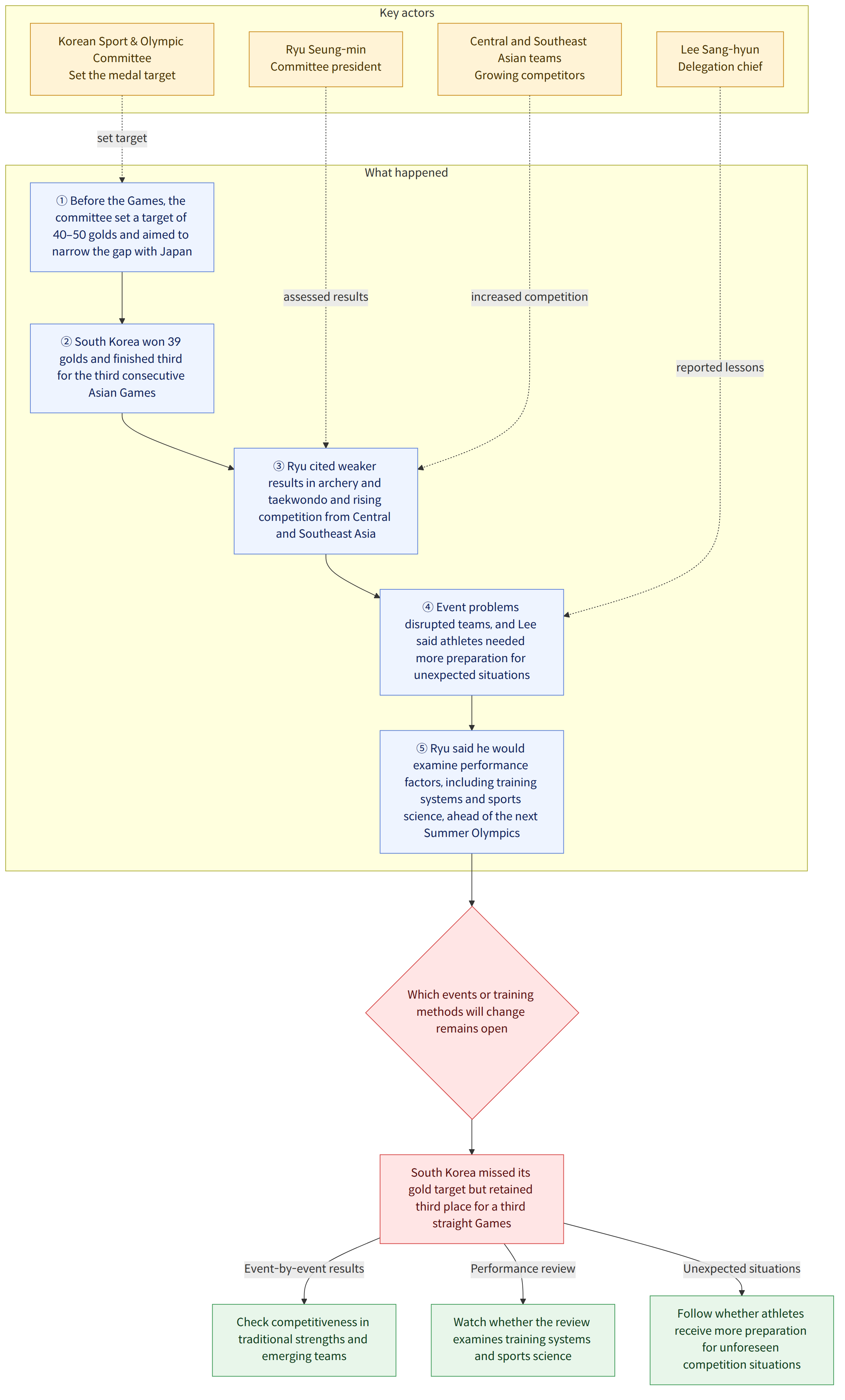
South Korea fell short of its gold-medal target at the Aichi-Nagoya Asian Games, finishing third overall with 39 gold medals. Before the Games, the Korean Sport & Olympic Committee (대한체육회) had set a target of 40–50 gold medals and sought to close the gap with Japan, but South Korea finished third for the third consecutive Asian Games. Committee President Ryu Seung-min said the lessons from the Games should be considered from several angles and that he would examine factors affecting the results and athletes’ performances.
Background and context
In terms of medal count, South Korea’s failure to meet its target may seem minor, but it fell one medal short even of the lower end of its target. It retained third place overall, but did not achieve its goal of narrowing the gold-medal gap with Japan. South Korea trailed Japan in the gold-medal race, 75–49 in 2018 and 52–42 in 2023.
China dominated the medal table at this year’s Games with 169 gold medals, while host Japan won 83, a record number of gold medals for the country at the Asian Games. Compared with South Korea’s 39, China’s and Japan’s medal totals were substantially higher.
President Ryu said poor results in traditionally strong Korean gold-medal events such as archery and taekwondo had adversely affected the medal race. He also noted that competition is no longer limited to China and Japan, with Central Asian and Southeast Asian teams improving rapidly. This means South Korea must respond not only to results in events where it has traditionally excelled, but also to a changing international competitive environment.
President Ryu said he would closely analyze factors that may affect athletes’ performances, including training systems and sports science. The aim is to use the Games to assess South Korea’s position ahead of the next Summer Olympics. However, the available reporting does not specify which events or training methods might be changed, or how.
What this news means
The result is about more than finishing one gold medal short of the target. Retaining third place and narrowing the gap with Japan are separate challenges. Given the assessment that poor results in traditionally strong events affected the medal race, a key next step may be to determine how to analyze results in specific events and translate that analysis into better training and performance.
The expanding field of competitors is also significant. If Central Asian and Southeast Asian teams continue to improve, it may become harder to assess South Korea’s standing by comparing it only with China and Japan, as in the past. One interpretation is that when South Korea sets its targets again, it should consider not only medal counts and overall rankings but also competitiveness in individual events and the results of emerging teams.
For example, if Korean athletes in a particular event did not meet expectations, one possible approach would be to analyze whether the result was related to the training system or competition preparation, while also taking athletes’ and coaches’ views into account. This is only an example of a possible approach; it does not mean the Korean Sport & Olympic Committee has finalized such improvements.
President Ryu also noted that medals are not everything. He cited achievements in team sports such as basketball, baseball, and soccer, as well as new gold-medal performances in modern pentathlon, skateboarding, and teqball, as positive results and signs of potential. Accordingly, assessments of the Games should consider event-by-event results and newly demonstrated potential separately from whether the gold-medal target was met.
Problems with event operations were also cited as lessons for South Korea. On the day of the men’s basketball team’s gold-medal game against Japan, a shuttle bus that was supposed to take the team to its training venue did not arrive, forcing the team to cancel its shooting practice. During the men’s soccer group stage, the South Korean and Qatari teams were directed to a baseball stadium instead of the soccer venue and arrived at the soccer stadium about 30 minutes later than scheduled. There were also incidents in which North Korea’s national anthem was played before a men’s field hockey game and South Korea was introduced as “Chinese Taipei” at a medal ceremony.
South Korean delegation chief Lee Sang-hyun said, in effect, that the experience of the 2023 Asian Games and the 2024 Olympics had not prepared them for what happened in Nagoya. He said athletes needed more training to prepare for unexpected situations during competition. President Ryu said that observing how the Games were run could also provide lessons for preparations for the next Summer Universiade, which will be held in the Chungcheong region. This can be understood to mean that, apart from medal results, event operations and the preparations of relevant organizations should be reviewed to ensure athletes can focus on competition.
Confirmed facts and what remains unknown
Confirmed facts
- South Korea won 39 gold medals and finished third overall, marking its third consecutive third-place finish at the Asian Games.
- Before the Games, the Korean Sport & Olympic Committee targeted 40–50 gold medals and a narrower gap with Japan.
- China won 169 gold medals, while Japan won 83; Japan’s total of 83 was a record for the country at the Asian Games.
- President Ryu Seung-min cited poor results in archery and taekwondo and the growth of new competitors, and said he would analyze training systems, sports science, and other factors.
What remains unknown
- No specific plans have been announced for which improvements will be applied to which events, when they will be implemented, or how they will be carried out, pending the analysis.
- It is not yet known how the positive results identified at these Games will inform preparations for the next Games or the Olympics.
- The reporting does not specify what procedures will be used to address problems with event operations in preparations for the next Summer Universiade.
What readers should watch
- Readers can look at how the Korean Sport & Olympic Committee’s announced analysis of competition results addresses performance by event, training systems, and sports science.
- It will be important to see whether athletes’ and coaches’ views are incorporated into future training and competition-preparation plans.
- Readers can also watch how operational issues—including athlete transportation, directions to venues, and pre-competition training conditions—are reviewed in preparations for the next Summer Universiade.
References
- Other coverage consulted: m.koreaherald.com
- Other coverage consulted: en.yna.co.kr