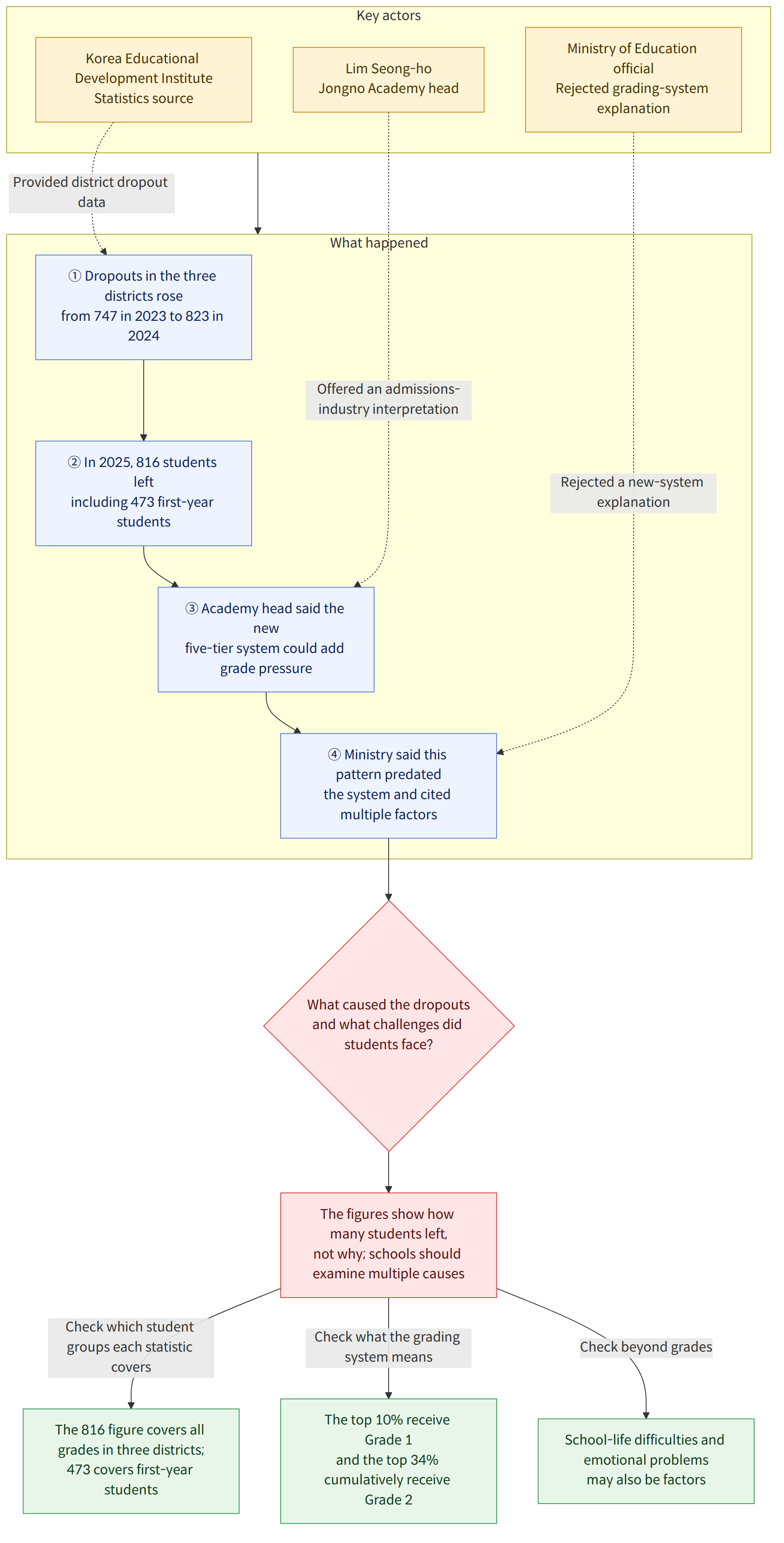
In the 2025 academic year, 816 students from Seoul’s Gangnam, Seocho and Songpa districts dropped out of general high schools, accounting for 28.3% of the citywide total of 2,884. Of these, a combined 473 first-year students from the three districts dropped out. Some interpreted the figures as evidence that the five-tier grading system (내신 5등급제) contributed to more students leaving school, but a Ministry of Education official said the trend was not caused by the new system.
The number of students who dropped out does not show why they left school. The statistics indicate how many students quit, but not the extent to which grades, difficulties with school life or emotional problems contributed to their decisions.
Background and context
According to the 2026 data on dropout rates and reasons by administrative district from the Korea Educational Development Institute’s Education Statistics Service (한국교육개발원 교육통계서비스), 2,884 students dropped out of general high schools in Seoul in the 2025 academic year. The 816 students in the three Gangnam-area districts accounted for 28.3% of that total. By district, there were 312 in Gangnam, 272 in Songpa and 232 in Seocho.
The number of students who dropped out of general high schools in the three districts rose from 747 in the 2023 academic year to 823 in 2024, then remained at a similar level in 2025. It is therefore difficult to conclude from the recent figures alone that dropouts have suddenly surged. Still, the high number of first-year students who left school points to the need to examine the challenges students face at the start of high school, including adjusting to school and competing for grades.
Reports citing data disclosed by School Info (학교알리미) gave first-year dropout rates and numbers of 5.23% and 129 students in Seocho, 4.82% and 184 in Gangnam, and 3.76% and 160 in Songpa. Compared with the previous year, the rate increased by 0.71 percentage points in Seocho and 0.01 percentage points in Gangnam, while falling by 0.09 percentage points in Songpa. The total number of first-year students across the three districts was 473. These figures cover a different group from the 816 students across all grades in the three districts, so they should not be compared as if they were based on the same criteria.
What this news means
Lim Seong-ho, head of Jongno Academy (종로학원), said the five-tier grading system was first applied to last year’s first-year high school students, with the top 10% receiving Grade 1 and the top 34% cumulatively receiving Grade 2. He said students in the competitive Gangnam area could feel a significant gap between grades if they failed to earn the marks they wanted. This is the admissions industry’s interpretation; it does not mean that all 816 students—or all 473 first-year students—left school because of the five-tier grading system.
A Ministry of Education official said the pattern of students in the three Gangnam-area districts with low grades dropping out and then taking the College Scholastic Ability Test had existed before, rejecting the explanation that the five-tier grading system created a new trend. The official also said that, when examining why students drop out, a range of factors should be considered, including not only grades but also difficulties with school life and emotional problems. Analyzing the causes in schools and the education system matters because assuming there is only one cause could mean overlooking the problems students face.
For example, imagine a first-year student considering dropping out after failing to get the grades they had hoped for. Statistics alone cannot show whether the student’s decision is due to grades or is also related to difficulties with school life or emotional problems. It is therefore important to be cautious both about generalizing dropout as an admissions strategy without looking at each student’s circumstances and about concluding that it has nothing to do with the grading system.
The report said that the 473 first-year students who dropped out in the three districts accounted for 58% of general high school dropouts in Seoul. However, the denominator’s scope differs from that of the separately cited figure of 2,884 students who dropped out of general high schools across Seoul, so the information provided does not make clear which group the 58% figure is based on.
What is confirmed and what is still unknown
Confirmed facts
- In the 2025 academic year, 2,884 students dropped out of general high schools in Seoul, including 816 in the three Gangnam-area districts, or 28.3% of the citywide total.
- The numbers of students who dropped out across all grades were 312 in Gangnam, 272 in Songpa and 232 in Seocho.
- Adding the district-level figures provided gives a total of 473 first-year students who dropped out in the three districts.
- Both the admissions industry’s interpretation that the five-tier grading system played a role and a Ministry of Education official’s explanation that the figures reflect an existing trend were presented.
What is still unknown
- The number of students who actually dropped out because of the five-tier grading system among those who left school in the three Gangnam-area districts in the 2025 academic year has not been confirmed.
- The number of students who chose to take the qualification exam for high school graduation and the College Scholastic Ability Test after dropping out, as well as their subsequent college admission outcomes, was not provided.
- The denominator and calculation scope for the figure that 473 students accounted for 58% of general high school dropouts in Seoul are unclear from the information provided.
- The respective contributions of grades, difficulties with school life and emotional problems to individual students’ reasons for dropping out are unknown.
What readers should check
- When looking at dropout statistics, first check whether the figures cover all grades or only first-year students. Figures for all students and for a particular grade cannot be directly compared.
- When assessing the relationship between the five-tier grading system and dropping out, distinguish the total number of students who left school from their actual reasons for doing so. The data do not give the number of students who dropped out because of the system.
- Students considering dropping out and their guardians should also consider difficulties with school life and emotional problems, in addition to grades, and find out what counseling or discussions are available at their school.