In 2025, 7,190 people were recorded nationwide as having died without next of kin. Of these, 53.4% received basic livelihood assistance (기초생활수급자), while 46.6% did not. In Seoul, most had lived in ordinary houses or apartments, and 74.9% of people recorded as having died without next of kin nationwide had legal next of kin. These figures show that poverty or the absence of family alone cannot explain these deaths. They also reveal a lack of a statistical system for understanding the circumstances surrounding deaths without next of kin at the national level.
Background and context
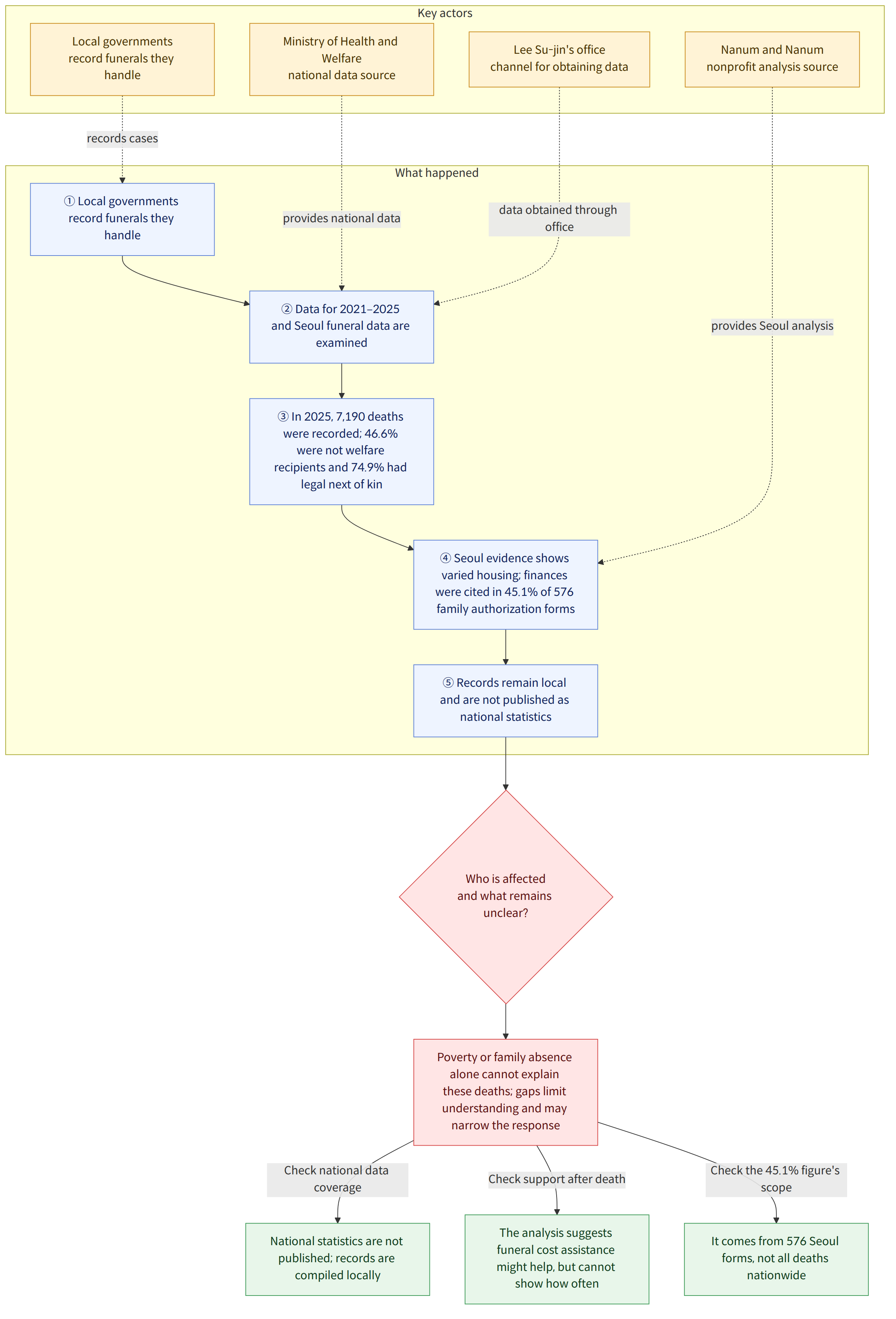
The analysis examined data on deaths without next of kin from the Ministry of Health and Welfare (보건복지부) for 2021–2025, obtained through the office of Lee Su-jin of the Democratic Party of Korea (더불어민주당), alongside Seoul public funeral data from the nonprofit organization Nanum and Nanum (나눔과나눔). Here, a death without next of kin is not limited to cases in which the person had no family or legal next of kin at all. Last year, 74.9% of people recorded nationwide as having died without next of kin had legal next of kin, such as a spouse, lineal ascendants or descendants, or siblings.
These figures show that having next of kin does not necessarily mean that a funeral can actually be arranged. The original report suggests that people may have declined to claim the deceased or arrange a funeral because of estrangement or the cost, but it does not state how much each reason accounted for across all cases.
Poverty is not a single dividing line between deaths with and without next of kin, either. Some 46.6% of those who died were not recipients of basic livelihood assistance, and a survey of the residences of 1,471 people recorded as having died without next of kin in Seoul found that 57% had lived in ordinary houses and 13% in apartments. Another 17% had lived in jjokbang rooms, gosiwon boarding houses, or inns. This indicates that deaths without next of kin are not confined to people in particular housing conditions or groups receiving welfare benefits.
Among the 1,471 people in Seoul, 1,233, or 83.8%, had never married or were divorced. This figure applies to the Seoul data; it is not a statistic on marital status for the nationwide total. Also, among those recorded nationwide as having died without next of kin last year, 149 were foreign nationals and 126 were in their 20s or 30s. These cases show that the circumstances behind such deaths cannot be reduced to a single profile.
What this means
If deaths without next of kin are viewed only as a problem of poverty or isolation, the scope of the response may be too narrow. The statistics also include people who were not welfare recipients or who lived in ordinary houses or apartments, as well as people who had legal next of kin but whose funerals were not arranged by them. This underscores the need to look not only at the deceased’s financial circumstances but also at situations in which a funeral cannot be arranged or is declined despite the presence of legal next of kin.
Nanum and Nanum’s analysis of 576 funeral authorization forms submitted by next of kin in Seoul found that financial problems were cited in 45.1% of cases as the reason the family declined to arrange the funeral. This result, however, is based on 576 authorization forms from Seoul and should not be interpreted as the proportion of all deaths without next of kin nationwide attributable to financial problems. The analysis also suggests that families might have arranged the funeral themselves if post-death support, such as funeral cost assistance, had been available, but the data alone cannot establish how often that might have been the case.
For example, even if someone has legal next of kin, it may be difficult to explain their final circumstances simply by noting that they have family if ties have been severed or the family cannot afford the funeral and does not take responsibility for it. This is a hypothetical example, not verified information about the circumstances of any individual death.
Statistics on deaths without next of kin are managed by collecting the number of funerals handled and entered into records by local governments, and are not published as national statistics. This limits the ability to understand not only the scale of the issue but also who came to be without next of kin and why.
What is known and what remains unclear
What is known
- There were 7,190 deaths recorded as without next of kin nationwide in 2025.
- Of those who died, 53.4% received basic livelihood assistance, while 46.6% did not.
- In 74.9% of cases recorded nationwide as deaths without next of kin, the person had legal next of kin.
- Among 576 funeral authorization forms from Seoul, financial problems were cited as the reason for declining to arrange a funeral in 45.1% of cases.
- Statistics on deaths without next of kin are not published as national statistics. They are managed by collecting the number of funerals handled and entered into records by local governments.
What remains unclear
- The figures do not show how the number of deaths without next of kin changed year by year from 2021 to 2025.
- Detailed information, including the deceased’s sex and the nationalities of foreign nationals who died, is not available.
- The figures do not give the proportions of reasons other than financial problems for families declining to arrange a funeral.
- The data do not show how many people recorded as having died without next of kin despite having legal next of kin experienced specific circumstances, such as estrangement or financial constraints.
What readers should check
- When consulting statistics on deaths without next of kin, check whether the figures are nationwide or from a Seoul survey, and identify the data and analysis sample on which they are based.
- The proportion citing financial problems in funeral authorization forms comes from an analysis of those documents. Check the scope before treating it as the proportion of all deaths without next of kin attributable to financial problems.
- If you are concerned about a family member’s or someone close to you’s funeral wishes or the financial burden, you can contact your local government to ask whether information is available about relevant funeral procedures and assistance. These data alone cannot establish eligibility for assistance or application requirements.