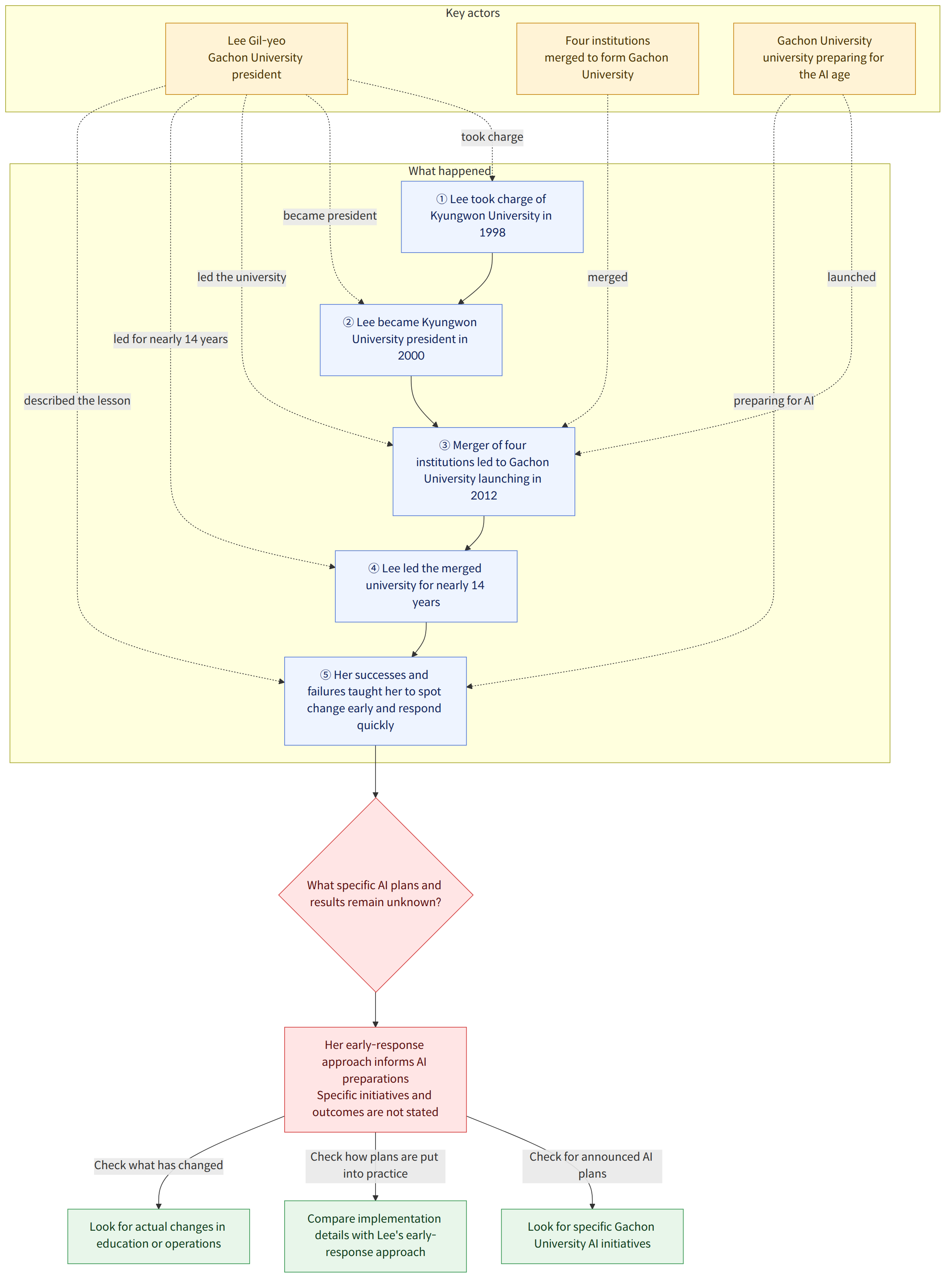
At 94, Gachon University (가천대학교) President Lee Gil-yeo continues to think about what lies ahead. South Korea’s longest-serving university president, she took charge of Kyungwon University (경원대학교) in 1998 and became its president in 2000. She led the merger of four institutions, which resulted in the launch of Gachon University in 2012, and has led the merged university for nearly 14 years.
What she emphasized in the interview was not simply how long she has worked. She said that the successes and failures she experienced while building hospitals and educational institutions taught her to spot change early and act quickly, and that this approach is guiding Gachon University’s preparations for the age of artificial intelligence.
Background and context
According to the article, university presidents in South Korea generally serve relatively short terms. Against that backdrop, President Lee’s tenure is exceptionally long. Her career—taking charge of Kyungwon University in 1998, becoming its president in 2000, and then leading Gachon University for nearly 14 years after its launch through the merger of four institutions—shows how she has overseen the university’s development and operations over an extended period.
President Lee said that she experienced not only success but also failure over the decades she spent building hospitals and educational institutions. The lesson she drew from those experiences was to spot signs of change early and respond quickly. She explained that this kind of proactive response is connected to Gachon University’s preparations for the age of artificial intelligence.
President Lee said, “Hardship itself is a kind of success and becomes the foundation for success.”
What this news means
President Lee’s example suggests that preparing for the age of artificial intelligence may involve more than simply adopting new technology; it may also mean watching for signs of change and responding before it fully takes hold. This is, however, a direction that can be inferred from her remarks. The article as provided does not establish what specific initiatives or curricula Gachon University is using to put this approach into practice.
Her long tenure is notable because it illustrates how one leader’s experience can shape a university’s approach to responding to change. At the same time, determining what changes that response has actually produced requires specific plans and details about their implementation. President Lee’s experience should therefore be distinguished from the university’s actual results in preparing for artificial intelligence.
For example, if a university needs to prepare for a new technological shift, the approach President Lee described can be understood as identifying change early and responding quickly rather than trying to catch up after the fact. This is an assumption about the approach, however, and does not mean that Gachon University is pursuing any particular initiative.
Confirmed facts and what remains unknown
Confirmed facts
- President Lee Gil-yeo is 94 and is South Korea’s longest-serving university president.
- She took charge of Kyungwon University in 1998 and became its president in 2000.
- The merger of four institutions led to the launch of Gachon University in 2012.
- She has led the merged Gachon University for nearly 14 years.
- She said her experiences of success and failure taught her to recognize change early and act quickly.
What remains unknown
- What specific initiatives is Gachon University pursuing to get ahead in the age of artificial intelligence?
- What specific examples of success and failure did President Lee experience while building hospitals and educational institutions?
- What actual changes in education or operations have resulted from the university’s proactive response?
What readers should check
- It is worth checking whether Gachon University has announced specific plans or initiatives related to preparing for the age of artificial intelligence.
- If such plans have been announced, readers can examine how they put into practice President Lee’s stated approach of identifying change early and responding quickly.
- Readers should not treat her long tenure as equivalent to the university’s results in preparing for artificial intelligence, and should check whether specific implementation details are available.