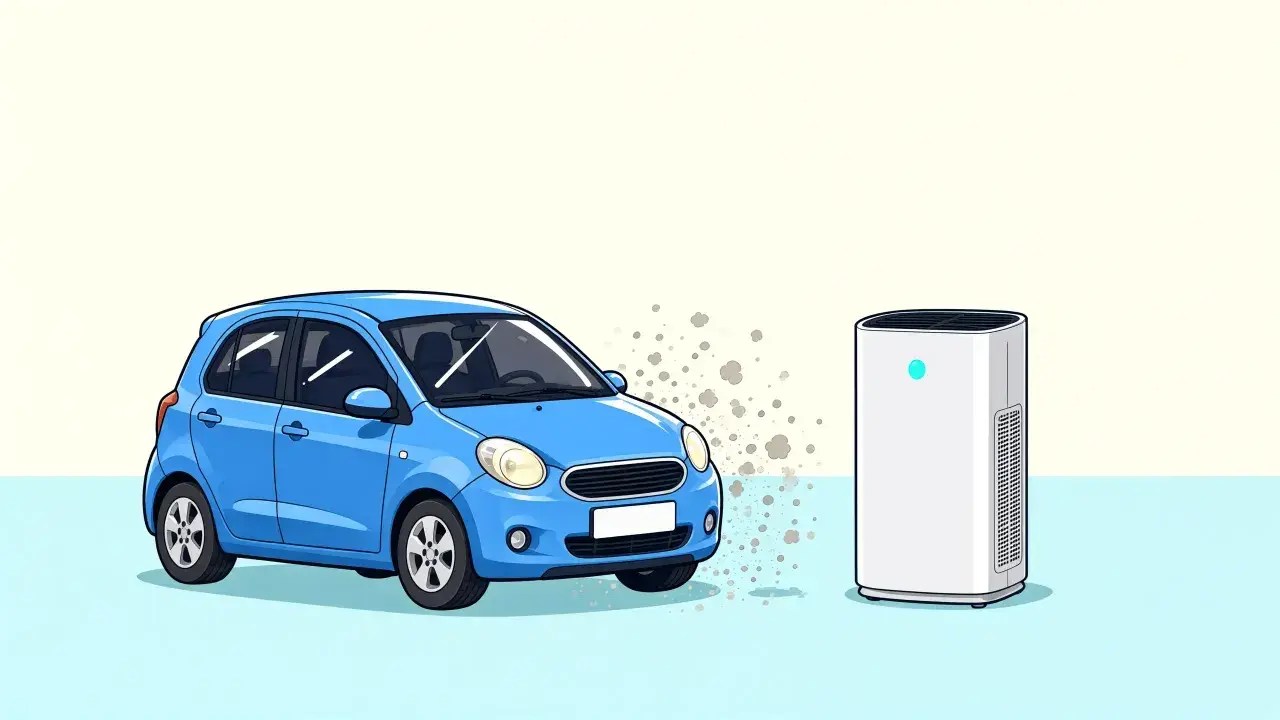
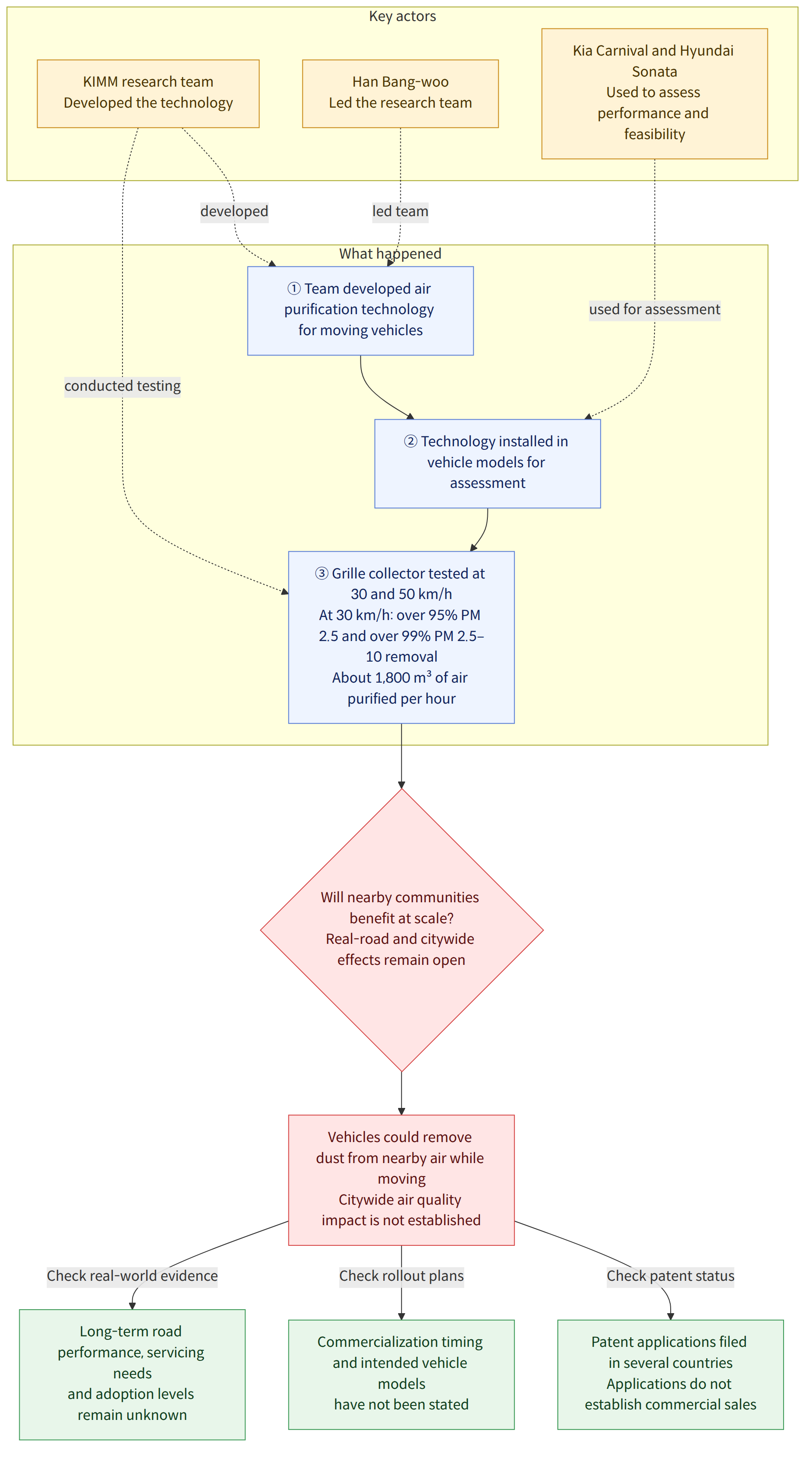
A research team at the Korea Institute of Machinery and Materials (한국기계연구원; KIMM) announced that it had developed an automotive air purification technology that removes fine dust and brake dust from the surrounding air while a vehicle is moving. In performance testing, the grille-type collector removed more than 95% of ultrafine particulate matter (PM 2.5) and more than 99% of fine dust (PM 2.5–10) when driven at 30 km/h. According to the article, this performance was maintained at 50 km/h, and one vehicle purified about 1,800 m³ of air per hour.
Background and context
The technology was introduced as one of the key achievements of AirFive, one of KIMM’s five flagship brands. The research team was led by Han Bang-woo, head of the Urban Environment Research Division at the Environmental and Energy Research Division. The technology aims to use vehicles traveling through cities as air purification devices, reducing dust around roads and particles generated by brake wear.
The purification method varies depending on the vehicle’s state. Grille-type and caliper-type collection technologies are used while driving, while wireless power transfer technology is included for purification while parked. However, the specific removal rates and hourly purification volume reported in the article are results from performance testing of the grille-type collector. No separate figures were provided for purification while parked or for the caliper-type collector.
The research team installed the technology in vehicle models including the Kia Carnival and Hyundai Sonata to assess its performance and feasibility. The findings were published in international academic journals, including Tribology International and Atmosphere, and multiple patents were filed in several countries, including South Korea, the United States and Germany. This means that research was conducted and patent applications were filed; it does not mean that the technology has been applied to specific vehicle models or that commercial sales have begun.
What this news means
The possibility raised by this technology is that cars could be used not only to transport people and goods, but also to purify the surrounding air as they move. The evaluation also reported that one vehicle could purify about 1,800 m³ of air per hour, but this figure alone is not enough to determine how much air quality across an entire city might change. Information on how widely the vehicles are adopted and how much they are driven, as well as how the technology performs in road conditions, would also be needed.
For example, if a vehicle equipped with this technology were to drive on urban roads, it could help reduce dust in the air around it. But this is an assumption based on how the technology works and the reported evaluation results. The original article does not say what area of air the technology affects on actual roads or how other vehicles and the surrounding environment might affect it.
In particular, it is important to distinguish between the removal rates confirmed in testing and the results that can be sustained in actual operating conditions. The article reports the grille-type collector’s performance at 30 km/h and 50 km/h, but does not explain whether the same performance is maintained after long-term use or how often the collection components need to be serviced. More information like this would be needed to assess the impact commercialization could have on urban air quality.
What is known and what remains unknown
What is known
- The KIMM research team announced that it had developed an automotive air purification technology that removes fine dust and brake dust from the surrounding air while a vehicle is moving.
- In testing, the grille-type collector removed more than 95% of PM 2.5 and more than 99% of PM 2.5–10 when driven at 30 km/h. According to the article, it maintained the same performance at 50 km/h.
- The reported purification volume was about 1,800 m³ per hour for one vehicle.
- The technology was installed in vehicle models including the Kia Carnival and Hyundai Sonata to assess its performance and feasibility.
- The research findings were published in international academic journals, and patent applications were filed in several countries.
What remains unknown
- The article does not say when the technology will be commercialized or which vehicles it is expected to be applied to.
- Its performance after long-term use in actual road conditions is unknown.
- The original article does not provide maintenance costs or the required maintenance schedule.
- Specific performance figures for purification while parked and for the caliper-type collector have not been confirmed.
What readers should check
- It will be important to see whether plans for specific vehicle models or commercialization are announced in the future. Installing the technology in research vehicles to assess feasibility and actually selling or applying it are separate stages.
- If information about a product or an equipped vehicle becomes available, readers can check the conditions under which its performance figures were measured and whether results while driving are distinguished from those while parked.
- Anyone considering purchasing or using the technology should also check whether long-term performance data, instructions for maintaining the collection components and maintenance costs have been made public.