BYD’s Atto 1 electric vehicle has a five-star safety rating and a touchscreen, and costs around NZ$30,000. The growing availability of affordable new EVs could do more than expand consumers’ choices: it could also affect the prices of widely used second-hand petrol cars in New Zealand and the businesses built around them. However, the actual scale of that impact has not yet been established.
Background and context
Used imported cars make up a large share of New Zealand’s automotive market. According to figures cited in the article, used imports accounted for 42% of the existing light-vehicle fleet in 2023, and almost 97% of used passenger-car imports in 2025 came from Japan. As a result, changes in new-car prices can extend beyond the new-car market, affecting the relative appeal and prices of used cars as well.
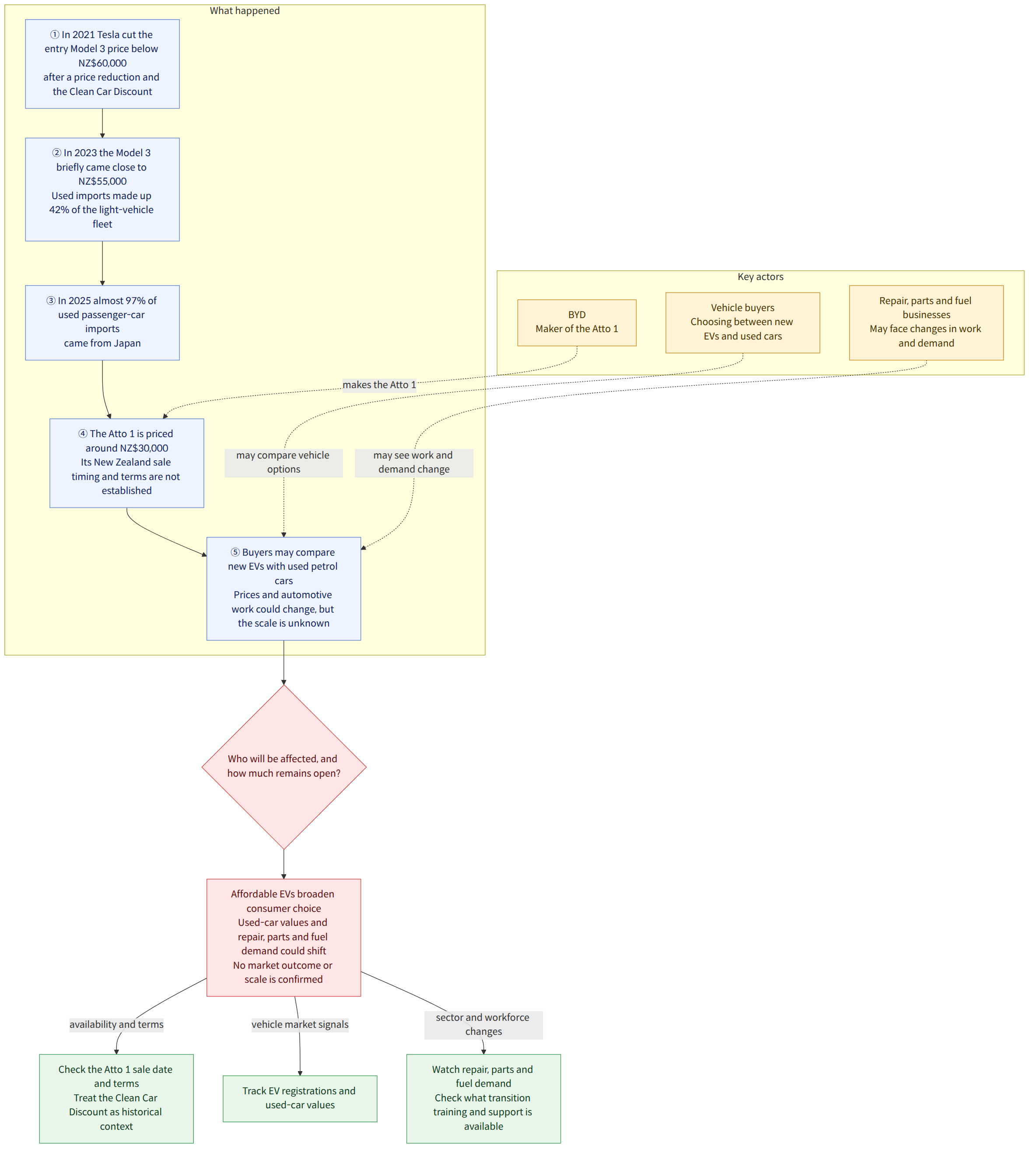
This is not the first time EV prices have drawn attention in the market. The article reports that Tesla cut the price of its entry-level Model 3 to below NZ$60,000 in 2021, following a price reduction and the effects of the Clean Car Discount scheme (청정차 할인 제도) then in place; in 2023, the price briefly came close to NZ$55,000 after the discount. The Atto 1’s price of around NZ$30,000 is noteworthy because it enters a price range where new EVs may be compared more directly with used petrol cars.
New and used cars are not separate markets. If buyers can pay a little more for a new EV with a similar purpose, they may reconsider whether the price of a used petrol car is still reasonable. If the so-called “price ladder”—the structure through which new-car prices have a knock-on effect on used-car prices—compresses, the value of older vehicles could come under pressure too, not just that of cars competing directly with new models.
What this means
For consumers, affordable EVs can expand the range of vehicles available to choose from. For people looking to buy or sell a used car, however, the price of a new EV could change the appeal and transaction prices of used petrol cars. The information available does not establish when the Atto 1 will go on sale in New Zealand, the terms on which it will be available, or the extent of any price changes.
For example, if the price gap between a new EV and a used petrol car with a similar purpose narrows, buyers may compare not only the upfront price but also the costs of keeping the vehicle and how they intend to use it. Used-car prices could then fall, but this is a hypothetical example illustrating a possibility, not an outcome already confirmed in the market.
The effects may extend beyond vehicle prices. New Zealand’s automotive sector employs more than 68,000 people across around 15,000 businesses and contributes about NZ$8 billion to gross domestic product. Around 23,400 people work in the automotive repair and maintenance sector. As the mix of vehicles changes, so can the parts and maintenance skills required, making it difficult to explain the transition solely in terms of consumers’ purchasing choices.
EVs still need tyre and suspension replacements, collision repairs and electrical-system maintenance. But they do not require oil changes, exhaust-system work, spark-plug replacements, or many engine and transmission repairs. This does not mean that all repair jobs will disappear, but the kinds of work repair shops and parts suppliers need to provide may change. If falling used-car values make it harder to afford repairs on older vehicles, some may be scrapped earlier, potentially affecting demand for parts, fuel and repairs.
What is known and what remains uncertain
What is known
- The BYD Atto 1 is described as having a five-star safety rating and a touchscreen, and as costing around NZ$30,000.
- Used imports accounted for 42% of New Zealand’s existing light-vehicle fleet in 2023, and almost 97% of used passenger-car imports in 2025 came from Japan.
- MITO’s 2025 report counted around 15,000 businesses and more than 68,000 jobs in the automotive sector, which contributes about NZ$8 billion to gross domestic product.
- According to the article, citing Statistics New Zealand data (뉴질랜드 통계청 자료), China supplied 73% of New Zealand’s fully electric vehicle imports in the year to June 2026.
What remains uncertain
- When the Atto 1 will become available to buy in New Zealand, and on what terms.
- How much affordable new EVs will change used-car prices and the scale of scrappage.
- What transition training and support would be available if jobs in repair, parts and fuel-related businesses decline or the work they do changes.
What readers should check
- Anyone considering buying a vehicle should check when the Atto 1 will go on sale in New Zealand and the actual terms of purchase. The currently quoted price of around NZ$30,000 alone does not establish when or on what terms it will be available.
- When buying or selling a used car, people can consider not only the prices of new EVs but also the price and repair needs of the vehicle they are comparing. The effect of changes in new-EV prices on used-car values has not yet been quantified.
- People working in the automotive industry and businesses in the sector should monitor not only EV registrations but also used-car values, scrappage, repair businesses and employment in the automotive sector. The article raises the need for training in electrical, electronics and software skills, but does not set out specific transition support measures.
The author stresses that these changes do not mean New Zealand’s automotive industry is on the brink of collapse. Vehicle replacement is a slow process, and petrol cars may remain on the road for decades. But as affordable EVs become more widely available, the way cars are bought and sold—and the work involved in repairing them and supplying parts—may change as well. To understand the economic effects of the EV transition, it is therefore necessary to look not only at registration numbers but also at used-car values and scrappage, as well as local businesses and employment.