
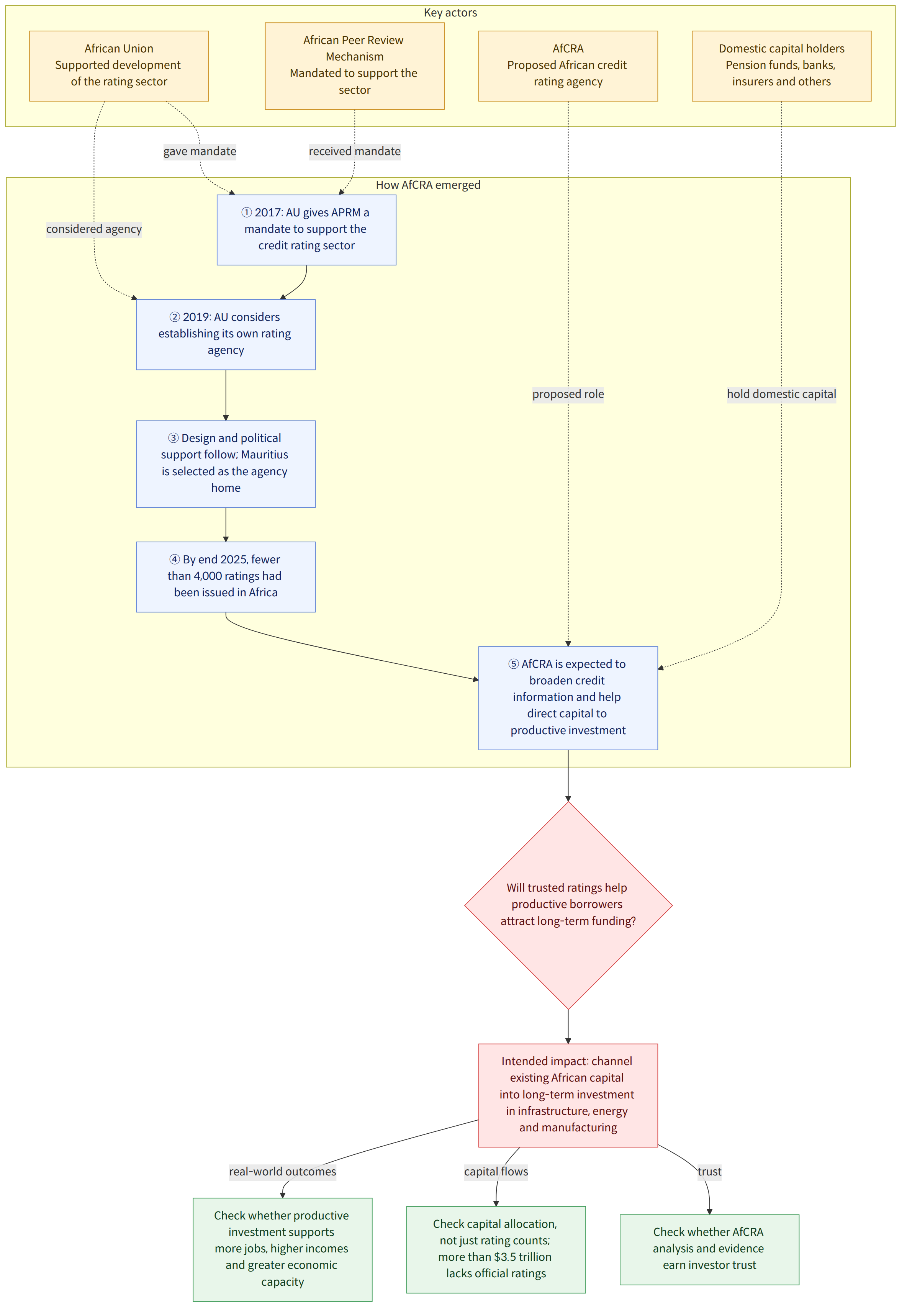
There is an ongoing debate over whether the African Credit Rating Agency (AfCRA, 아프리카신용평가기관) should be seen as a competitor to established international credit rating agencies, and whether Africa needs a new rating agency. The author, Misheck Mutize, argues that these questions miss the point. Rather than replacing existing agencies, AfCRA’s role should be to broaden Africa’s credit information and capital markets, helping direct capital that already exists toward productive investment.
Background and context
A credit rating assesses the ability of a government, company or other borrower to repay its debts. The assessment can influence where investors allocate their money and how much it costs to raise funds. According to the article, Africa’s rating industry is small, and entities and issuers that have received credit ratings account for less than 5% of the estimated total capital.
Africa has substantial domestic capital held or controlled by pension funds, sovereign wealth funds, banks, insurers and other investors. Estimates cited in the article put this capital base at $4 trillion. However, the author explains that much of this domestic capital is concentrated in 90-day treasury bills and bonds, while productive sectors such as infrastructure, manufacturing and energy do not receive enough funding.
The scale of financial instruments and economic entities with official credit ratings is put at less than $500 billion. The article also reports that, as of the end of 2025, international and domestic rating agencies had issued fewer than 4,000 credit ratings in Africa. In the same year, the European Union had 823,000 ratings and the United States had more than 2 million. There are nine rating agencies operating in Africa, fewer than the 10 in the United States and the 29 in the European Union.
Efforts to establish AfCRA did not begin overnight. Other reporting says the African Union (아프리카연합) gave the African Peer Review Mechanism (아프리카 동료검토 메커니즘) a mandate to support the credit rating sector in 2017 and considered the possibility of establishing its own rating agency in 2019. Design work and political support for a private-sector-led model followed, and Mauritius was selected as the agency’s home. This process shows that creating an institution and providing ratings that are actually trusted are two separate matters.
What this means
AfCRA’s ratings could provide investors with information to assess risk. The article highlights the concern that, in an environment with few rated entities and limited information, the risks of a company or project may be perceived as greater than they actually are, or the region’s economic, political and institutional context may not be adequately reflected. If the agency’s analysis and supporting evidence earn trust, investors may consider a wider range of investments beyond short-term, easily liquidated instruments.
However, assigning ratings alone will not automatically shift money into infrastructure or manufacturing. The role the author proposes for AfCRA goes beyond issuing ratings. Its aims also include adding credit information on more than $3.5 trillion in capital that has no official rating, broadening the market information ecosystem investors need to distinguish between risks, and improving a structure in which risk perceptions keep capital from reaching productive sectors.
Accordingly, when assessing its performance, the focus should be not only on the number of ratings but also on how its analysis changes the allocation of capital. The author argues that the ultimate measure should be whether AfCRA contributes to more jobs, higher incomes and greater economic capacity through productive investment in infrastructure, energy and manufacturing. This means AfCRA’s mission should extend beyond increasing its market share as a rating agency to helping create a more balanced financial structure in Africa.
For example, if an African company or project has struggled to attract long-term funding because it lacked sufficient credit information, an AfCRA rating could give investors a more detailed explanation of the risks. Even so, it will be necessary to separately establish whether the company or project can actually secure funding and whether that funding leads to productive activity and jobs.
Related institutions and support information
The materials provided do not include information about support programs readers can apply for, deadlines, visa requirements or personal legal procedures. However, AfCRA’s establishment is connected to the African Union’s efforts to build institutions in the credit rating sector. Other reporting says the African Peer Review Mechanism was mandated to support member countries’ credit rating sectors, and that AfCRA was envisioned as an agency that would complement, rather than displace, the world’s three largest rating agencies.
A key element of this vision is whether independent, context-sensitive assessments are actually provided. Investors and the entities being rated need to be able to understand not only the ratings themselves, but also the data and evidence used and the context of the analysis. The materials do not explain AfCRA’s specific rating methodology, funding or governance, so these should not be treated as settled institutional arrangements.
What is known and what remains unclear
What is known
- According to the article, Africa’s domestic capital base is estimated at $4 trillion, and much of that capital is concentrated in short-term treasury bills and bonds.
- The scale of financial instruments and economic entities subject to official credit ratings is put at less than $500 billion.
- Fewer than 4,000 credit ratings had been issued in Africa as of the end of 2025, and nine rating agencies operate in Africa.
- AfCRA is presented as an agency that would broaden Africa’s credit information and financial market ecosystem rather than directly compete with established international rating agencies.
- The author argues that AfCRA’s success should be assessed by whether it contributes to productive investment and expands jobs, incomes and economic capacity.
What remains unclear
- The materials do not say when AfCRA will actually begin operating or what its specific rating methodology will be.
- Its funding and governance arrangements have not been confirmed.
- It remains unknown how much its ratings will change investors’ capital allocation or how much long-term funding they will actually direct to productive sectors.
What readers should watch for
- If AfCRA begins issuing ratings, readers should look at not only the ratings but also the supporting rationale and how regional context is reflected.
- Readers should check whether the expansion goes beyond increasing the number of entities rated and connects long-term funding to productive sectors such as infrastructure, energy and manufacturing.
- Readers can watch whether cooperation among rating agencies, investors, policymakers and financial institutions actually builds trust in information and changes how capital is allocated.
References
- Other coverage consulted: theconversation.com