
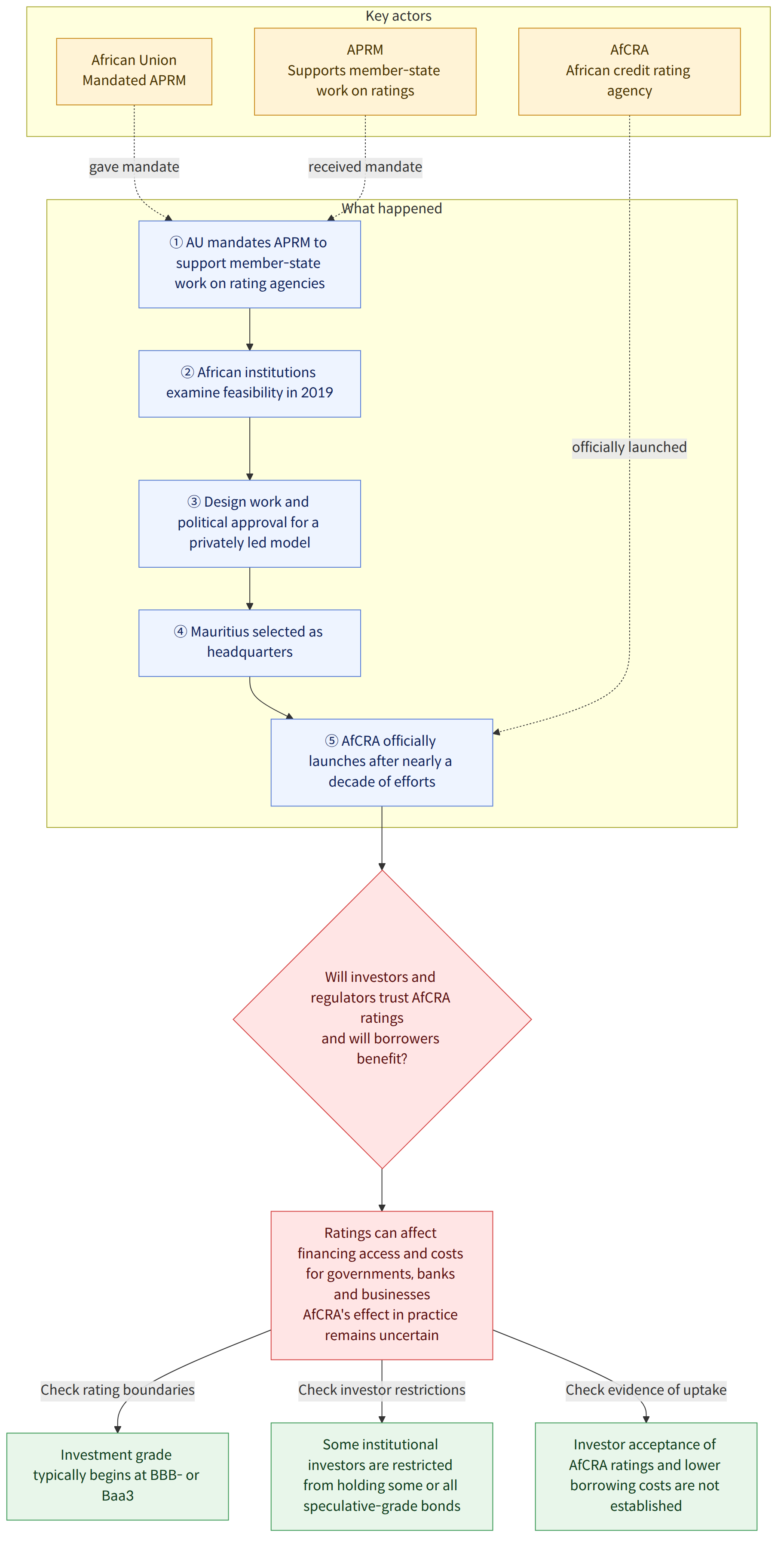
The African Credit Rating Agency (아프리카신용평가기관, AfCRA) has officially launched after nearly a decade of efforts to establish it. The African Peer Review Mechanism (아프리카 동료검토메커니즘, APRM) describes the agency as a complement to Moody’s, S&P Global Ratings and Fitch, not a competitor to them. AfCRA’s mission is to provide fair, independent, context-sensitive and accurate assessments of African economies.
The launch is a milestone in institution-building, but whether AfCRA can carry out its mission in practice and earn the confidence of investors and regulators is a separate question.
Background and context
AfCRA was not established overnight. In 2017, the African Union (아프리카연합, AU) gave APRM a mandate to support member states’ work related to credit rating agencies, and African institutions began examining the feasibility of establishing their own agency in 2019. This was followed by design work, political approval for a privately led model and the selection of Mauritius as the agency’s headquarters.
One distinction is important here. The available evidence supports the claim that a privately led model received political approval and that Mauritius was selected as the headquarters. That alone does not establish that AfCRA is actually operating under that model.
Alongside the AU’s becoming a permanent member of the G20 in 2023, AfCRA’s launch is part of a broader trend of institution-building at the continental level. AfCRA’s role, however, is to assess borrowers’ creditworthiness—not to lend money or set trade rules.
The assessment matters because it is linked to development finance. The development, infrastructure and industrial capacity-building initiatives pursued by African governments and businesses may require external financing beyond what can be funded through domestic revenue alone. In that context, assessments of how reliably a borrower is likely to repay can affect whether investors provide financing and what costs they demand.
What this news means
A credit rating is a specialized agency’s opinion on the likelihood that a borrower will repay its debt in full and on time. Ratings are expressed on a scale ranging from investment grade to speculative grade. The article identifies the lower boundary of investment grade as typically BBB- or Baa3 under Moody’s scale. Some institutional investors are restricted from holding all or some speculative-grade bonds.
Ratings, therefore, may be more than a simple scorecard. If some investors do not accept bonds below a particular rating, borrowers may be affected both in terms of the pool of investors available to lend them money and the cost of financing. Because assessments of a government’s creditworthiness can also affect financing conditions for banks and businesses, the impact of a rating need not be limited to government bonds.
The figures also show why the investment-grade threshold matters. An analysis by IMF economists Laura Jaramillo and Catalina Tejada of 35 emerging market economies from 1997 to 2010 found that entering investment grade reduced borrowing spreads—the additional interest paid on top of a benchmark rate—by 36% compared with the level expected on the basis of macroeconomic fundamentals alone. This does not mean AfCRA’s ratings would have the same effect. Rather, the analysis shows that a change in rating category can be linked to financing conditions.
According to UNCTAD data, from early 2012 through May 2023, developing countries paid an average of about 200 basis points (bp) more than developed countries for international capital. A basis point is a unit used to express an interest-rate difference. This gap alone does not show that credit ratings are the cause, but it does underscore that financing costs are a significant issue in discussions about development finance.
For example, imagine an African company seeking external investment. If an investor consults the company’s credit rating and restricts bonds below a certain grade, the rating could affect whether the investor participates or what interest rate it demands. But it cannot be assumed in advance that AfCRA’s ratings will be accepted by investors in practice or lower the company’s financing costs.
Related institutions and rating criteria
A credit rating is an opinion about a borrower’s ability to repay, not a guarantee that the debt will be repaid. The boundary between investment grade and speculative grade attracts attention because it may be linked to restrictions on what some institutional investors can hold. When interpreting a rating, it is therefore important to consider not only the rating itself but also which ratings the providers of financing accept.
Ratings can also become part of financial rules. According to the article, in 1975 U.S. financial regulators began formally recognizing ratings from designated agencies when setting capital requirements for regulated institutions. This is an example of how rating agencies’ assessments can intersect with regulation, beyond informing the judgments of market participants. That fact alone, however, does not tell us how or whether AfCRA’s ratings will be recognized under the regulations of any country.
How different reports framed the issue
One source emphasizes that APRM describes AfCRA as a complement to the world’s three major rating agencies, not a challenger to them. Another source reports that some analysts have portrayed AfCRA as a competitor to the existing three major agencies, while arguing that this framing misses the bigger picture.
What is confirmed and what remains unknown
What is confirmed
- AfCRA has officially launched after nearly a decade of efforts to establish it.
- In 2017, the AU gave APRM a mandate to support member states’ work related to credit rating agencies, and African institutions began examining the feasibility of establishing their own agency in 2019.
- During the establishment process, a privately led model received political approval and Mauritius was selected as the headquarters.
- APRM describes AfCRA as a complement to the existing three major global rating agencies and sets out a mission to provide fair, independent and context-sensitive assessments of African economies.
What remains unknown
- Will AfCRA be able to provide independent, context-sensitive assessments in practice?
- How widely will investors and regulators accept AfCRA’s assessments?
- Will AfCRA’s ratings be able to lower financing costs for African borrowers?
What readers should look for
- When reviewing a credit rating, readers should look not only at the name of the rating agency but also at whether the rating is investment grade and whether the relevant financing provider accepts it.
- Readers should watch for whether AfCRA’s assessments are recognized in actual investment decisions or relevant regulations. The fact that the agency has launched does not establish whether the market will accept its ratings.
- When encountering claims that a change in ratings will lower borrowing costs, readers should distinguish between an effect that has been demonstrated and one that is expected or projected by an analysis.
References
- Other coverage consulted: theconversation.com