
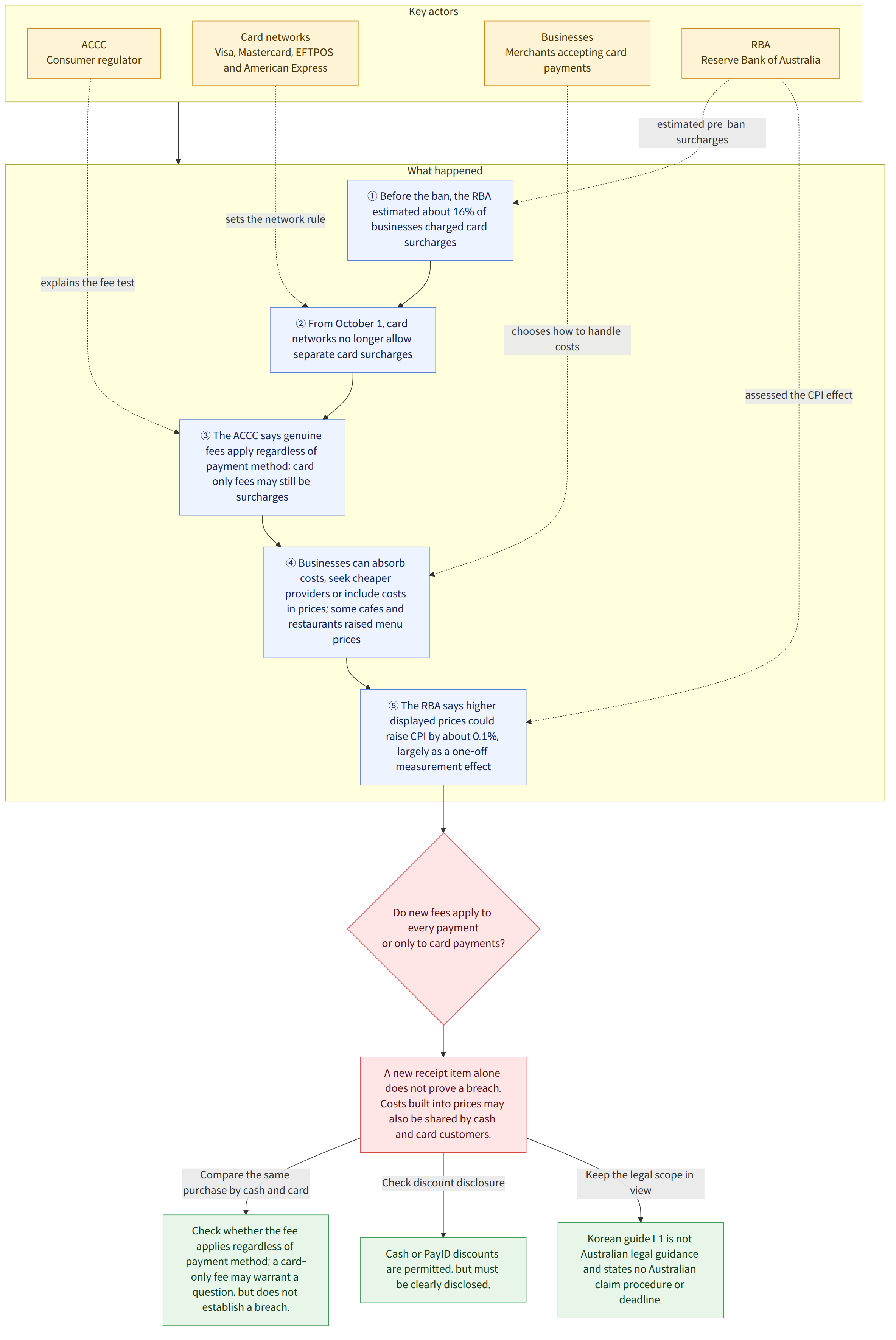
With Australia’s card surcharge ban taking effect on October 1, Visa, Mastercard, EFTPOS and American Express no longer allow businesses to add a separate fee for customers paying by card. However, not every newly visible “service fee” or “daily surcharge” is prohibited. The key is not what the fee is called, but what causes it to be charged.
Background and context
The Australian Competition and Consumer Commission (호주 경쟁소비자위원회, ACCC) says businesses may continue to charge genuine service fees or booking fees that apply regardless of payment method. Conversely, if a fee is charged only when a customer pays by card, it may count as a card surcharge even if it is called a “service fee.” The ACCC warns that changing the name of a surcharge to get around the rules could mislead consumers.
Before the ban, the Reserve Bank of Australia (호주중앙은행, RBA) estimated that about 16% of businesses charged card surcharges. These included cafés, restaurants, grocery stores, Aldi and some online stores, while most large retailers did not charge them. According to the RBA, consumers paid about A$1.6 billion in card surcharges in 2024–25; the source cited in the article put the fees at 0.5–1.5% of the transaction amount.
The surcharge ban does not eliminate businesses’ costs of accepting card payments. Businesses can absorb those costs, look for a cheaper payment service provider, or factor them into the prices of their goods and services. The article also reports that some cafés and restaurants raised menu prices on October 1 to offset the costs charged by card providers.
What this means
For consumers, the appearance of a new item on a receipt does not, by itself, establish that a business has breached the rules. The starting point is whether the fee applies to all payments or only to card payments. For example, if there is no extra charge when the same product is bought with cash but a fee is added when paying by card, there is reason to ask whether that item is a card surcharge—even if it is labelled a “service fee.” However, the examples or fee descriptions in the article do not establish that any particular business has breached the rules.
If businesses include the cost in their prices, customers paying with cash or a cheaper payment method may also share some of the cost of accepting card payments. Discounts for paying with cash or PayID are permitted, but the discounts must be clearly disclosed. With separate surcharges gone, extra charges immediately before payment may be less visible, but it may be harder to tell how much of a displayed price reflects the cost of card payments.
It is also important to distinguish price indicators from actual spending. The RBA estimated that including existing card surcharges in displayed prices could raise the Consumer Price Index (CPI)—a measure of changes in the prices of goods and services purchased by households—by about 0.1%. Existing surcharges were not included in the CPI, but higher displayed prices would be, so the RBA describes this as largely a one-off measurement effect. This should be distinguished from a situation in which a business raises its overall prices by more than the previous surcharge, in which case consumers would actually pay more.
Relevant rules and support information
Internal legal guide L1 is a resource addressing consumer harm and advertising and disclosure issues in Korea; it is not legal guidance on Australia’s card surcharge rules. However, when considering whether consumers may be misled, the Korean resource’s standard—that the overall impression received by a reasonably careful consumer should be assessed objectively, rather than looking at isolated wording in an advertisement or disclosure—may be useful when checking how a fee is presented. This standard does not tell consumers what evidence Australian regulators would actually require.
L1 explains that in a claim for damages, the issues may include not only whether a disclosure caused confusion but also actual loss and the causal link between the conduct and that loss. Therefore, if consumers want to raise a concern about a price difference, distinguishing what changed—for example, the displayed price, the amount shown at checkout, or a fee item on the receipt—may help them explain the situation. However, L1 does not specify a particular deadline for making a claim, and it cannot be used to draw conclusions about rights or procedures in Australia.
What is known and what remains unclear
What is known
- From October 1, card networks no longer allow businesses to add card surcharges for customers paying by card.
- Genuine service fees and booking fees that apply regardless of payment method may still be charged.
- Businesses can absorb the cost of accepting cards, find a cheaper payment provider, or factor the cost into their overall prices.
- Mandatory ordinary service fees that cannot be avoided and can be calculated in advance generally must be included in the displayed total price.
- Cafés and restaurants may display weekend and public holiday surcharges separately, but menus must prominently state the surcharge rate and the days it applies.
What remains unclear
- The article does not say what evidence regulators would require to determine whether a particular service fee is a card surcharge with only its name changed.
- It has not been established whether any of the individual businesses mentioned in the article actually breached the rules.
- It is not possible to know across the board whether each business absorbed the cost of card payments, chose another provider, or factored the cost into its prices.
What readers can check
- Compare the displayed price before payment with the amount at checkout and the receipt, and check which payment methods trigger any new fee.
- If there is a mandatory ordinary fee, check whether it can be calculated in advance and whether it is included in the displayed total. For weekend and public holiday surcharges, check that the applicable days and rate are clearly stated on the menu.
- If a discount for paying with cash or PayID is advertised, check that its terms are clearly disclosed. Even if a fee seems unfair, do not conclude that it breaches the rules based only on its name; check the actual conditions and payment details.