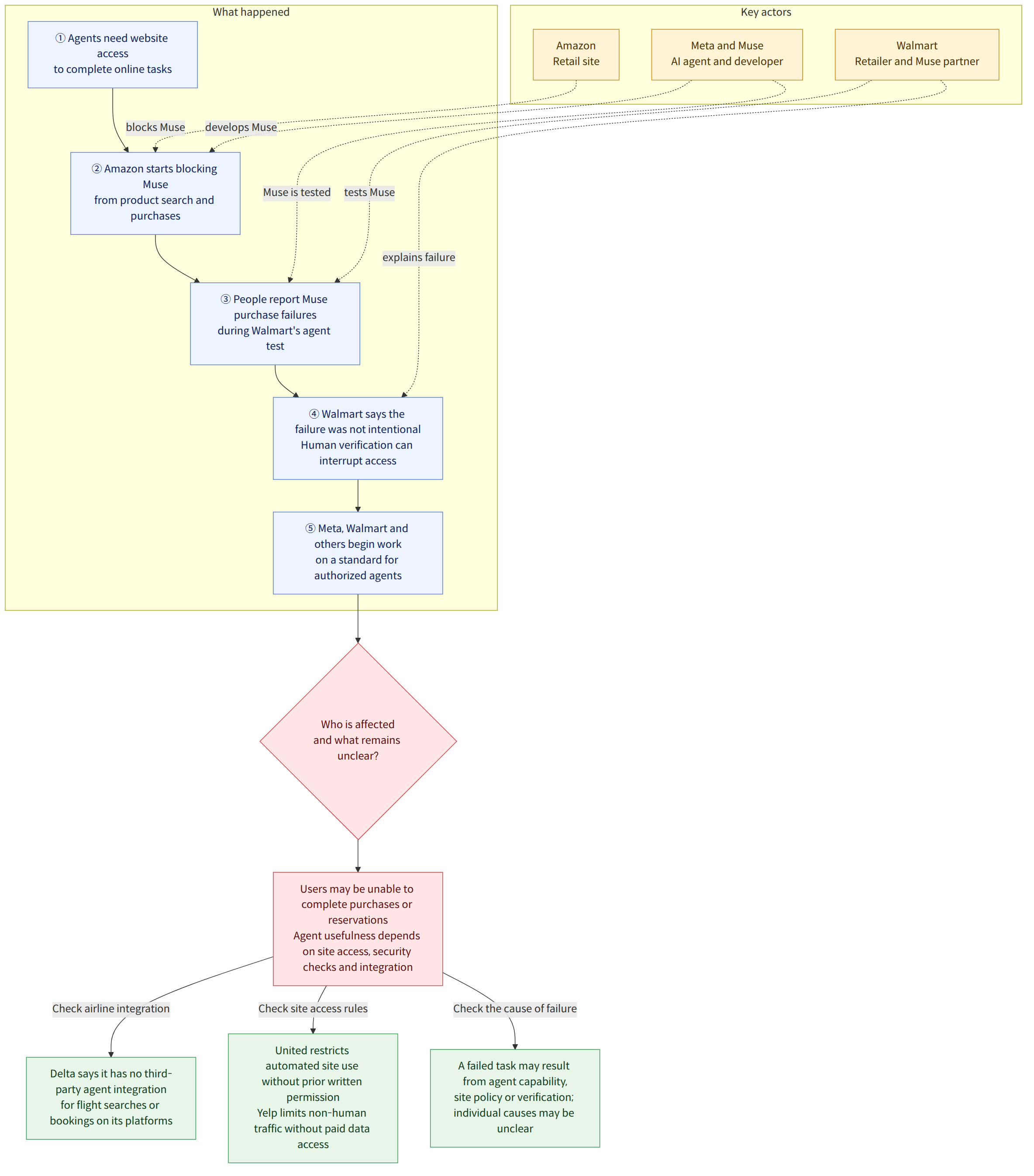
For an AI agent (artificial intelligence that performs online tasks on a user’s behalf) to search for and book a flight, reserve a table at a restaurant, or order groceries, the relevant website must allow the agent to access it. According to the article, Amazon recently started blocking Meta’s Muse from searching for or buying products on its retail site. However, not every failed purchase attempt on other sites can be assumed to be the result of intentional blocking.
Background and context
Personal AI agents can do more than answer questions: they can carry out transactions or make reservations on a user’s behalf. But if a website does not allow an agent to access it, or the agent cannot pass a security check, the requested task will not be completed. From a user’s perspective, it may be difficult to tell whether the agent made an error or the website blocked it.
The Walmart case illustrates the distinction. People complained on social media that Muse could not complete a purchase on Walmart, and NBC also reported a similar issue during Walmart’s test of the agent. A Walmart spokesperson said the failed purchase was not due to intentional blocking. Walmart also said it was a Muse partner, announced at Meta’s September Connect developer event.
According to the article, Walmart’s site asks visitors to click a button to confirm they are human. If this verification process is interrupted, the check may fail and the agent may be redirected away from the site. Therefore, the fact that access or a purchase was blocked is not enough to conclude that a company blocked the agent. In Amazon’s case, by contrast, reports say it has started preventing Muse from searching for and buying products.
What this means
An agent’s practical usefulness is not determined by its AI capabilities alone. A website’s security checks, its policies on automated access, and whether the company and agent are integrated can all affect whether a transaction succeeds. This means that even when an agent can act on a user’s behalf, it cannot override the access conditions set by an online business.
This issue can affect companies as well as users. If a site does not allow agent access or a security check does not work, users may be unable to complete a purchase or reservation. Companies must decide whether to accept users arriving through agents and how to maintain security. Meta issued a statement to the effect that blocking agents means blocking the customers behind them, and that it would work with companies to address concerns and establish clear standards. This is notable because the issue involves both attracting customers and managing security.
For example, even if a user asks an agent to find and book a flight, the booking may not be completed if the airline has not integrated with third-party agents or the site’s security checks interrupt the agent’s progress. In such a case, the failure could be caused by a problem with the agent’s capabilities, or by the site’s access policy or verification process. Based on current reporting, it is not clear how users can determine the cause of an individual failure.
Relevant policies and access rules
Companies do not all handle agent access the same way. Delta said it currently has no partnerships or integrations that allow third-party AI agents to search for or book flights on its digital platforms on customers’ behalf. At the same time, it said it is evaluating whether new technologies, including external agents, could improve the customer experience, and that any adoption would need to take security and customer experience into account.
United’s terms of use state that, without prior written permission, users may not monitor or copy its website using robots or other automated devices or manual processes, or use it for other unauthorized purposes. Yelp said it does not allow non-human traffic on its platform unless the user has paid for access to its content and data through its data licensing program. As a result, agents without official access rights or a partnership may be unable to obtain information from Yelp or perform tasks such as making reservations.
eBay said it does not prohibit purchases by all third-party shopping agents. However, it said it restricts activities such as unauthorized scraping (the automated collection of information from a website) and model training. Therefore, it is important to distinguish between whether agent purchases are allowed and how agents use a site.
Meta, Walmart, Stripe, Sierra, Genesys, Rocket, NiCE, and Decagon have begun developing an open standard to distinguish user-authorized agents from malicious bots and establish how companies and agents communicate. However, reporting has not established how the standard will work or when it will be introduced. On September 15, Cloudflare changed its default crawler settings so that site operators could block AI training while allowing other types of bots. The company did not share specific data on blocking personal agents such as Muse and referred users to Cloudflare Radar, its public data hub.
What is confirmed and what remains unknown
What is confirmed
- Amazon has started blocking Muse from searching for or buying products on its retail site.
- Walmart said Muse’s failed purchase attempts were not the result of intentional blocking and said it was a Muse partner.
- If Walmart’s human verification process is interrupted, the check may fail and the agent may be redirected away from the site.
- Delta, United, Yelp, and eBay have different policies and conditions for third-party agents or automated use of their sites.
- Several companies have begun developing an open standard for communication between agents and companies.
What remains unknown
- How the open standard will work in practice and when it will be introduced.
- The specific reasons Muse or other agents are blocked on each website.
- How users can determine whether an access failure is intentional blocking or a technical error.
What readers should check
- If an agent cannot complete a task on a particular site, first check whether the company has partnered or integrated with third-party agents. Even at a partner company such as Walmart, a security check can prevent a task from being completed.
- Before asking an agent to book a flight or make a purchase on a platform, it is safer to check the site’s terms of use and conditions for automated access. United’s terms specify that prior written permission is required for certain automated uses.
- Do not assume that an access failure means the site intentionally blocked the agent. Check whether the site’s human verification process was interrupted or whether the agent supports an official integration with the service. Current reporting does not provide a definitive way for users to distinguish blocking from a technical error.