

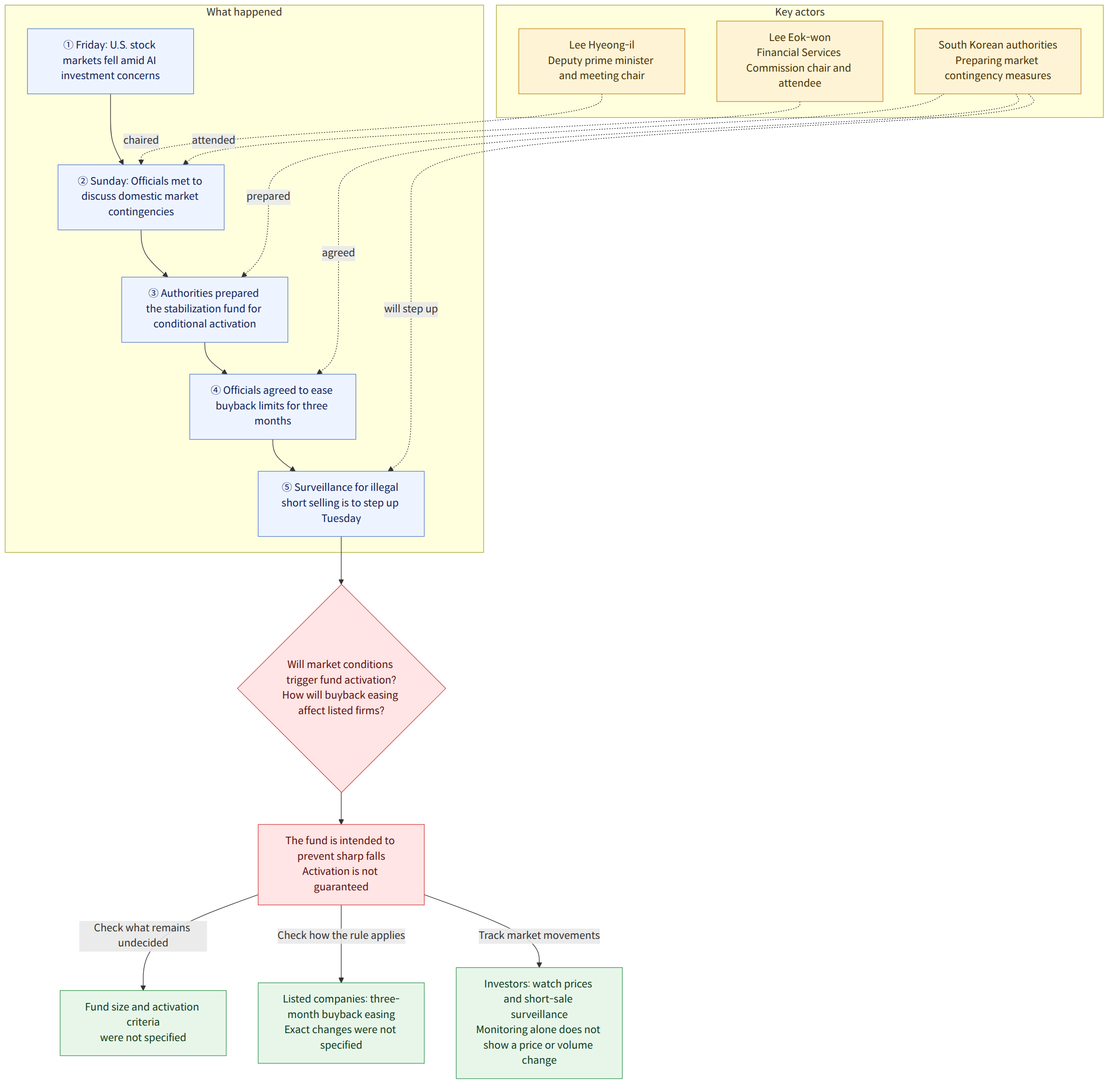
At an emergency meeting of relevant agencies chaired by Lee Hyeong-il, deputy prime minister and Minister of Economy and Finance (재정경제부), on Sunday afternoon, officials discussed contingency plans for a decline in the domestic stock market. They agreed to ease limits on listed companies’ share buybacks for three months and step up surveillance for illegal short selling starting Tuesday.
Background and context
The authorities’ response came amid concerns that a steep drop in U.S. markets could further weaken investor sentiment when the domestic stock market opens on Monday. On Friday, the Dow fell 1.93%, the S&P 500 dropped 3.7%, and the Nasdaq declined 5.28%. Reports said market anxiety had been fueled by massive investment in the AI industry and questions about whether that investment would generate sufficient returns.
The declines were also reflected in indicators used to gauge the Korean market. The iShares MSCI South Korea ETF, cited as a reference point for investor sentiment in the Korean stock market, fell 8.42%, while KOSPI 200 night futures, which closed on Saturday morning, were 6.99% below the regular-session close. The KOSPI 200 Volatility Index, an indicator of investors’ anxiety about stock price fluctuations, closed at 53.18 on Friday, up 3.03 points, or 6.04%, from the previous week.
Declines in U.S. technology stocks were another source of concern. Nvidia shares fell 14.01% on Friday to $125.53, which the article said was 48% below their October 6 peak. The stock market stabilization fund (증시안정기금) being prepared by the authorities is a fund that buys shares using contributions from financial institutions and others to prevent sharp falls in stock prices. South Korea last used it during the 2008 global financial crisis, when 500 billion won was deployed.
What this news means
The key point is not an announcement that the fund has already been deployed, but that the authorities are preparing to activate it if market conditions warrant. Minister Lee said contingency response plans were in place and that the authorities were preparing to take necessary measures in a timely manner. He also said preparations for the stock market stabilization fund meant reviewing the procedures needed in case it was activated. The minister did not specify when it might be deployed or in what amount. This means that those details were not provided in the reports; their omission is not, by itself, grounds to conclude whether a decision has been made.
For stock investors, the policy response may signal an effort to mitigate a sharp decline, but it does not mean that prices will be supported or a rebound is guaranteed. Reports said the decision to activate the fund would depend on market conditions. For example, investors who hold stocks can distinguish between an announcement that the authorities are preparing and an announcement that the fund has actually been activated, while also keeping an eye on market prices.
Listed companies need to check how the three-month easing of limits on share buybacks applies to them. However, reports did not specify exactly how the limits would change. Stepped-up surveillance for illegal short selling is a market-monitoring measure; investors should not assume based on that announcement alone that the price direction of individual stocks or the volume of short selling has changed.
What is confirmed and what is not yet known
Confirmed facts
- An emergency meeting chaired by Minister Lee Hyeong-il was held on Sunday afternoon. Lee Eok-won, chair of the Financial Services Commission (금융위원회); Lee Chan-jin, governor of the Financial Supervisory Service (금융감독원); and Shin Hyun-song, governor of the Bank of Korea (한국은행), attended.
- The authorities are preparing to activate the stock market stabilization fund depending on market conditions and agreed to ease limits on listed companies’ share buybacks for three months.
- Surveillance for illegal short selling is to be stepped up starting Tuesday. The stock market stabilization fund uses contributions from financial institutions and others to buy shares in an effort to prevent sharp falls in stock prices.
- Major U.S. indices and market indicators related to South Korea fell, and the KOSPI 200 Volatility Index closed at 53.18 on Friday.
What is not yet known
- Reports did not specify the size of the stock market stabilization fund being prepared or the specific criteria for activating it.
- It has not been confirmed how, or by how much, the limits on share buybacks will be eased.
- Based on the reports provided, it is not possible to know when the fund being prepared will actually be activated or how long the current market decline will continue.
What readers should check
- Investors can distinguish between an announcement that the authorities are preparing and an announcement that the fund has actually been activated. Reports said the minister described preparations to activate it depending on market conditions and a review of procedures.
- Listed companies and investors should check subsequent announcements for the specific changes to share buyback limits and the three-month period of application.
- To follow market trends, readers can also check the scheduled U.S. Personal Consumption Expenditures price index release on Wednesday, as well as earnings announcements from Hewlett Packard Enterprise on Monday and Dell the following day. The article described the Personal Consumption Expenditures price index as an indicator used by the U.S. Federal Reserve when setting interest rates.
References
- Other coverage consulted: en.yna.co.kr
- Other coverage consulted: hani.co.kr