
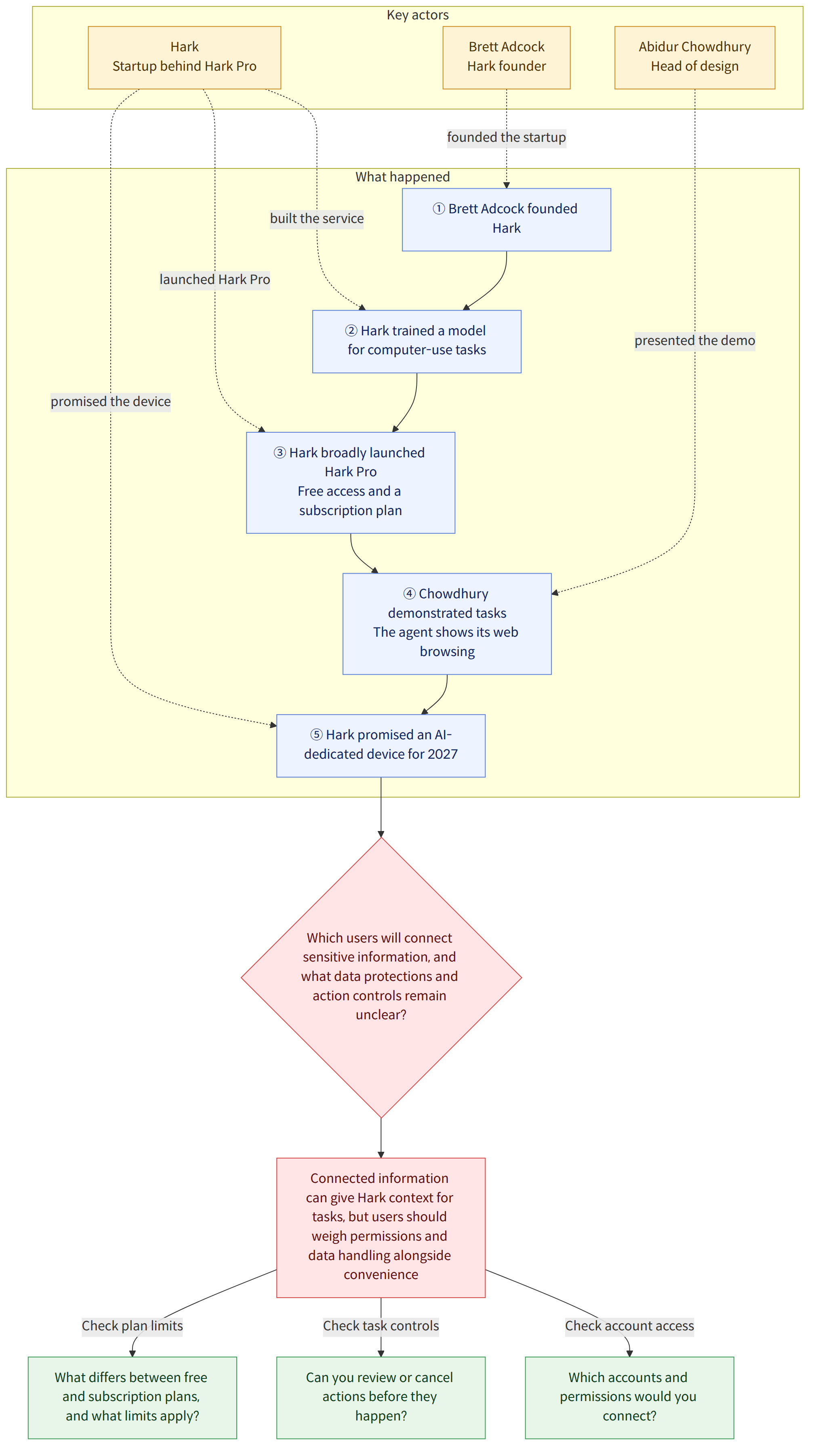
Startup Hark has broadly launched Hark Pro, an AI assistant that uses users’ computers to handle digital tasks for them. Users can access it for free or choose a subscription plan for heavy users. Hark says the service can be set up to access email, calendars, hard drives, credit cards, and more, and describes its goal as building a user interface for AI.
Hark Pro’s selling point is convenience: rather than merely answering questions like a chatbot, it performs tasks on users’ behalf. But to judge whether that is genuinely useful, users need to consider what information they must connect, what actions the AI takes, and how they can review and control those actions.
Background and context
Founded by Brett Adcock, Hark was less than a year old at the time this article was written. The company says its mission is to build a user interface for AI—not to develop AGI (artificial general intelligence) or cure cancer. Its underlying model was trained specifically for computer use, and Hark is using it to build a service that operates users’ computers on their behalf.
Hark Pro is not simply an app with a central chat window. It offers a full-screen interface with a central conversation window and a feed suggesting tasks, along with “panels”—mini dashboards organized around users’ interests. The background displays an image tailored to the user’s local weather and time. Hark aims to develop the service beyond an app into an operating system for future AI computers.
In a product demonstration, Hark head of design Abidur Chowdhury showed the AI reminding a user to approve an expense, reply to an email, meet with a reporter, and book a flight. He also described a case in which the AI noticed that a colleague’s vehicle registration was due for renewal and handled the renewal process on the California DMV website. These are use cases presented by Hark; they do not mean that the same results will occur for every user’s tasks.
What this news means
When deciding whether to use this product, users should consider not only “how much work will it do for me?” but also “what will I let it access?” If users set it up to access email, calendars, files, and payment information, the AI can draw on more context to perform digital tasks. At the same time, the broader the range of connected information, the more important access permissions and data handling become as factors in the decision—not just convenience.
For example, if users allow access to their calendars and email, the service may suggest tasks based on appointments or messages that need replies. In the demonstration, Hark Pro also reminded users about email replies, meetings, and flight bookings. But the available evidence does not show whether the AI only makes suggestions, how far it goes in performing tasks for users, or whether users can review or cancel actions before they are carried out.
Hark Pro shows the agent browsing the web in a small window. Chowdhury said this design is intended to build trust by letting users see whether the agent is doing the task correctly. Showing the process can give users a way to monitor the AI’s actions, but it does not by itself establish how data is stored or protected, or whether tasks are always completed accurately.
Chowdhury said Hark is not trying to sell ads to users or take their data. That statement reflects the company’s stated approach, but should be distinguished from specific information about how data is stored and protected. Because the service connects to users’ digital lives broadly, trust is notable not just as a matter of what the company says, but also of how permissions and information handling work in practice.
Hark says its model is specialized in computer-use tasks, making it faster and cheaper at those tasks. The article reports, however, that it is unclear how much broader knowledge and capability it gives up compared with frontier large language models. Chowdhury invited people to evaluate it critically against other services and said he believes it produces better results and handles tasks from start to finish. But it has not been established whether Hark Pro has undergone independent performance testing against other AI assistants.
Hark has promised to release an AI-dedicated device to support its software in 2027. The device’s form has not been disclosed, and Chowdhury said Hark’s first device will be a product that has never existed before. For now, what can be confirmed is the release promise and the company’s description. How the device will be used and what form it will take remain unknown.
What is known and what is not yet known
What is known
- Hark has broadly launched Hark Pro, offering free access and a subscription plan for heavy users.
- Hark Pro’s underlying model was trained specifically for computer use, and users can set it up to access email, calendars, hard drives, credit cards, and more.
- The product offers a full-screen experience that includes a chat window, a feed of suggested tasks, and panels organized around users’ interests.
- Hark shows the web-browsing process in a small window, which its head of design said was intended to build trust.
- Hark has promised to release an AI-dedicated device in 2027, but has not disclosed its form.
What is not yet known
- What are the specific prices and usage limits for the free and paid plans?
- How are email, calendar, and payment information stored and protected?
- How can users control the scope of access to the information they connect, or control the AI’s execution of tasks?
- What form and features will the AI-dedicated device have, and has Hark Pro’s performance been independently evaluated against other AI assistants?
What readers should check
- Before signing up, check the prices and usage limits for the free and paid plans. The available information does not include subscription prices or specific limits.
- Review which items—email, calendars, files, or payment information—you will grant access to, and check how the service stores and protects that information.
- Check what tasks the AI suggests and which it actually performs on your behalf, and whether you can review or cancel them before they are carried out. The available information does not establish what controls are available.