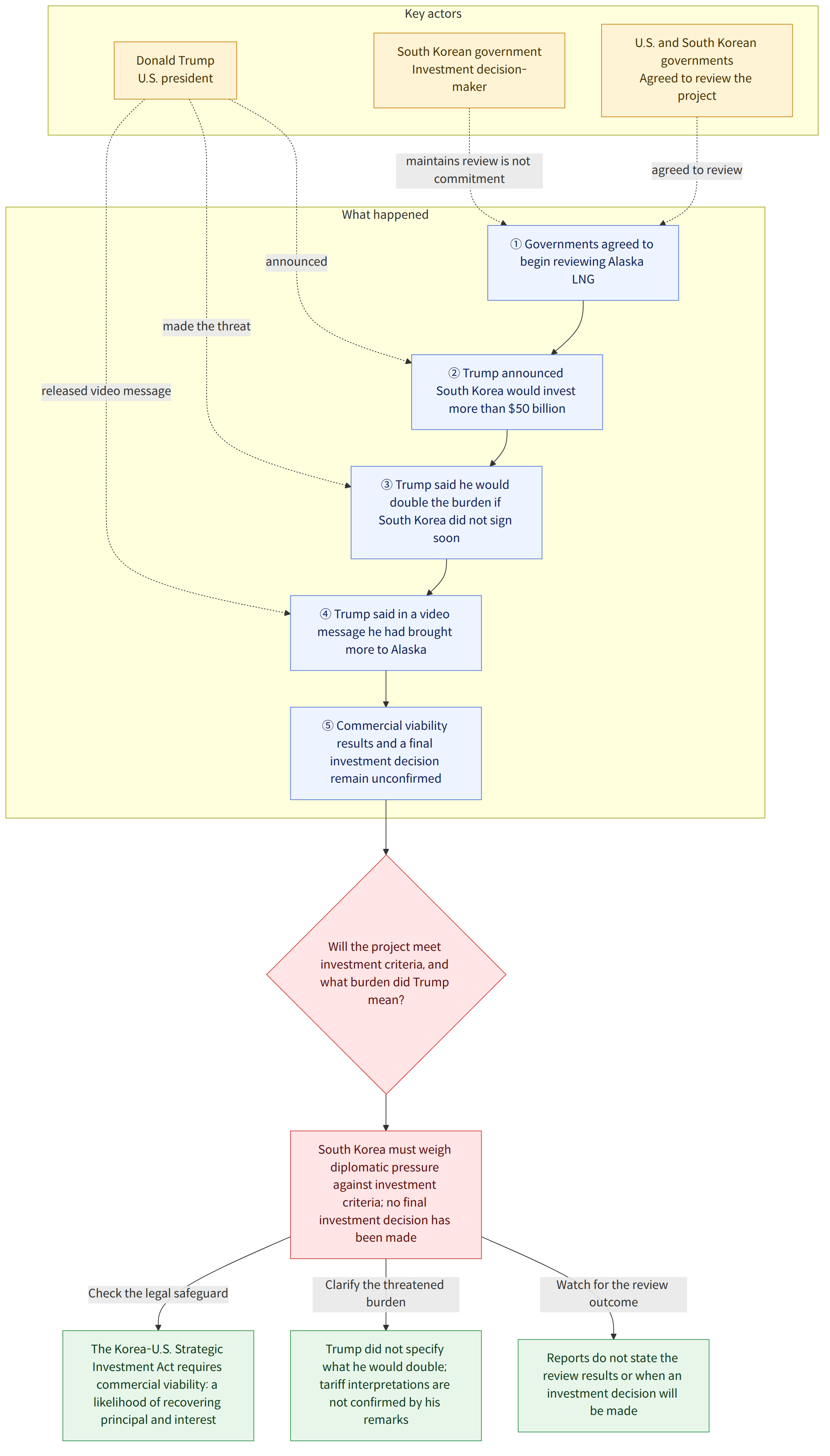
U.S. President Trump has pressured South Korea, saying he would double the burden if it did not sign on to the Alaska liquefied natural gas (LNG) project soon. However, the two governments agreed in a fact sheet only to “begin reviewing” the project. The results of a commercial viability review and South Korea’s investment decision have not yet been confirmed, and Trump has not specified what he would double.
Background and context
On the 2nd (local time), at the White House, President Trump was asked whether South Korea had yet reached an agreement. He said he would double the burden if South Korea did not sign soon. He did not specify what he meant by doubling. An editorial and reports covering the remarks interpreted them as a reference to higher tariffs, but the remarks themselves do not establish what the target would be.
The day before, on the 1st, President Trump announced that South Korea would invest more than $50 billion in the Alaska project. In a video message on the 3rd, he said he had brought more to Alaska than anyone in human history. Despite these announcements and remarks, it is important to distinguish the fact that the step agreed to by the two governments was a review of the project from the fact that South Korea has not made a final investment decision.
The Alaska project is not the only point of contention surrounding investment pledges to the United States. According to reports, South Korea agreed to invest $350 billion in the United States: $150 billion in shipbuilding cooperation and $200 billion in strategic investments. President Trump presented South Korea’s participation in Alaska LNG as part of this strategic investment package, but the South Korean government’s position is that it agreed only to begin reviewing the project, not to finalize whether to invest or how much to invest.
The project’s economic viability is also central to the decision. One report said developer Glenfarne Group estimates the project will cost $44.5 billion to $54.5 billion and will require an 800-mile (1,287-kilometer) gas pipeline from northern Alaska to Nikiski, gas-processing facilities, and an LNG terminal. This information on the project’s cost and scale provides context for the review, but does not in itself establish South Korea’s investment decision or the project’s profitability.
What this news means
The issue facing the South Korean government is how to address diplomatic pressure while also applying its investment criteria. If President Trump’s remarks refer to tariffs, they draw attention to the possibility that investment reviews and trade burdens could be linked. However, because he did not specify what he meant by “double,” it cannot be stated definitively what action he threatened to take.
It also matters that public funds could be used for the investment. If an investment decision were finalized before commercial viability—whether the project is likely to repay principal and interest—had been established, consideration of whether to assume the project’s risks could become entangled with political pressure. Conversely, determining whether the review results meet the investment criteria could be a way to apply the government’s stated principle in practice.
For example, if the project review finds that the likelihood of recovering principal and interest is insufficient, the government could choose not to invest in accordance with its existing principle. This hypothetical does not mean that this is the conclusion of the current commercial viability review. The reports provided do not state the review’s results or when an investment decision will be made.
U.S. political timing has been reported as context for understanding the remarks made under pressure. An editorial said that Democrats are projected to win the House ahead of the November midterm elections, and that a poll shows a Democratic candidate ahead of the incumbent Republican in the Alaska Senate race. These electoral circumstances may provide context for President Trump’s remarks, but should be distinguished from evidence that establishes his intent.
Relevant laws and support information
An editorial reported that the Korea-U.S. Strategic Investment Act (한미전략투자법) explicitly stipulates a commercial viability requirement. Here, commercial viability means the likelihood of recovering the investment’s principal and interest. The South Korean government maintains the principle that it will not invest if this standard is not met, and this condition is a safeguard cited in connection with investment in the United States.
The key question for this project, then, is not only whether an investment has been announced, but also how commercial viability will be assessed in the actual review and how the results will inform the investment decision. However, the reports provided do not detail the procedures for applying the relevant provision of the law, the body responsible for making the assessment, or the review schedule. The fact that the law sets out this condition alone does not establish the outcome of this project or its specific legal effects.
Points reported differently
Reports generally gave the same account of the tariff pressure surrounding the Alaska project and the project’s review stage, but differed in the scope and emphasis of their coverage of election polls. An editorial cited both the outlook for a Democratic victory in the House and a poll showing a Democratic candidate ahead in the Alaska Senate race. Another report cited polls showing Democratic candidates ahead or in close races within the margin of error in Senate races across five Republican-leaning states, including Alaska and Ohio.
Remarks made at a rally in Ohio were also reported separately: President Trump said he could impose tariffs of 150% to 300% on foreign companies that do not build factories in the United States. These were separate from his remark about doubling the “burden” if South Korea did not sign in connection with the Alaska project. The two statements can be interpreted together, but President Trump did not specify that tariffs were what he meant by “double.”
What is confirmed and what remains unknown
Confirmed facts
- The step agreed to by the two governments in the fact sheet on the Alaska project is to “begin reviewing” it.
- President Trump said he would double the burden if South Korea did not sign soon, but did not specify what he meant.
- President Trump announced that South Korea would invest more than $50 billion in the Alaska project.
- The South Korean government maintains the principle that it will not invest unless commercial viability is established, and reports say this condition is also stipulated in the Korea-U.S. Strategic Investment Act (한미전략투자법).
- Separately, President Trump said he could impose tariffs of 150% to 300% on foreign companies that do not build factories in the United States.
What remains unknown
- What President Trump meant when he said he would “double” the burden.
- When the commercial viability review of the Alaska LNG project will conclude and when South Korea will make an investment decision.
- The specific contents of the document the United States is asking South Korea to sign.
What readers should look for
- When the government announces the review results and whether it will invest, readers should check whether it distinguishes between “beginning a review” and a finalized investment decision.
- Readers can examine how the grounds for the investment decision reflect commercial viability criteria, including the likelihood of recovering principal and interest, and how these relate to the requirements of the Korea-U.S. Strategic Investment Act (한미전략투자법).
- Readers should watch for whether the target of the “double” remark or the contents of the document to be signed are officially specified. The reports available so far do not establish what action will actually be taken.
References
- Other coverage consulted: m.koreaherald.com
- Other coverage consulted: hani.co.kr