U.S. Vice President JD Vance said Monday that the United States and South Korea need to further coordinate details of the Alaska liquefied natural gas (LNG) project. At the same time, he expressed confidence that the project will ultimately move forward. According to reports from the White House pool, Vance said the United States wants to make the project happen and that several U.S. allies in Asia do, too. He also said Japan would want a pipeline.
He said East Asian economies, where natural gas prices were high, could benefit from increased supplies of U.S. gas. He also cited strong demand for U.S. natural gas as a reason the project could succeed. But citing demand and a willingness to move ahead is not the same as confirming the project’s terms.
Background and context
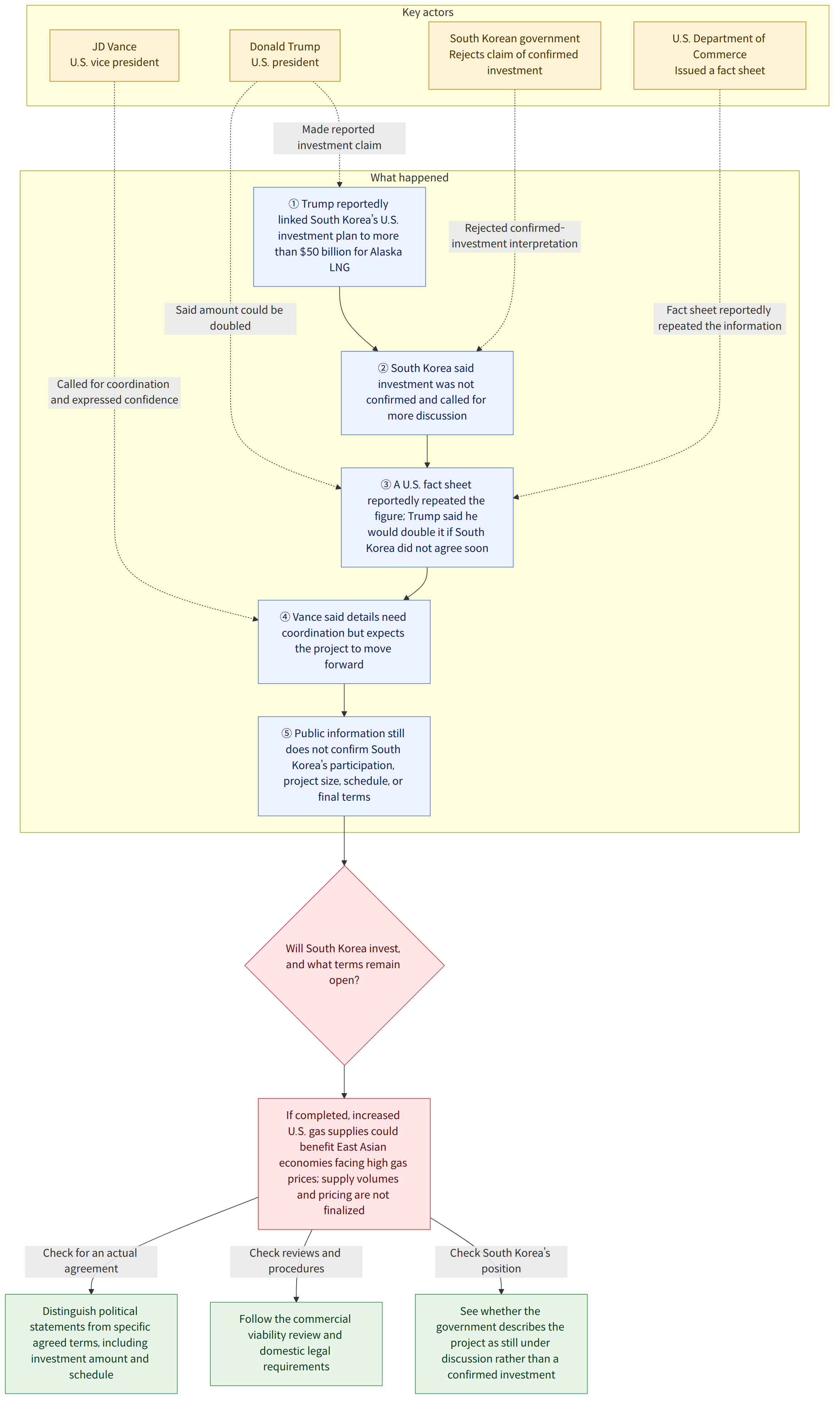
The central question is not only whether there is an intention to pursue the project, but also whether South Korea has already agreed to invest. According to reports, U.S. President Donald Trump said on the 30th of last month, in effect, that South Korea’s investment plan in the United States included more than $50 billion in investment related to the Alaska project. However, the South Korean government (한국 정부) has rejected interpreting this as a confirmed investment, saying the project requires further discussions on matters including its commercial viability and domestic legal requirements.
Reports also said that a fact sheet released by the U.S. Department of Commerce contained the same information. When asked about South Korea’s denial that it had agreed to invest, Trump said, in effect, that if it did not agree soon, he would double the amount. Against this backdrop, Vance’s remarks show that the United States expects the project to proceed, while also making clear that detailed negotiations remain.
What this means
The key distinction for South Korean readers is between the U.S. side’s intention to pursue the project and whether South Korea has committed to invest. Vance said he expects the project to move forward, but also said in the same remarks that the details need further coordination. His optimistic outlook alone therefore does not mean that South Korea has made an investment decision or that the two countries have reached a final agreement.
If the project does move forward, it could affect East Asian economies that are counting on supplies of U.S. gas. That is the expected benefit Vance described; it does not mean that supply volumes or pricing terms have been finalized. For example, even if someone expects a South Korean company to receive gas through the project, the available public information does not confirm whether that company will participate or what the supply terms would be.
Since the South Korean government has said that it must further assess the project’s commercial viability and domestic legal requirements, it is also important to distinguish political announcements from actual business decisions. The reports available here do not establish the investment amount or schedule, who would bear the costs, or what rights or obligations South Korea would have.
What is confirmed and what remains unknown
Confirmed
- Vice President Vance said the United States and South Korea need to further coordinate details of the Alaska LNG project.
- He said he expects the project to move forward and also mentioned Japan and demand in Asia.
- He said increased supplies of U.S. natural gas would benefit East Asian economies where natural gas prices were high.
- According to reports, President Trump said South Korea’s investment plan in the United States included more than $50 billion related to the Alaska project, but the South Korean government rejected the interpretation that an investment had been confirmed.
Still unknown
- The project’s specific size and schedule have not been confirmed in the information made public.
- It has not been disclosed which details the United States and South Korea still need to coordinate.
- It is not known whether a specific plan for South Korea to participate in or invest in the project has been finalized.
What readers should look for
- In subsequent announcements, readers should check whether the South Korean government describes the project as a matter for further discussion rather than a confirmed investment.
- They should look at how the project’s commercial viability review and domestic legal procedures are being handled.
- When an investment amount or outlook for the project is mentioned, it is useful to check whether it is a politician’s statement or the terms of a specific agreement.
References
- Other coverage consulted: hani.co.kr
- Other coverage consulted: en.yna.co.kr