The 2026 Aichi-Nagoya Asian Games concluded its 16-day run on Sunday. The event, which drew more than 15,000 athletes and officials from 45 countries, attracted attention for operational problems, including accommodation and transportation. Reports highlighted both the use of hotels, cruise ships and temporary container facilities instead of a dedicated athletes’ village and bus mix-ups during the Games.
Background and context
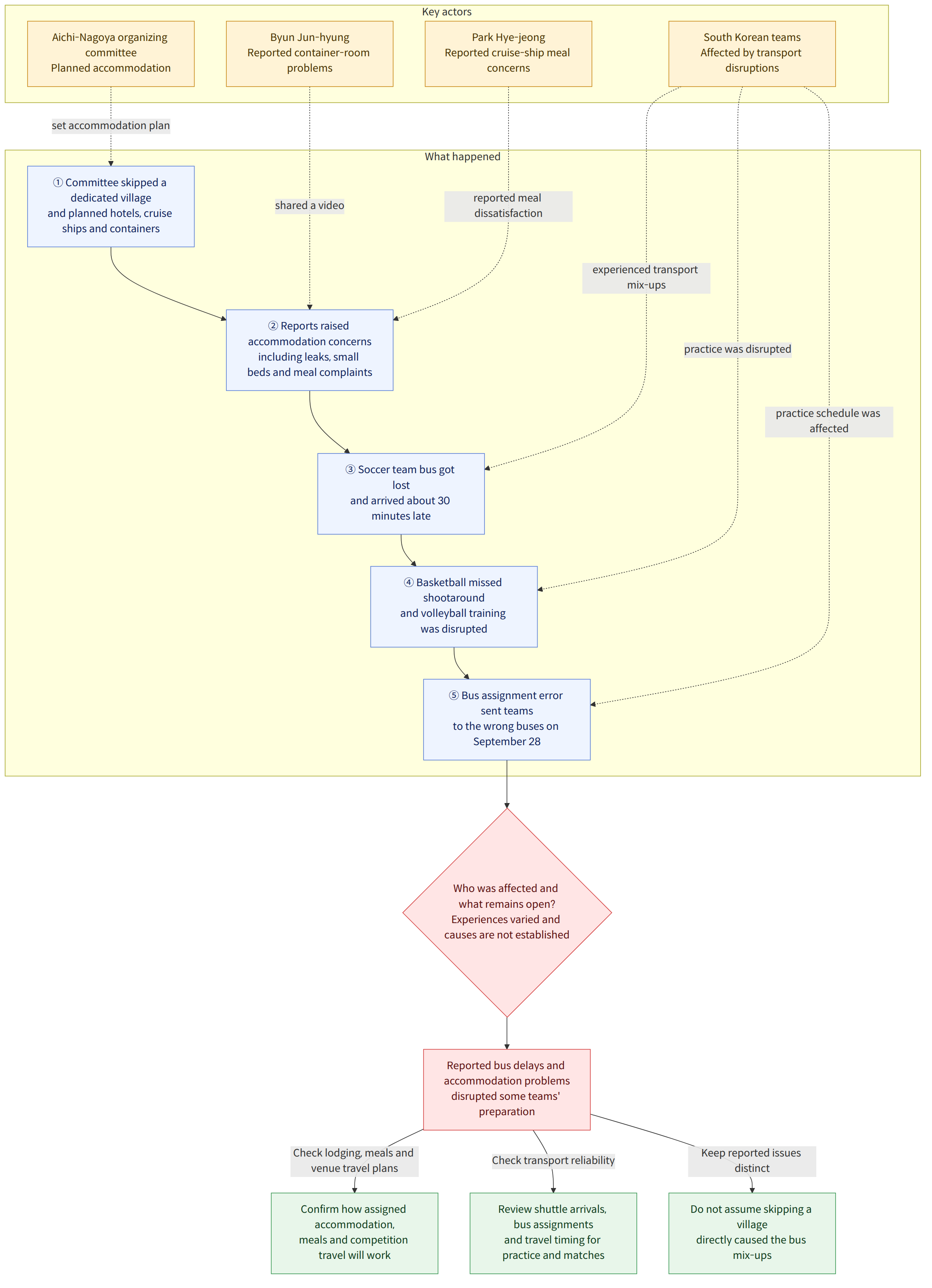
The organizing committee did not build a dedicated athletes’ village, citing cost savings and environmentally friendly policies. Its accommodation plan called for about 9,000 people to stay in hotels, 4,000 on cruise ships and 2,000 in wooden container facilities. The South Korean delegation numbered about 1,000, and athletes from five sports, including men’s basketball, jujitsu and cycling, were assigned to container facilities. According to reports, each container unit could accommodate up to six people.
Concerns about a shortage of accommodation and potentially poorer-than-expected conditions were raised even before the Games opened. One example reported after the Games involved South Korean basketball player Byun Jun-hyung, who shared a short video showing water leaking and noting that the beds were too small for tall basketball players. Complaints about meals and other aspects of life aboard a cruise ship moored at Nagoya Port were also reported. Park Hye-jeong, who won silver in the women’s over-86-kilogram weightlifting event, reportedly said she was dissatisfied with the meals served on the ship and had lost about 4 kilograms.
Sustainability and cost savings were behind this approach. One report said the organizing committee’s official response was that it had saved 64 billion yen by not building new accommodation facilities. Officials also said they had minimized operating costs, including by holding swimming events in Tokyo. However, there is no basis for concluding that the decision not to build accommodation facilities directly caused transportation mix-ups or individual accommodation problems. These are operational issues that should be examined separately.
What this news means
For participants, accommodation is more than just a place to sleep. Meals, rest and travel to competition venues are all tied to the event schedule, so even minor disruptions to accommodation or transportation can affect training or preparation for competition. In one reported instance, the bus driver for South Korea’s national soccer team got lost on the way to a match against Qatar, and the team arrived at the venue about 30 minutes later than scheduled. Its recovery training the following day was also delayed because of a bus problem.
There were other cases as well. South Korea’s men’s basketball team missed its scheduled shootaround—a pregame shooting practice—before the final against Japan because the scheduled shuttle bus did not arrive. The men’s volleyball team’s training was also disrupted by similar transportation problems. On September 28, a bus assignment error led to the bus allocated to South Korea picking up Pakistan’s team, while another bus assigned to Pakistan picked up South Korean athletes. The organizing committee apologized for the mix-up. Reports said South Korea’s practice schedule was affected and Pakistan’s preliminary match was delayed.
These cases show that cost-cutting alone does not make an event sustainable. Even if organizers choose not to build new accommodation facilities, participants may feel the inconvenience more than the benefits of the savings if the assigned accommodation, meals and transportation to competition venues are not reliably managed. This is an interpretation that can be drawn from the reported cases; it does not mean that every participant had the same experience.
For example, if participants in a future event are assigned to temporary accommodation, they may need to check not only where they will stay but also how they will get to competition venues and how meals will be provided. Dividing accommodation among several types of facilities can be one way to house a large number of participants. However, the reports draw attention to the fact that actual convenience depends on how well on-site facilities and transportation operations work together.
What is known and what remains unclear
What is known
- The Games concluded their 16-day run on Sunday, with more than 15,000 athletes and officials taking part.
- The organizing committee planned to provide accommodation in hotels, on cruise ships and in wooden container facilities instead of building a dedicated athletes’ village.
- Bus-related mix-ups involving South Korea’s soccer, basketball and volleyball teams, as well as the South Korean and Pakistani teams, were reported.
- Reports described a video by a South Korean basketball player showing his container accommodation and an athlete’s dissatisfaction with meals on a cruise ship.
What remains unclear
- How often transportation problems occurred across the Games and what effect they had on delegations other than South Korea’s.
- What the overall actual conditions were like in the container and other accommodation, and how athletes assessed them overall.
- How much the accommodation and transportation problems affected athletes’ performance.
What readers should check
- Participants should check whether information about their assigned accommodation and transportation to competition venues is provided together, and whether bus times and assignments match their schedules.
- When encountering reports of accommodation problems, readers can distinguish individual videos or statements from the condition of all facilities and check whether the experiences of multiple participants have been confirmed.
- When assessing sustainable event operations, it is important to consider not only the fact that new facilities were not built but also information about participants’ actual convenience, including meals, rest and transportation.
References
- Other coverage consulted: en.yna.co.kr
- Other coverage consulted: hani.co.kr