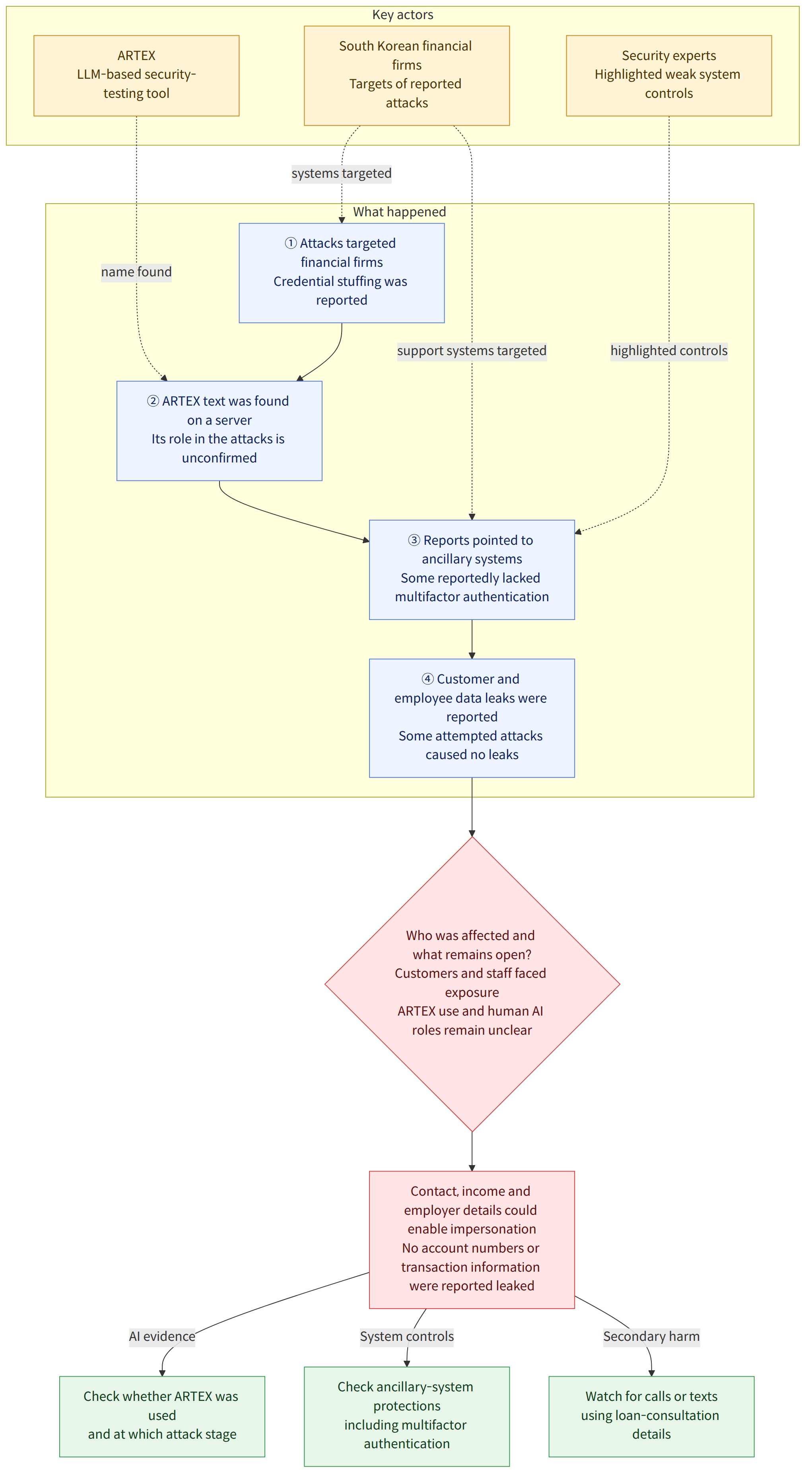
Text reading “ARTEX-自主渗透测试控制台” (“ARTEX—Autonomous Penetration Testing Console”) was found on a web server used in hacking attacks targeting South Korean financial firms, including Shinhan Bank (신한은행), late last month. ARTEX is a security-testing tool based on a large language model (LLM)—an artificial intelligence model trained on large volumes of documents and data to generate text and process information. Reports based on accounts from the security industry have raised the possibility that the tool was exploited in the attacks, but it has not been confirmed what function it performed at any stage of the actual attack.
Around the same time, personal information leaks or attack attempts were reported across the financial sector, affecting not only banks but also savings banks, capital companies, and mutual finance institutions. The important question is not simply, “Did AI hack them?” Traces of an AI tool may indicate that attacks were made faster or more sophisticated, but the vulnerabilities and state of management of the systems that allowed such attacks to succeed also need to be examined.
Background and context
The ARTEX project is a tool published on GitHub. It won the “Agent Plus” (에이전트 플러스) offensive-capabilities challenge hosted by the Baidu Security Response Center (바이두 보안대응센터) in China last August. The discovery of related text on a web server used in the attacks is a clue suggesting a possible link between ARTEX and the attacks. However, finding the tool’s name on a server does not, on its own, establish that ARTEX carried out the entire attack or autonomously broke in without human involvement.
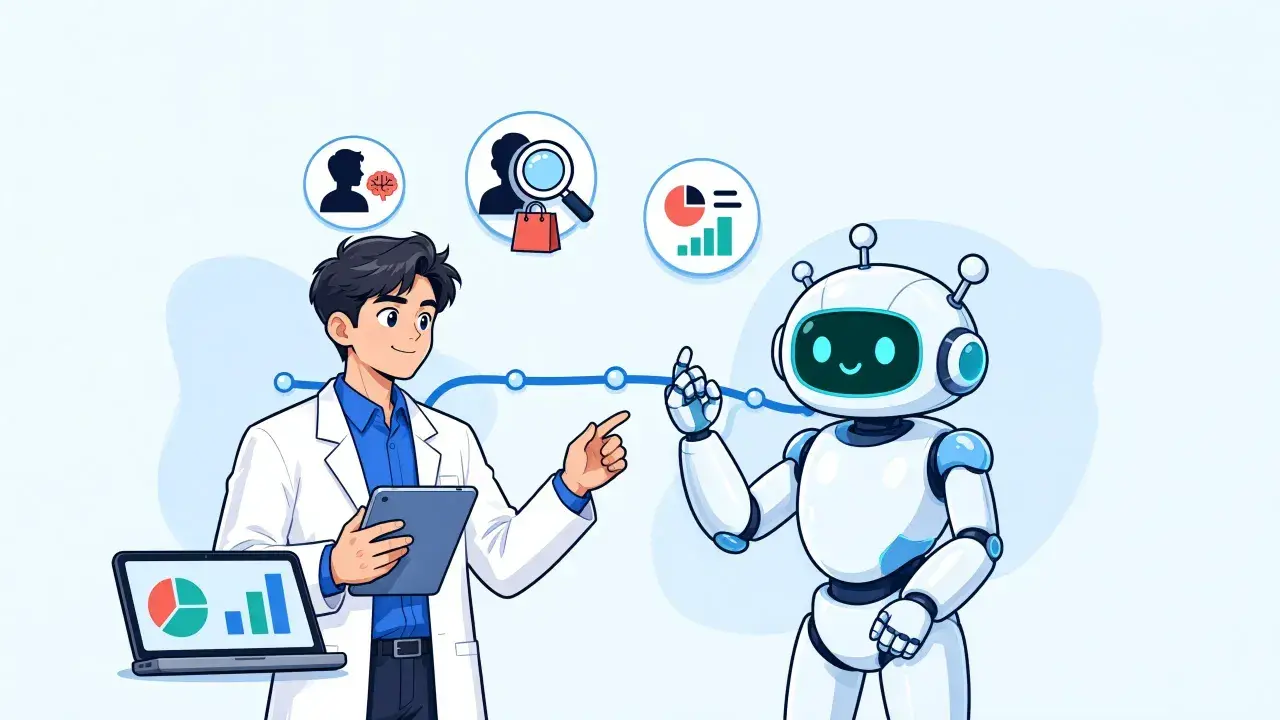
Credential stuffing, reported as the method used in the attacks, involves repeatedly entering usernames and passwords illegally distributed on the dark web to log in and then steal personal information. In the past, automated bots typically entered login credentials mechanically according to commands written in advance by hackers. This time, the possibility has been raised that a tool was used to identify system vulnerabilities with an LLM and execute attacks, but the respective roles played by humans and AI in the process have not been disclosed.
Hwang Seok-jin, a professor at Dongguk University (동국대), explained that entering login credentials could take five seconds for a person, one second for a conventional automated bot, and 0.3–0.5 seconds for an AI agent. He also said that an AI agent could make an attack more sophisticated by filtering out accounts that do not meet system requirements. This is an explanation of possible speeds and capabilities, not confirmation that those speeds or capabilities were used in this incident.
Reports on the financial sector also pointed to a common feature of the business systems targeted. Services such as Shinhan Bank’s lookup service for loan agents were not part of the main computer systems used by customers, but rather ancillary or business-support systems. They were reportedly designed with relatively lax security, including without multifactor authentication. Kim Myeong-ju, a professor at Seoul Women’s University (서울여대), said the key issue should be not whether AI was used, but the failure to properly manage vulnerabilities in banks’ ancillary systems.
What this news means
According to reports on the financial sector, it was confirmed that information belonging to approximately 25,000 Shinhan Bank customers was leaked, including names, phone numbers, annual income, employer names, and portions of resident registration numbers. Reports said information belonging to 119 customers at KB Kookmin Bank and 89 customers at Hana Bank was also leaked. At Busan Bank, information belonging to 11 outsourced development employees was exposed during an attempted attack on an external web server. Woori Bank and NH Nonghyup Bank (NH농협은행) reportedly faced similar attacks, but no actual leaks resulted.
In the non-bank financial sector, reports said information belonging to approximately 40,000 customers of Yegaram Savings Bank and 146 loan agents at Hyundai Capital was leaked. The Saemaul Geumgo Federation (새마을금고중앙회) and Nonghyup Mutual Finance (농협 상호금융), among others, reportedly fended off similar access attempts. Financial institutions explained that the systems targeted were separate from internet and mobile banking, and that no financial transaction information, such as account numbers, was leaked. However, the leaked information could include contact details, income, and employer information, prompting concerns about secondary harm from impersonation calls or texts that appear to know about actual loan consultations.
For this reason, it is important both to check whether information was leaked and to be alert to impersonation attempts using that information. For example, even if you receive a call or text that appears to know the details of a loan consultation you had, it is safer not to assume that the person is a financial company employee based solely on the information they know. Reports said financial companies were individually notifying affected customers about the leaks and ways to prevent secondary harm, and had said they would fully compensate customers for any harm caused by this information leak.
More broadly, a key issue in this incident is that business-support systems cannot be considered low-risk simply because they are not the main computer systems used by customers. Services used by loan agents or employees may also contain personal information, and, if authentication is relatively lax, they can become a route for attackers. Alongside assessing the speed and automation capabilities of AI, examining which systems can be accessed externally and how accounts and authentication are managed may be essential to preventing a recurrence.
Relevant laws and support information
According to an in-house legal guide, Article 48(1) of the Information and Communications Network Act (정보통신망법) provides a basis for determining whether a person had legitimate authorization to access an information and communications network and whether they exceeded the permitted scope. Knowing a username and password, or having been authorized to use them in the past, does not by itself establish that the person still has access permission. The specific circumstances, including the authorization granted by the service provider and its permitted scope, must be examined.
Therefore, reports that a tool called ARTEX was found on an attack server are not enough to determine the legal liability of a particular actor or whether a crime was committed. The circumstances of the actual access, the authorization involved, the actions taken, and the evidence must be examined. The legal guide also cautions that conclusions in individual cases may vary depending on the laws in effect at the time and the specific facts, so current laws and specific evidence should be reviewed in any actual case.
What reports covered differently
The reports differed in focus and level of detail. Reports about ARTEX focused on the text found on the attack server and the nature of the tool, emphasizing that it remains unclear at what stage ARTEX was used. Reports covering the financial sector more broadly described leaks and blocked attacks at several financial companies, along with some victim counts and types of leaked information. These reports covered different aspects of the incident; they do not mean that the actual use of ARTEX or the total scale of the harm has been established.
What is confirmed and what remains unknown
Confirmed facts
- Reports said that ARTEX-related text was found on a web server used in the attacks.
- ARTEX is an LLM-based security-testing tool published on GitHub, and it won an offensive-capabilities challenge last August.
- Personal information leaks or external attack attempts were reported at several financial companies.
- Some business-support systems, including Shinhan Bank’s lookup service for loan agents, were separate from the main computer systems used by customers and reportedly had relatively lax security.
- President Lee Jae-myung (이재명 대통령) reportedly received a briefing on personal information leaks and responses at financial and public institutions, and ordered a thorough investigation and the development of countermeasures.
What remains unknown
- At what stage of the actual attacks was ARTEX used, and what functions did it perform?
- To what extent were humans and AI each involved in the attack process?
- How will the total scale and scope of harm from personal information leaks across all reported cases be established?
- Were there additional attacks on financial companies that were not reported publicly?
What readers should check
- If you receive a notice from a financial company that your personal information was leaked, check what information was involved and review the recommended preventive measures.
- Do not immediately trust calls or texts that mention a loan consultation or financial information; independently verify the caller’s claimed identity and how they contacted you.
- If you suspect harm resulting from the use of leaked information, keep relevant notices and records of consultations, and check the reporting and compensation procedures announced by the financial company.
References
- Other Crimes under the Criminal Act: Elements and Points to Note
- Other coverage consulted: hani.co.kr
- Other coverage consulted: hani.co.kr