
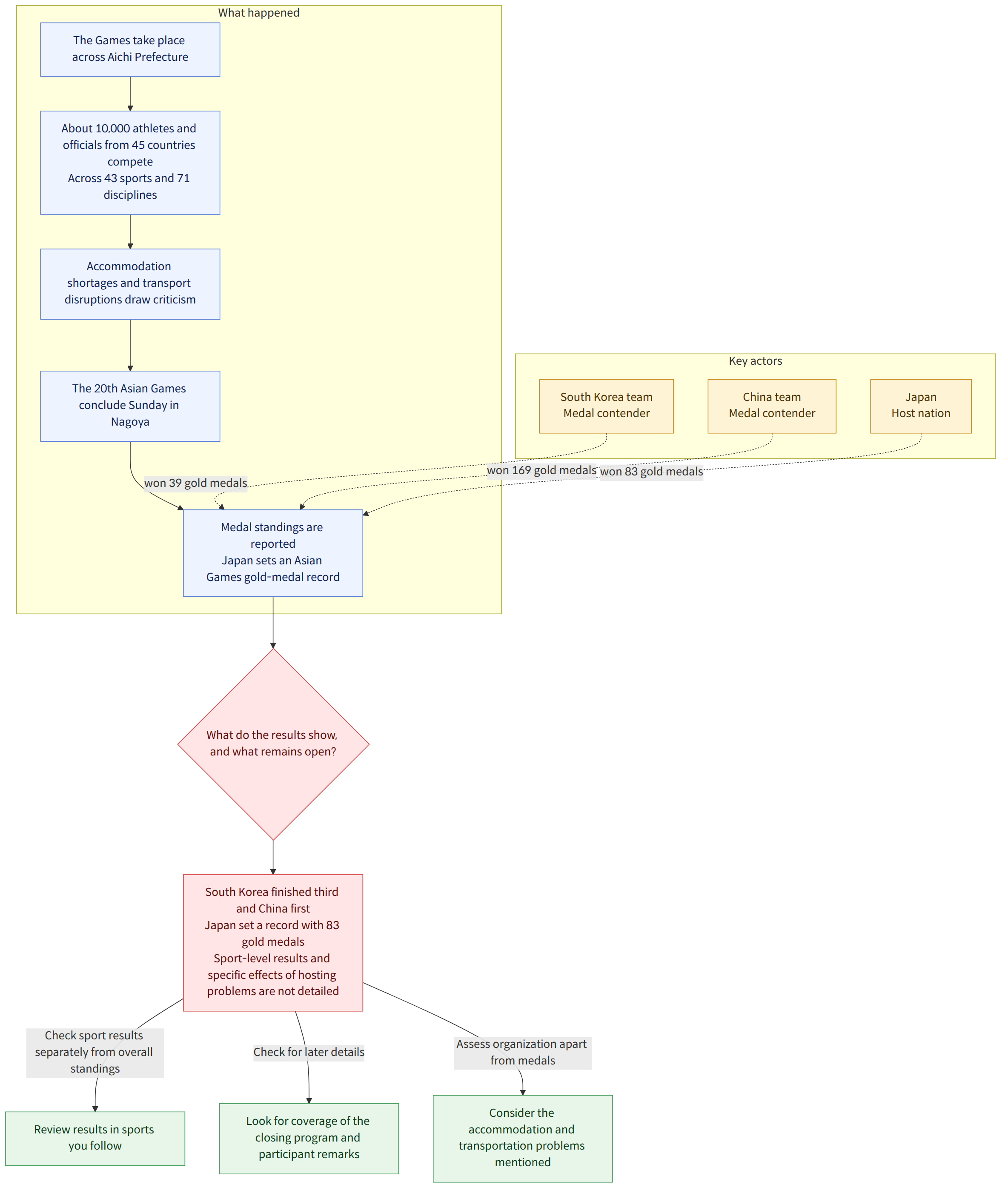
The 20th Asian Games concluded on Sunday in Nagoya, central Japan. The Games were said to have ended with a tribute to athletes, supporters and volunteers. South Korea finished third overall with 39 gold, 43 silver and 68 bronze medals.
About 10,000 athletes and officials from 45 countries took part in the Games, competing for 469 gold medals across 43 sports and 71 disciplines. China won 341 medals in total, including 169 gold, while host Japan set a record for the most gold medals in Asian Games history with 83.
Background and context
Billed as an event for Aichi Prefecture and Nagoya, these were the third Asian Games held in Japan. Events took place across Aichi Prefecture, with some competitions held outside the prefecture. Existing or refurbished venues were used primarily in an effort to reduce costs.
Meanwhile, criticism of the Games’ organization continued. A shortage of athlete accommodations and transportation disruptions were among the problems cited. The closing therefore marked a moment to celebrate sporting achievements, while also prompting reflection on the facilities and transportation conditions needed to host a major international event.
The Games ran for 16 days under the slogan “Imagine One Asia” (하나의 아시아를 상상하라). However, the provided material does not include the specific venue or program for the closing ceremony, or any remarks made at the event, so it is difficult to confirm exactly how the Games concluded.
What this news means
South Korea’s third-place finish shows that its team won a combined total of 150 gold, silver and bronze medals at these Games. China led in both gold medals and total medals, while Japan, as host, set a record for the most gold medals in Asian Games history. These figures alone, however, do not show which sports or athletes determined the rankings.
The host nation Japan’s record shows that, when assessing a Games, attention may focus not only on the gold-medal standings but also on the host country’s results. Conversely, criticism over accommodations and transportation suggests that medal achievements and assessments of the event’s organization can be considered separately.
For example, readers looking to check the results can look beyond South Korea’s overall ranking and also review the results in the sports they are interested in, as well as what coverage of the event’s organization addresses. The provided article does not include individual competition results or details of the closing ceremony, limiting the information available for an overall assessment of these two areas.
What is confirmed and what remains unknown
Confirmed facts
- The 20th Asian Games concluded on Sunday in Nagoya, Japan.
- About 10,000 athletes and officials from 45 countries took part in the Games.
- The Games featured 469 gold medals across 43 sports and 71 disciplines.
- South Korea finished third with 39 gold, 43 silver and 68 bronze medals.
- China won 341 medals, including 169 gold, and Japan set a record for the most gold medals in Asian Games history with 83.
What remains unknown
- Exactly where the closing ceremony was held and what its schedule and program were.
- What the major results and medal outcomes were in individual sports.
- What athletes or event officials said about the closing ceremony or the end of the Games.
- How the accommodation shortage and transportation disruptions specifically affected participants.
What readers should check
- When checking the results of a sport you are interested in, distinguish between the overall medal standings and results in that sport.
- If you want to know what actually happened at the closing ceremony or what participants said, check whether subsequent coverage provides those details.
- When assessing the organization of the Games, consider separately the accommodation and transportation problems mentioned in the article, alongside the medal results.
References
- Other coverage consulted: koreatimes.co.kr