A Silver Medal, and Another Milestone
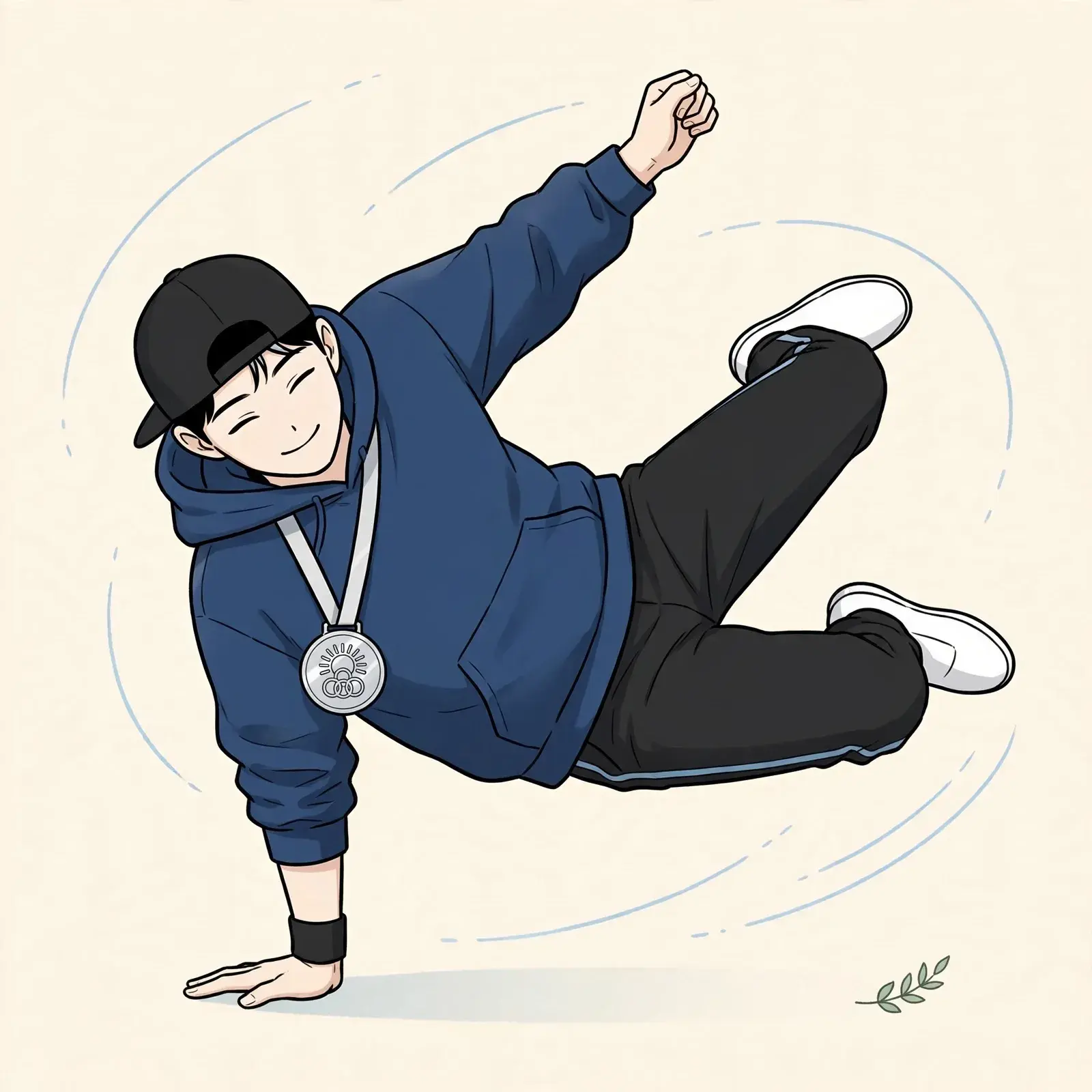
South Korean breaker Kim Hong-yul, better known by his stage name Hong10, added another Asian Games medal to a career spanning decades. He won silver in the men’s breaking competition at the 2026 Aichi-Nagoya Asian Games, held in Tokoname, Japan, after losing the final 0–3 to Japan’s Shigekix, who is 18 years younger.
The result followed Hong10’s gold medal at the previous Asian Games, held in Hangzhou in 2023 after being postponed from 2022. He did not defend his title, but became a medalist at two consecutive editions of the continental event. In a sport built around explosive movement, strength and control, his latest finish was a striking achievement for a dancer in his early 40s.
“I came with my hair dyed gold, hoping to bring home some golden energy,” he said after the final, acknowledging his disappointment. “But I fully achieved my first goal: to enjoy the competition.”
Choosing to Enjoy the Battle
At the previous Asian Games, the competition was closely tied to qualification for the Paris Olympics. Hong10 said that pressure had kept his attention fixed on winning, leaving him little room to enjoy the experience. This time, with that qualifying pressure behind him, he made a conscious effort to let his body follow the rhythm and take in the atmosphere.
He said he may have smiled more during this competition than at any other point in the tournament. The audience responded warmly to his performances, and the energy in the venue grew as he moved across the floor. For a breaking battle, where dancers perform in turns and answer one another through movement, the crowd’s reaction is part of the live experience—but the outcome still depends on the judges’ evaluation.
Hong10 admitted that his body did not always keep up as he advanced toward the final. He joked that even being five years younger might have helped him feel stronger. Still, his silver-medal performance showed how experience, musical timing and carefully prepared movement can remain powerful assets in a physically demanding contest.
What Breaking Involves
Breaking, often called breakdancing, is a dance style in which competitors take turns performing to music. They combine movement while standing, floor-based steps, spins and acrobatic elements, shaping their routines in response to the beat and the other dancer.
- Toprock refers to the steps performed while standing, often used to introduce a dancer’s style before moving to the floor.
- Floor moves and spins require balance, coordination and strength, as well as a sense of rhythm.
- In a battle, dancers must show their own identity while responding creatively to an opponent.
That blend of athletic skill and personal expression helps explain why a battle can feel different from a routine performed alone. A dancer needs to prepare specific movements, but also adapt in the moment—much like a musician playing a planned melody while improvising around it.
Preparing Through Strength, Practice and New Moves
In the run-up to the Games, Hong10 followed a demanding training schedule at South Korea’s national training center in Jincheon. His routine included strength training in the morning, dance practice in the afternoon and additional individual work in the evening. The goal was to improve his physical condition while sharpening the details of his performance.
He also paid close attention to his toprock, the standing dance performed before a breaker moves into floor work. He wanted to make that opening section especially memorable and added new moves so he could offer the audience something it had not seen from him before. In a discipline where signature movements can help distinguish competitors, new material requires both creativity and repeated practice to perform reliably under pressure.
Hong10’s preparation reflects a balance at the heart of elite breaking. Power and stamina matter, but so do musical interpretation, precision and the ability to make a sequence look natural. For an older competitor, maintaining fitness while continuing to develop new material can mean treating training not as a fixed routine, but as an ongoing process of adjustment.
A Long Career Built on Curiosity
Hong10 first began breaking in middle school, dancing with classmates as a way to spend time together. What started as a social activity gradually became a larger part of his life as he met new people and found room to grow through dance. His career reached an early landmark in 2002, when he became the first South Korean dancer to win an international breaking competition.
He later won the Red Bull BC One World Final three times, in 2006, 2013 and 2023. Looking back, he said he still remembers the feeling of achievement from his first international victory. He also described competing at the Asian Games as one of the experiences he would not forget.
Even after reaching the top, Hong10 has continued to look for new ideas. He said the scene is changing as younger dancers influence its style and trends, and that he does not want to rely only on the approach that worked for him in the past. Instead, he tries to observe and learn from younger performers—a process he says has made dancing more interesting and helped keep him going.
“Learning how younger dancers move is what keeps me dancing,” he said.
Experience Does Not Mean Standing Still
Hong10’s career illustrates that longevity in sport is not simply a matter of repeating what once brought success. In a fast-changing dance culture, an experienced performer may need to keep learning from people with different habits and ideas. His silver medal suggests that age alone does not determine whether an athlete can remain competitive, even though physical recovery and stamina can become more challenging over time.
That does not mean every dancer will follow the same path or face the same physical demands. Rather, Hong10’s example offers a more personal lesson: a long career can remain meaningful when a competitor stays curious, adapts and continues to find enjoyment in the work.
A Message for People Who Think It Is Too Late
Hong10 knows that his appearance on the Asian Games floor can mean something beyond the result. Seeing a performer in his 40s continue to compete at the highest level may encourage people who have delayed a goal because they think they have missed their chance. He said he hopes his challenge can become a small source of courage and hope for someone else.
“I want to show that a new beginning is possible even when you think you are too late. I hope my challenge gives someone a little courage and hope.”
He also offered encouragement to people around his age, acknowledging that life can be difficult while reminding them that good days can still come. For him, dance has provided a way to laugh again through challenging moments. The message is not that age or hardship disappears, but that a meaningful pursuit can still bring energy and connection.
Looking Ahead to Korean Breaking’s Future
After decades of competition, Hong10 is thinking about what he can leave behind for the sport. He said he wants Korean breaking to become strong again and is willing to share what he has learned with younger dancers. He hopes to be remembered as a competitor who respected the culture and values of breaking, enjoyed the dance and had a positive influence on those who followed.
His next task is already on the calendar: preparing for the National Sports Festival. The Asian Games silver medal is therefore not presented as a final chapter, but as another point in a career that continues to move forward. For Hong10, the lasting value of the result may be not only the medal itself, but also the reminder that commitment, curiosity and the willingness to start again can keep a person moving—whatever their age.