
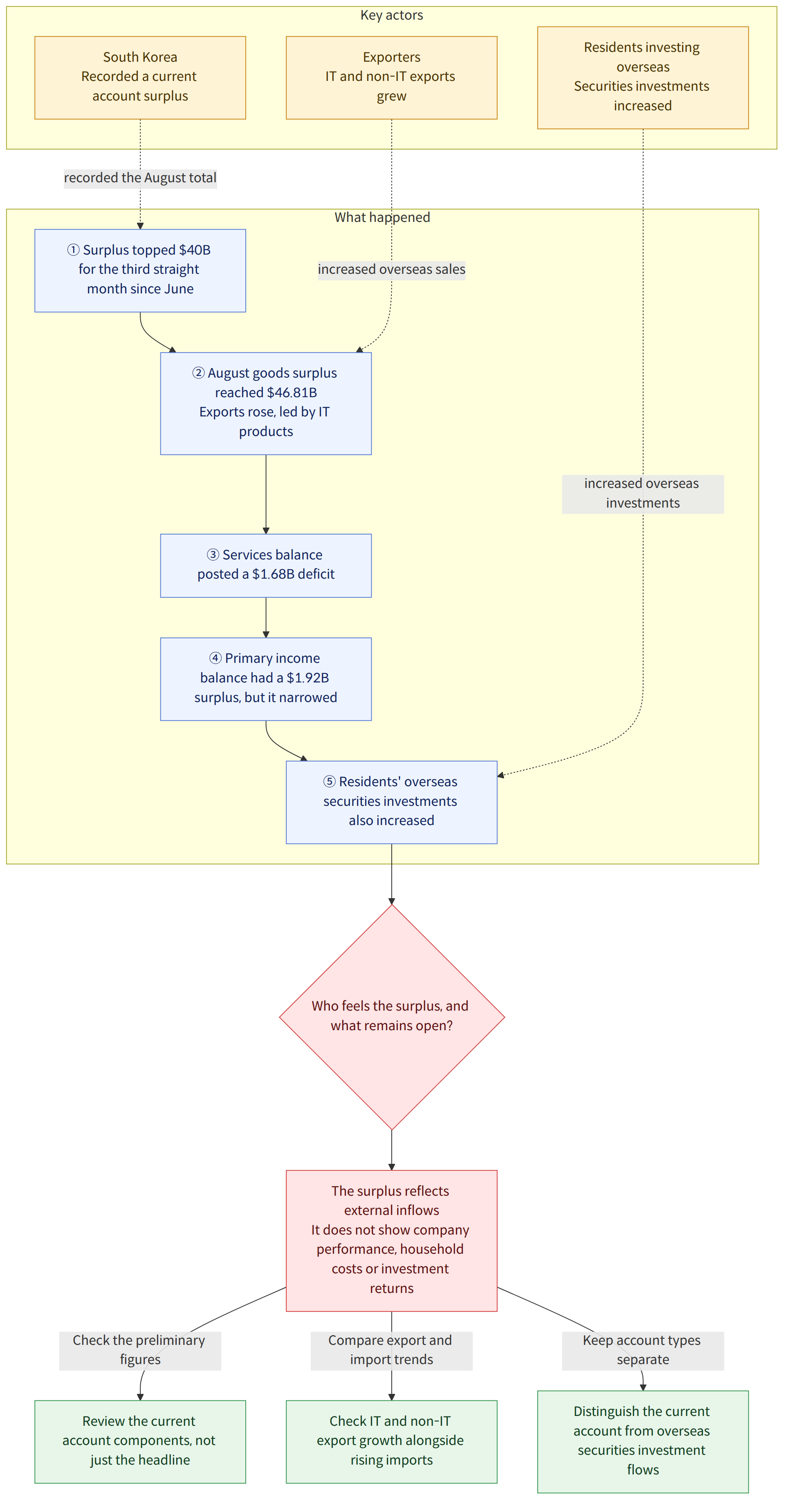
South Korea continued to run a current account surplus in August. Based on preliminary figures, the surplus was $46.11 billion, the second-largest monthly surplus on record, and topped $40 billion for the third consecutive month since June. Strong exports of information technology products, including semiconductors, were the main driver of the surplus.
However, the surplus alone does not reveal the full picture of movements in exports and imports, services transactions, and investment income. In August, the goods balance posted a large surplus, but the services balance was in deficit, and residents’ overseas securities investments also increased significantly. That is why the current account should be understood through the trends in its individual components, rather than as a single figure.
Background and context
The current account is an indicator of the difference between money coming into and leaving the country through external transactions, including trade in goods and services and investment income. A surplus means that, overall, more money came in from external transactions than went out, but the details need to be examined to understand what drove it.
The goods balance—the difference between the value of goods exports and imports—posted a surplus of $46.81 billion in August. Exports totaled $104.8 billion, up 82.1% from the same month a year earlier, while imports rose 23.8% to $57.99 billion. Exports exceeded $100 billion for the third consecutive month.
Export growth was not limited to information technology products. Exports of information technology products, including semiconductors, increased 162.6% from a year earlier, while exports of non-information technology products rose 8.1%. Imports of raw materials and capital goods continued to grow, while consumer goods imports also returned to growth, widening the increase in total imports.
The services balance posted a deficit of $1.68 billion. The travel deficit widened amid the peak overseas travel season, while the transport surplus grew on the back of higher export freight rates. The deficit in charges for the use of intellectual property also narrowed, reducing the overall services deficit.
The primary income balance recorded a surplus of $1.92 billion, but the surplus narrowed. The balance of dividend income posted a surplus of $1.18 billion. Seasonal factors, including quarterly securities investment dividend payments concentrated in May, August, and November, were cited as factors that reduced the surplus.
What this news means
The current account surplus and export trends are important indicators for assessing South Korea’s external trade and economic situation. These figures show that export growth contributed significantly to the goods surplus. In particular, exports of both information technology and non-information technology products increased, indicating that strong exports were not confined to a single product category. However, given the large difference in growth rates between the two groups, the composition of exports should also be considered when interpreting the overall trend.
For businesses, expanding exports can affect sales and production, but the current account surplus alone cannot determine the performance of individual companies or the circumstances of households in South Korea. For example, an exporting company might look at how increased overseas sales affect its business, but the actual impact can vary by company. Imports also rose 23.8%, making it difficult to explain overall external transactions by looking only at export growth.
For households and investors, too, the size of the surplus does not directly indicate living costs or investment performance. The increase in residents’ overseas securities investments is a financial account flow distinct from the current account. The two indicators need to be considered separately for a broader understanding of external transactions.
How coverage differed
Headlines emphasized different aspects. One cited robust exports as the reason the surplus continued, while another highlighted the semiconductor boom and stated the size of the surplus. Detailed Korean-language coverage reported figures for each component, including the goods, services, and primary income balances, as well as the financial account.
These reports did not give different figures; they summarized the same August current account from different perspectives. To check the figures and detailed trends, it is more accurate to look at the individual components in the preliminary statistics than to rely on headline wording.
Confirmed facts and what is not yet known
Confirmed facts
- The current account recorded a surplus of $46.11 billion in August, the second-largest monthly surplus on record.
- The monthly surplus exceeded $40 billion for three consecutive months, from June through August.
- Exports increased 82.1% from a year earlier, while exports of information technology products rose 162.6%.
- The goods balance was in surplus, while the services balance was in deficit, and the primary income surplus narrowed.
- Residents’ overseas securities investments increased by $16.6 billion.
What is not yet known
- The August figures in this report alone cannot show whether the surplus or export growth will continue in subsequent months.
- The information presented in the article is not enough to determine how changes in individual components will affect the current account next month.
- The share of total export growth accounted for by individual products or companies is not known.
What readers should check
- When looking at the next current account release, check the direction of the goods, services, and primary income balances separately, along with the overall surplus.
- When checking export growth, compare trends in information technology and non-information technology products, as well as the import growth rate.
- When reviewing indicators related to overseas travel or overseas securities investments, distinguish between the current account and the financial account, as they represent different external transaction flows.
References
- Other coverage consulted: en.yna.co.kr
- Other coverage consulted: hani.co.kr