
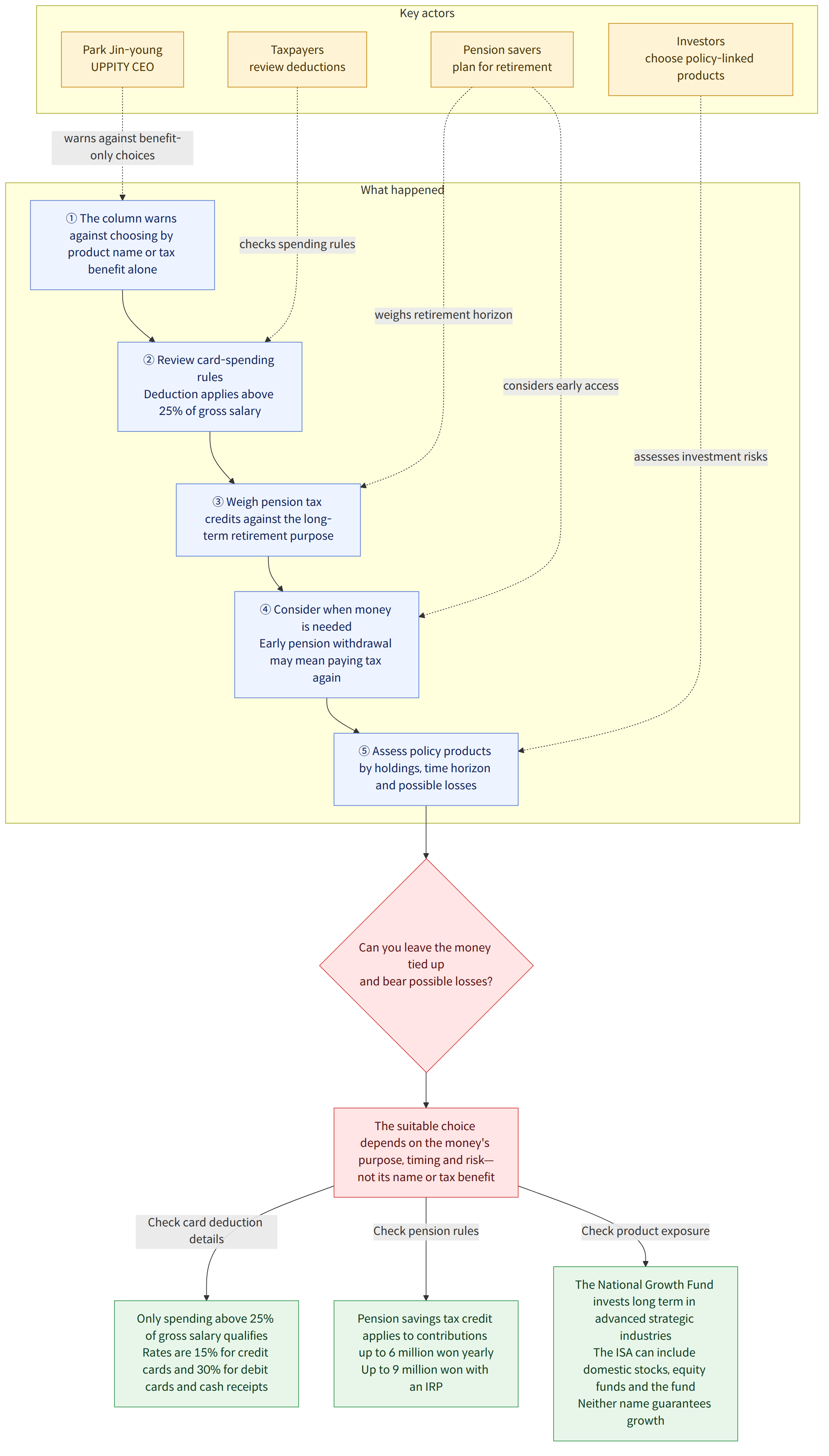
Park Jin-young, CEO of UPPITY (어피티), advises against deciding whether to use year-end tax deductions, pension accounts, the National Growth Fund (국민성장펀드) or the Productive Finance ISA (생산적 금융 ISA) based only on their names or tax benefits. The column emphasizes that people should consider not only the benefits offered by these programs but also what they plan to use the money for, how long they can leave it tied up and whether their investments could lose value.
Background and context
Year-end tax settlement is the process, conducted early the following year, of comparing the taxes withheld from a person’s salary during the year with the amount they actually owe. Even if a company withholds taxes from pay in advance, it cannot account for every individual circumstance, such as dependents, spending and pension contributions. The settlement therefore recalculates the amount: people may get back taxes they overpaid or have to pay more if they underpaid.
The column explains that focusing on a program’s name can distract people from its actual rules. The “income deduction for spending on credit cards and other payment methods” does not refer to credit cards alone. It also includes debit cards, prepaid cards and cash receipts. According to the article, the deduction applies only to spending above 25% of gross salary.
The deduction rates given are 15% for credit cards and 30% for debit cards and cash receipts. Thus, the column explains, spending up to 25% of gross salary is not eligible for the deduction regardless of which card is used; beyond that threshold, the deduction rate for debit cards and cash receipts is twice the rate for credit cards. However, the rates and threshold discussed in the article do not, by themselves, establish the detailed outcome for every individual.
The column says that pension savings qualify for a tax credit on contributions of up to 6 million won a year, or up to 9 million won when combined with an individual retirement pension (IRP). A tax credit is an amount deducted from the calculated tax owed. But the tax credit is not the pension account’s sole purpose. It is also important to remember that the program is designed to help people prepare for retirement by saving over the long term and receiving the money as a pension after they retire.
What this means
This information shows that a choice that increases a tax deduction may not always be the best one for an individual. For example, if someone withdraws money from a pension account for another purpose before retirement after receiving a tax credit on the contribution, they may have to pay tax again. The column advises people to consider whether they can leave the money untouched until retirement before using funds they may need in the near future—for a home purchase, wedding plans or a leave of absence—to fill their contribution limit.
For example, someone who expects to need money to buy a home could consider whether they can keep the money in a pension account until retirement before deciding whether to use it to fill the remaining tax-credit limit. This is an example of how the decision may vary depending on an individual’s circumstances; the column stresses that the timing of when the funds will be needed should take priority over filling the limit.
The same considerations apply to policy-linked products. The National Participation-type National Growth Fund (국민참여형 국민성장펀드) was described as a product that pools public funds to make long-term investments in advanced strategic industries and shares the returns with investors. The Productive Finance Individual Savings Account (ISA) was described as a program intended to channel household funds into South Korea’s capital markets and growth companies by investing in domestic stocks, equity funds and the National Growth Fund, among other assets.
The policy aims of these products may not be the same as an individual’s goal of growing their assets. Names such as “growth” or “productive” do not guarantee that an investor’s assets will grow. The key considerations are what the investment holds, how long the money can remain tied up and whether the investor can bear potential losses.
Related programs and support information
The deduction rules and limits mentioned in the column may be useful when considering a choice, but they do not explain every detailed requirement that applies to an individual. The article says that the card-spending deduction applies to spending above 25% of gross salary, and that pension savings qualify for a tax credit on contributions of up to 6 million won a year, or up to 9 million won when combined with an IRP. When determining how these rules apply in practice, people should not draw conclusions from these figures alone and should check the detailed requirements separately.
The policy aim described for the National Growth Fund and the Productive Finance ISA is to direct funds into South Korea’s capital markets and growth companies, but the column does not provide specific eligibility requirements, fees or terms for withdrawing invested money. Neither expected returns nor the scale of potential losses can be determined from a product’s name or policy purpose alone. Investors need to check the assets invested in, how long their money will be tied up and the possibility of losses.
The name of a tax benefit or policy-linked product cannot determine whether it suits the purpose for which you need your money. Before considering the benefits, first look at how you plan to use the funds, how long you can leave them invested and what risks you are willing to take.
What is known and what remains unclear
Known facts
- The column describes year-end tax settlement as a process, conducted early the following year, of comparing taxes paid in advance with the amount actually owed.
- It says the card-spending deduction applies to spending above 25% of gross salary, with deduction rates of 15% for credit cards and 30% for debit cards and cash receipts.
- It says pension savings qualify for a tax credit on contributions of up to 6 million won a year, or up to 9 million won when combined with an IRP.
- The National Growth Fund and the Productive Finance ISA are described as serving not only individuals’ asset-growth goals but also the policy aim of channeling funds into advanced strategic industries and South Korea’s capital markets.
What remains unclear
- What are the specific eligibility requirements and fees for the National Growth Fund and the Productive Finance ISA?
- What are the investment risks and potential losses associated with the two policy-linked products, and what are the terms for withdrawing invested money?
- What detailed requirements apply to the year-end tax deduction rates and limits described in the article?
What readers should check
- When considering the card-spending deduction, distinguish the 25% of gross salary threshold from the deduction rates for each type of card. Check separately whether the figures in the article apply to your specific circumstances.
- Before deciding to contribute to a pension account, consider near-term funding needs, such as buying a home, wedding plans or a leave of absence, and check whether you can leave the contributed money untouched until retirement.
- When considering a fund or ISA, look beyond its name and policy purpose. Check the investment assets, how long the money will be tied up, the possibility of losses, the eligibility requirements and fees, and the terms for withdrawing your money.