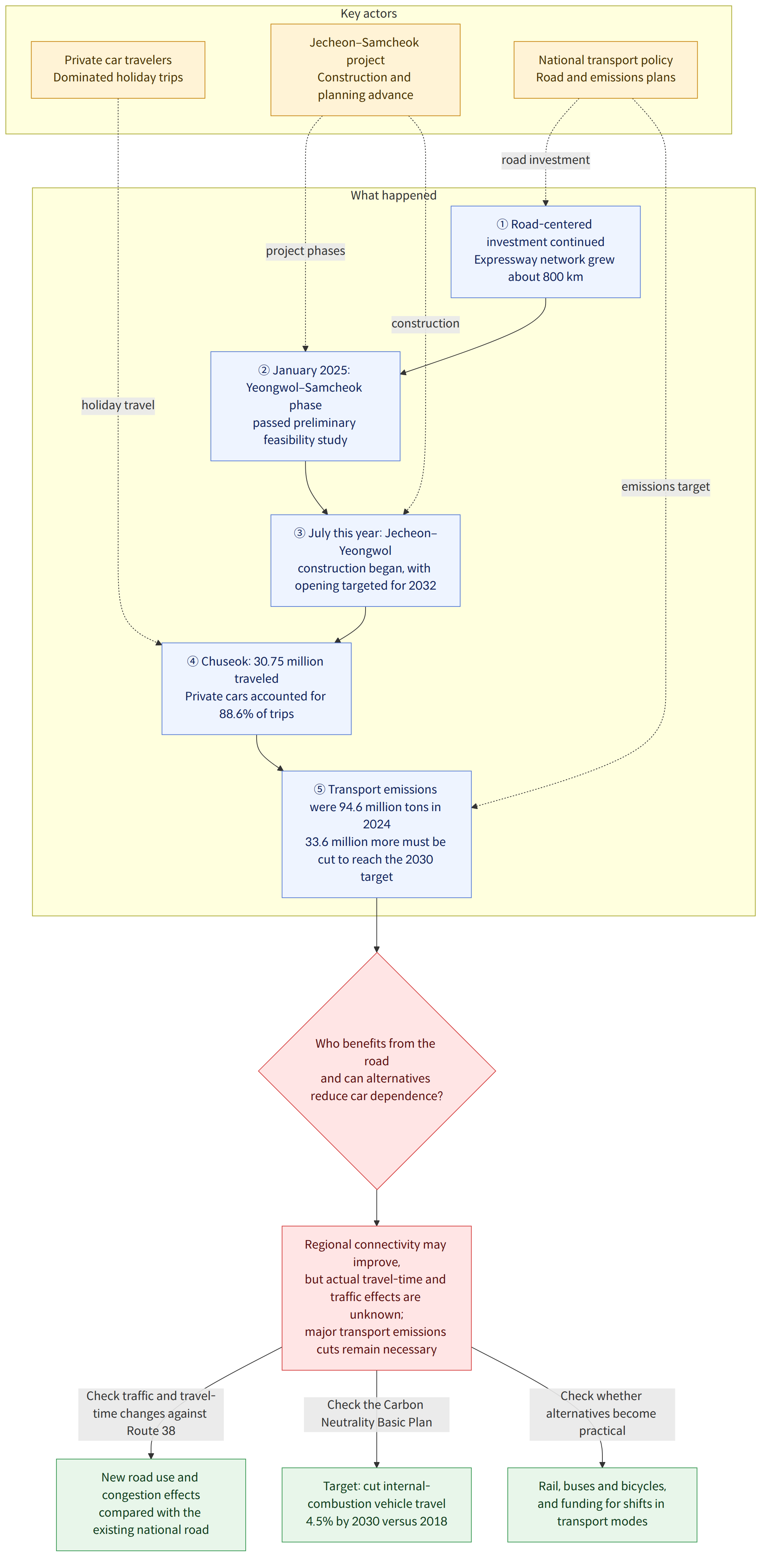
Over the five days of this year’s Chuseok holiday, 30.75 million people traveled, and private cars accounted for 88.6% of their trips. Average daily traffic on expressways reached 6.09 million vehicles, up 12.6% from 5.41 million last year, while the journey home to Seoul from Mokpo took as long as 10 hours and 30 minutes. Holiday congestion is temporary, but the transport environment in which many people depend on private cars and roads persists throughout the year.
Against this backdrop, the Jecheon–Samcheok Expressway project is moving forward. Construction on the first phase, the Jecheon–Yeongwol section, began in July this year. The 29.9-kilometer, four-lane, two-way road is targeted to open in 2032, at a cost of 1.9975 trillion won. The second phase, the 70.3-kilometer Yeongwol–Samcheok section, has a total project cost of 5.6167 trillion won and passed a preliminary feasibility study in January 2025.
Background and context
The issue surrounding this project is not simply that a new expressway is being built. A four-lane, two-way National Route 38 already runs from Jecheon through Yeongwol, Jeongseon and Taebaek to Samcheok, and according to the article, it experiences little congestion for most of the year. By contrast, the Benefit-Cost Ratio (a measure comparing a project’s costs with its economic benefits) for the Yeongwol–Samcheok Expressway was 0.27. The project reportedly passed a preliminary feasibility study despite falling short of the economic viability threshold, in consideration of balanced regional development and policy needs, among other factors.
This figure shows that the project’s need was not determined by economic benefits alone. However, assessing its impact requires considering factors such as traffic on the existing national road, expected future use of the new expressway and regional connectivity. The information currently available does not show how much the new road will actually reduce travel times or change traffic volumes.
Road-centered investment did not begin recently. According to the article, central government investment in roads exceeded investment in rail for long periods between 1985 and 2026, while the expressway network grew by about 800 kilometers. As of July this year, South Korea had more than 22.235 million registered private cars, or 43.5 vehicles per 100 people. An international comparison from 2018 put South Korea’s rail length per land-area index at 0.06 and found that expressways made up 4.01% of all roads—the highest share among the countries compared.
These outcomes cannot be explained by road investment alone, but the fact that private cars have become a major means of travel as the road network has expanded raises questions about the direction of policy. The Second National Road Network Comprehensive Plan (제2차 국가도로망종합계획) calls for the construction or expansion of an additional 945 kilometers of expressways by 2040. Meanwhile, the Carbon Neutrality Basic Plan (탄소중립 기본계획) sets a target of cutting the total distance traveled by internal combustion engine vehicles by 4.5% by 2030, compared with 2018. Plans to expand roads and a target to reduce vehicle travel are therefore in place at the same time.
What this news means
When considering traffic congestion and greenhouse gas reductions together, the question is not limited to whether more roads should be built. It also matters whether conditions are adequate for people to use rail, buses and bicycles instead of private cars. Greenhouse gas emissions from the transport sector fell from 96.2 million metric tons in 2018 to 94.6 million metric tons in 2024, but a further 33.6 million metric tons must be cut to reach the 2030 target of 61 million metric tons. Given the large gap between the target and the current figure, changes to travel modes and patterns, as well as the adoption of zero-emission vehicles, are also worth considering.
The allocation of public funds offers one indication of this challenge. In 2025, spending on four programs for public transit, a shift to other transport modes and green logistics totaled 176.766 billion won—about one-twelfth of the 2.123418 trillion won budget for zero-emission vehicle adoption and charging infrastructure. In 2026, the budget for public transit, bus rapid transit (BRT), a shift to other transport modes, green logistics and related areas rose to 940.382 billion won, while the budget for zero-emission vehicle adoption and charging infrastructure also reached 3.305451 trillion won. Shifting to zero-emission vehicles is necessary, but changing the power source of cars alone will not change a system in which travel demand is concentrated on roads.
It also matters whether people can actually use bicycles and public transit to get around. Use of Seoul’s public bicycle system Ttareungyi (따릉이) reached more than 43.85 million trips in 2024, about 400 times the 113,000 trips recorded 10 years earlier. This is an example of how bicycles can be used for everyday travel, but the article also notes that expanding bicycle use requires safe roads, parking facilities and connections to buses and rail. Given differences in public transit conditions across regions, policies to expand travel options need to take routes and service conditions into account as well.
For example, even if someone wants to take a train or bus instead of driving, making the switch may be difficult if there is no way to get to a station or stop, or if connecting services are inconvenient. This is not a claim about the specific circumstances of any particular region; it means that connections between different modes of transport can determine the range of choices available. When assessing the impact of a new road, it is also worth examining whether conditions for choosing other modes improve, alongside any changes in travel time.
The information presented does not establish how much road expansion will reduce congestion, or how much greenhouse gas emissions would fall if travel demand shifted to other modes.
What is confirmed and what is not yet known
Confirmed facts
- A total of 30.75 million people traveled over the five-day Chuseok holiday, and private cars accounted for 88.6% of trips.
- Construction is under way on the Jecheon–Yeongwol Expressway, a 29.9-kilometer, four-lane, two-way road targeted to open in 2032.
- The Benefit-Cost Ratio for the Yeongwol–Samcheok section was 0.27. The section reportedly passed a preliminary feasibility study in consideration of balanced regional development and policy needs, among other factors.
- Greenhouse gas emissions from the transport sector fell from 96.2 million metric tons in 2018 to 94.6 million metric tons in 2024. A further 33.6 million metric tons must be cut to meet the 2030 target.
What is not yet known
- No figures have been provided for how traffic volumes and travel times will change after the Jecheon–Samcheok Expressway opens.
- The future use and economic benefits of the Yeongwol–Samcheok section have not been confirmed.
- The amount by which greenhouse gas emissions from the transport sector would fall if travel demand shifted to rail, buses and bicycles has not been quantified.
What readers can check
- When reviewing a road project, readers can check whether information is provided not only on the project cost and target opening date, but also on traffic conditions on existing roads, expected usage and actual changes in travel times.
- Anyone planning to travel by public transit or bicycle can check whether services run between their origin and destination, whether transfers are well connected, and whether conditions are safe for cycling.
- When evaluating transport policy, readers can compare the scale of road construction with the budgets allocated to public transit, shifts to other transport modes and green logistics, and consider how the target for reducing total distance traveled by internal combustion engine vehicles is being addressed.