
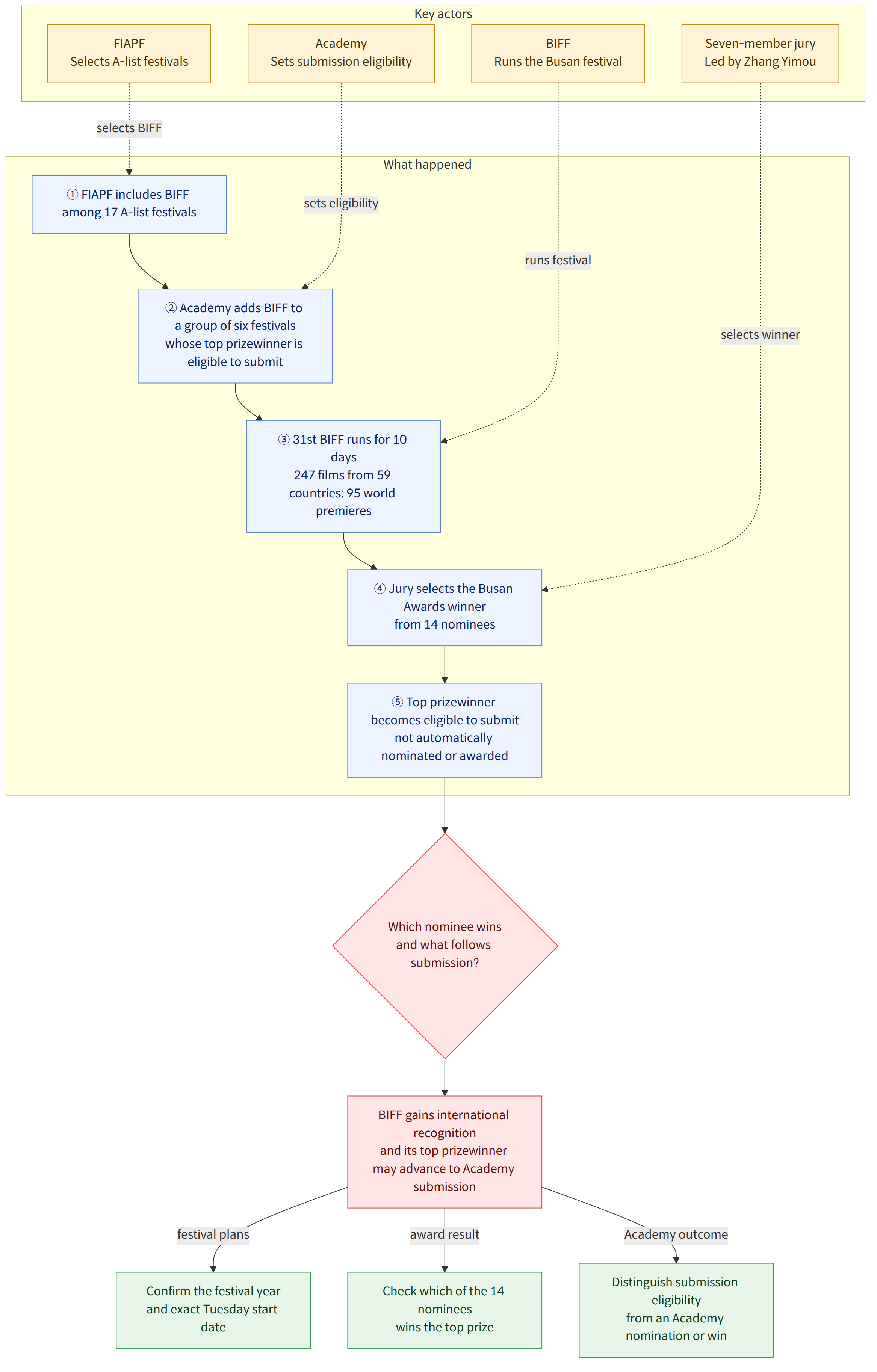
The 31st Busan International Film Festival (부산국제영화제, BIFF) begins in Busan on Tuesday and runs for 10 days. This year’s festival is scheduled to continue through October 15. According to the organizers, the official selection comprises 247 films from 59 countries. It is the largest selection since 2019, and 95 of the selected films will have their world premieres at BIFF.
One reason BIFF is drawing particular attention this year is that it has been included for the first time among the A-list festivals of the International Federation of Film Producers Associations (국제영화제작자연맹, FIAPF). The connection between the Busan Awards and eligibility to submit a film for the Academy Award for Best International Feature Film (아카데미 국제장편영화상) is also a development that could raise the festival’s international standing and increase the prospects for award-winning films to advance.
Background and context
FIAPF selected BIFF as one of 17 A-list festivals, a group that includes the Cannes, Berlin and Venice film festivals. This can be understood as a new recognition of BIFF within the international film festival system. However, the information provided does not establish the criteria for A-list selection or the specific benefits that come with it.
The Academy of Motion Picture Arts and Sciences also added BIFF to a group of six festivals whose top Busan Awards prizewinner becomes eligible for submission to the Academy Award for Best International Feature Film. The key point here is “eligibility to submit.” It does not mean that the Busan Awards winner is automatically selected as an Academy nominee or winner.
The Busan Awards winner will be selected from 14 nominees by a seven-member jury led by director Zhang Yimou. As the festival draws greater attention, which film will win the top prize and gain eligibility for submission is also becoming a focus.
What this news means
BIFF’s A-list selection is significant because the festival has joined a group of internationally recognized events. The 247 selected films from 59 countries, including 95 world premieres, show the scale of this year’s festival and its platform for unveiling new films. With the top Busan Awards prizewinner also eligible for Academy submission, BIFF’s competition results could lead to a next step beyond winning an award at the festival.
However, it is important to distinguish possibility from outcome. Inclusion on the A-list is a change related to BIFF’s international standing, while the Academy connection concerns the top prizewinner’s eligibility to submit a film. The information provided does not establish which film will win or what result it will achieve after submission.
For example, if one of the 14 nominees wins the top Busan Awards prize, that film will become eligible for submission to the Academy Award for Best International Feature Film. This means the door to submission is open; it does not guarantee a nomination or a win.
Confirmed facts and what remains unknown
Confirmed facts
- The 31st BIFF begins in Busan on Tuesday, runs for 10 days and is scheduled to continue through October 15.
- The official selection comprises 247 films from 59 countries, making it the largest since 2019.
- Of the selected films, 95 will have their world premieres at BIFF.
- BIFF has been included for the first time among the 17 A-list festivals selected by FIAPF.
- A seven-member jury led by director Zhang Yimou will select the Busan Awards winner from 14 nominees.
What remains unknown
- The exact year of this year’s festival and the date of the Tuesday start are not provided.
- The titles of the 14 Busan Awards nominees and the final award results have not been confirmed.
- It is not known whether the top prizewinner will actually be submitted to the Academy or what result it might achieve after submission.
What readers should check
- Anyone making festival or viewing plans should separately confirm the year and the exact date of the Tuesday start. Neither is specified in the information provided.
- When checking the Busan Awards nominees and results, readers can identify which film is eligible for Academy submission by seeing which of the 14 nominees wins the top prize.
- In coverage related to the Academy, it is important to distinguish eligibility for submission from a nomination or a win.