
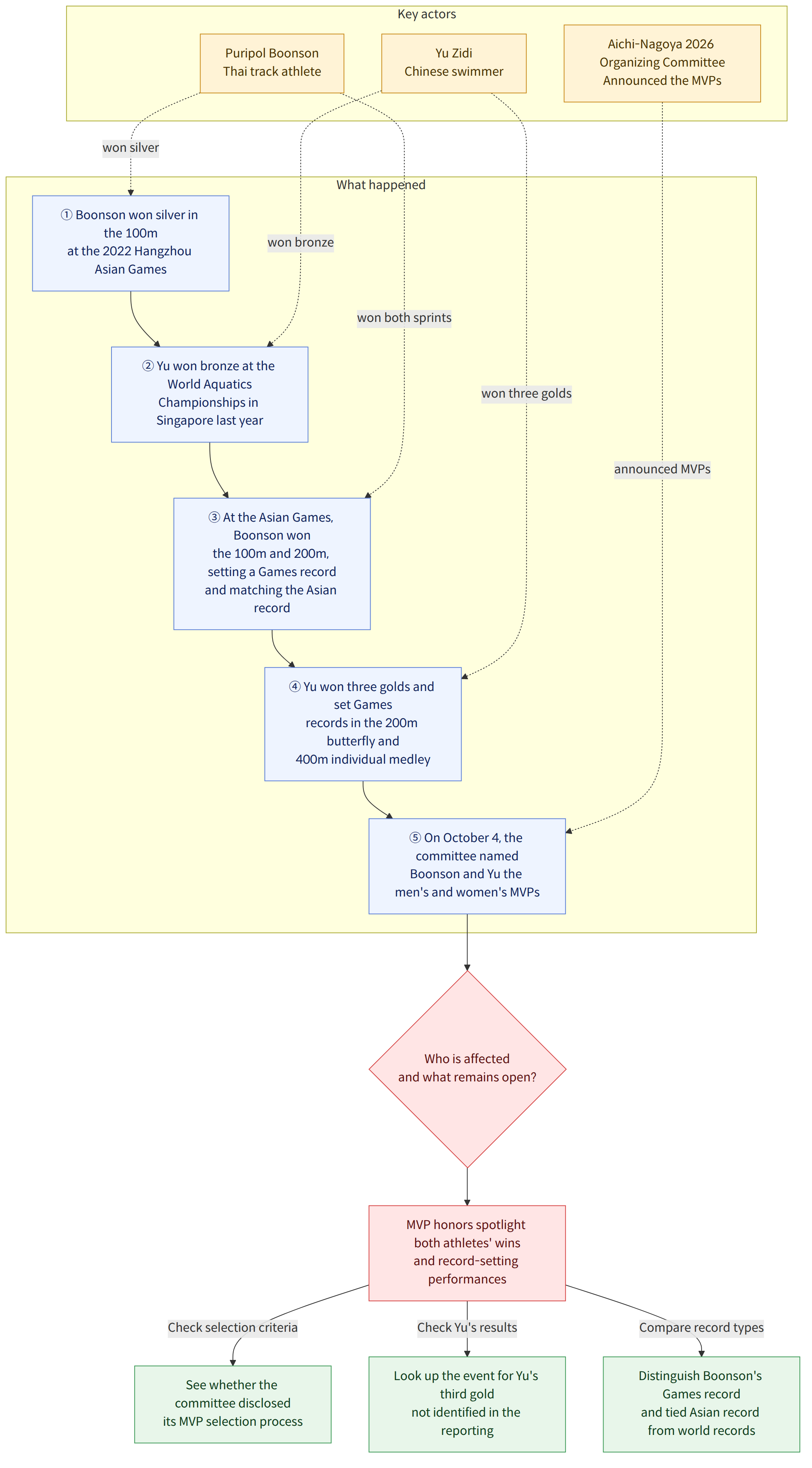
The Aichi-Nagoya 2026 Asian Games Organizing Committee (2026 아이치·나고야 아시안게임 조직위원회) announced on October 4 that Thai track athlete Puripol Boonson had been named the men’s MVP and Chinese swimmer Yu Zidi the women’s MVP. Boonson swept the men’s 100m and 200m to become a two-time champion, while 13-year-old Yu won three gold medals at the Games.
What the two athletes had in common was that they not only won but also set records. However, their records and medals alone do not reveal the specific criteria or process used to select the MVPs.
Background and context
Boonson clocked 9.90 seconds in the men’s 100m final, setting a Games record. In the 200m final, he clocked 19.88 seconds, matching the Asian record. A Games record is a new record set at that edition of the Games; a tied record equals an existing record.
His achievements also build on his performance at the previous Asian Games. Boonson won silver in the men’s 100m at the 2022 Hangzhou Asian Games, when he was 17.
Yu clocked 2:05.08 in the women’s 200m butterfly and 4:28.56 in the 400m individual medley, setting Games records in both events. This was his first international multi-sport competition. He had previously made headlines as the youngest medalist in history after winning bronze at last year’s World Aquatics Championships in Singapore.
What this news means
For Boonson, being named MVP means that attention was drawn both to his wins in two events and to his record-setting performances. According to the reporting, the men’s 100m and 200m world records are 9.58 seconds and 19.19 seconds, respectively, both set by Jamaica’s Usain Bolt. These figures provide a point of comparison for distinguishing Boonson’s times from the world records, but the records he set at these Games were a Games record and a tied Asian record.
In an interview after the 200m race, Boonson said he did not know how fast he could be but would set more records and faster records. His remark shows his own determination to achieve more in the future, but the reporting available now does not establish what records he will actually set.
In Yu’s case, both his age and his achievements stand out. Winning three gold medals and setting Games records at age 13, then being named MVP at his first international multi-sport competition, shows how the Games showcased his achievements in several ways. However, the reporting gives specific times for only two of the three events in which he won gold.
For example, a reader seeking to compare Yu’s performances event by event should not infer the event for his third gold medal from the results in the two events for which times were reported. The number of gold medals and the records in individual events are different kinds of information and should be considered separately.
Confirmed facts and what remains unknown
Confirmed facts
- The organizing committee announced on October 4 that Boonson and Yu Zidi had been named the men’s and women’s MVPs, respectively.
- Boonson won both events, clocking 9.90 seconds in the men’s 100m and 19.88 seconds in the 200m.
- Yu won three gold medals and set Games records in the women’s 200m butterfly and 400m individual medley.
- Yu made headlines as the youngest medalist in history after winning bronze at last year’s World Aquatics Championships in Singapore.
What remains unknown
- The reporting does not specify the criteria or decision-making process used to select the two MVPs.
- The reporting alone does not identify the other event in which Yu won gold.
- What records Boonson may set in the future is not a confirmed fact but something yet to come.
What readers can check
- When comparing times, readers can distinguish whether Boonson’s mark was a Games record, a tied Asian record, or a world record.
- Readers who want to know all three events in which Yu won gold will need to separately check the results for the one event not mentioned in the reporting.
- Readers seeking more precise information about the MVP selections can check whether the organizing committee’s announcement disclosed the selection criteria and decision-making process.